The post Live Stream Shopping: How Will This New Popular Trend Empower E-commerce? appeared first on Apocalypse Retail.
]]>We want to give our special thanks to Ambre Kadmiri, Leila Benjelloun & Teseo Dori, the two students who co-authored this post.
Live Shopping, or Live Stream Shopping, sounds like a new term. It’s a mix of a concept we’ve known for years – teleshopping – and one that’s newer – influencer marketing on social media. But, what is Live Shopping exactly? What does it look like, and does it work?
What is the Live Shopping Experience?
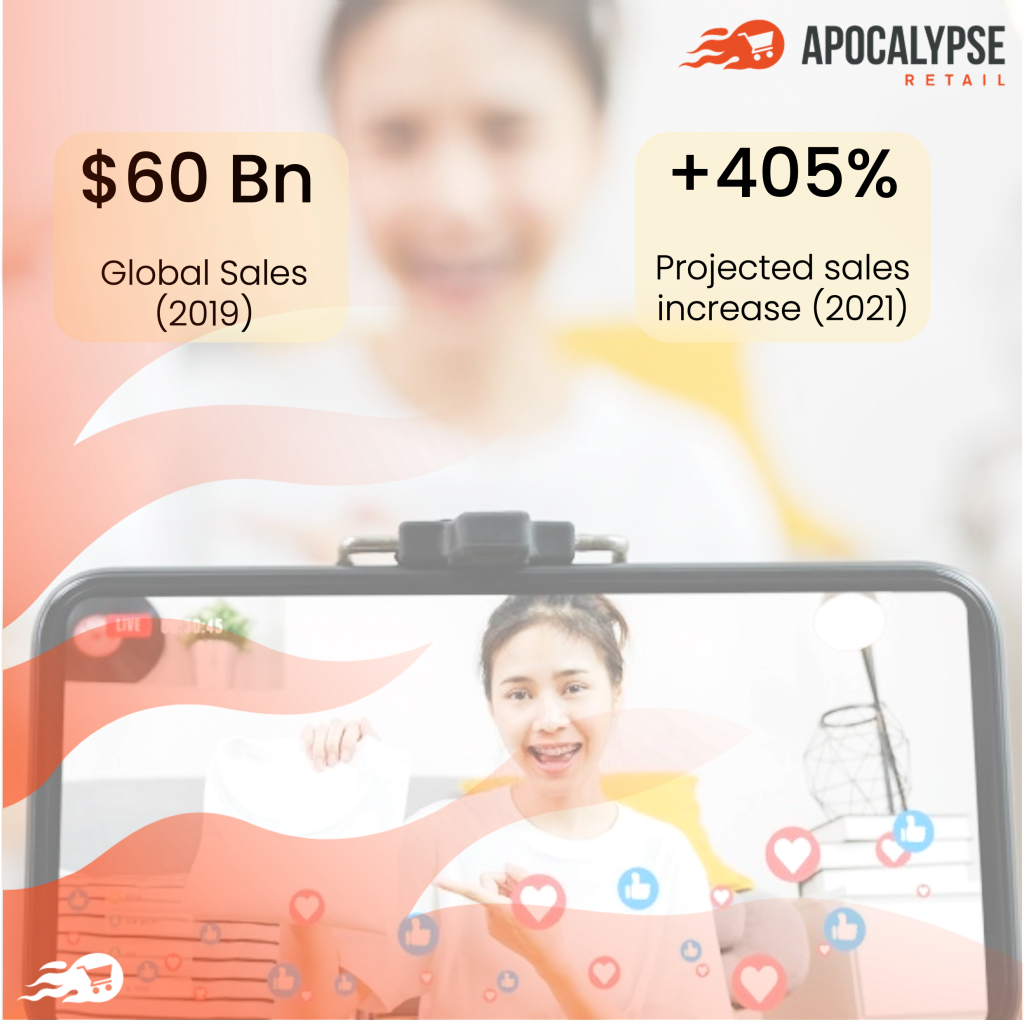
Live Shopping is disrupting the E-commerce industry as we know it. An interactive shopping experience where you can buy the promoted items on the spot.
As Coresight puts it, “It’s digitizing QVC and HSN,” and using technology to make sales. Very successful in China, Live Stream Shopping was a $60 billion market in 2019.
This phenomenon is proving to be a big revenue source for brands globally.
We can expect it to become far more popular in the United States as the idea catches on.
Have you ever seen an influencer do a live try-on, or a brand does a live fashion show on Instagram Live? Welcome to Live Shopping!
How to Boost Sales with Live Shopping?

We know that Live Shopping is gaining traction fast and wide, but how does it generate revenue?
Prompted by the COVID-19 crisis, Live Shopping takes advantage of the at-home shopper.
With the pandemic, E-commerce sites have invested in their online shopping experiences. As a result, it’s far cheaper to sell online without having to pay storefront leases.
Live Shopping hosts can expect a dramatic increase in sales and brand awareness.
What do Live Shopping Platforms Look Like?

You can imagine the preparation necessary to make a Live recording without any flaws.
Live Shopping is live, unlike Instagram Stories or television shows.
There’s a lot more preparation behind the scenes than you may expect between the brand and the host.
The host is usually someone famous, like the Kardashian’s. It happens on platforms such as YouTube, Instagram, and Snapchat.
An example would be Kim Kardashian showing herself using a teeth-whitening product on Instagram Live.
Live Shopping is Page Out of China’s E-commerce Playbook.

Many of the big live streaming platforms available in China are unavailable in the US.
Some examples are Taobao, JD.com, and Pinduoduo, an agricultural-based E-commerce site. These companies also provide buyers with same-day delivery and shipping – as good as Amazon.
JD.com and TaoBao have Live Shopping streaming integrations built into their websites. Unfortunately, the live shows don’t show salespeople selling a product that isn’t their own. Still, they are home to independent authors, creators, and emerging artists selling for themselves.
These selling avenues are possible and welcomed on sites like TaoBao in China. This broadens the market and the selling opportunities for all types of businesses.
What makes Live Shopping more profitable is payment platforms such as WeChat Pay. These platforms make live selling even more successful because of how accessible they are to mobile users.
Live Streaming has proven to foster a comparable sense of customer loyalty and engagement to in-person shopping. But, as we know, technology, social media, and anything digital is addictive.
Live Streaming platforms have created communities where hosts share their favorite products. Kim Kardashian shared her teeth-whitening kit with her Instagram audience, for example. The connection they make with their fans increases the chances of sales.
The power of Live Streaming comes from the endorsement of someone they admire. China has jumped on this trend and generates most of this industry’s $60 billion revenue.
How is Live Stream Shopping Beating Traditional Retail?

So clearly, Live Shopping excels in the Chinese Market. But, how does it compare in the US or European markets? How does it impact the Retail industry in other countries?
Live Shopping surprisingly benefits Retail stores that are unsuccessful in physical stores.
Live Shopping is a way to promote fashion brands to create a unique social environment. It’s proving to support Retail brands with many smaller boutiques.
In contrast to in-store retail, the shopper doesn’t have to leave their home, dress up, or interact with a sales associate, unless they’d like to. With Live Shopping, you can join from anywhere and stay for however long you’d like, whenever you’d like.
It benefits the brand or store as well. With E-commerce booming, Retail stores can sell their items online, where most buyers are shopping already. So not only are they meeting their buyers where they already are, but they’re making it easier for themselves as well.
E-commerce stores save on rent, pay staff, and only have to work when they’re making sales. In addition, this type of selling allows merchants to boost brand awareness globally instead of just where the store is.
This awareness can be a crucial distinction between a highly profitable business and a struggling one.
In an increasingly digital world, more and more transactions happen online. However, things aren’t set to change anytime soon, so not only is e-commerce booming, but it is set to expand with services like Live Streaming.
Live Streaming bridges the gap between 1-1, in-person shopping, and quick and easy online sales. It provides a vetted, honest opinion of a product and the ease of an online transaction, all in one. In the world we live in, this type of shopping is here to stay.
What Are the Benefits of Using Live Stream Shopping?

Is the future of sales going to be video? Rebecca Minkoff is convinced, but she is interested in making it an interactive customer experience like many other brand owners and designers.
The benefit of video sales seems to be in the ability of the product in real life and a multidimensional view. On websites, you’ll see on many product pages how there’s often someone modeling the effect through a short video clip, along with photos.
Video promotions are extremely popular and generate higher sales due to the product’s transparency and the shopper’s ability to make a more informed decision on whether or not they like the item.
On Live Stream shopping platforms, this is compounded with the ability of the host to speak about the product and answer questions live verbally. 96% of people who have made online purchases admit that they watch an “explainer” video before purchasing.
This statistic indicates that videos transform the buyer’s journey, and 85% of product marketers have capitalized on using video as a marketing tool and have seen a positive increase in sales revenue.
To build on this, the live video aspect of Live Stream Shopping appears to create a more robust personal engagement than regular e-commerce shopping or even in-person shopping.
Ads on Instagram, Twitter, or YouTube have lost integrity over the years, with influencer’s taking on promotional language and photos that diminish any personal touch. With Live Shopping, hosts can answer shopper’s questions, show the product, and give real-time promotions, adding exclusivity and creating a shopping network.
This type of online purchasing translates a true sense of authenticity, often masked behind edited and photoshopped promotional advertisements that have become too popular elsewhere.
What Are the Drawbacks of the Live Shopping Experience?

Some have pointed out that Live Stream Shopping has a more personal, natural touch than regular e-commerce. Still, it doesn’t have a unique, 1-1 shopping experience.
While the viewer can see the host or merchant, they can’t see the viewers and engage with them the same way they may be at a store.
Unfortunately, some level of interactivity that the in-store shopping experience offers is lost in live shopping. For example, a sales associate telling a buyer that a dress looks fantastic on them isn’t possible like it is in traditional stores.
What are the Most Popular Live Shopping Platforms?

PinDuoDuo, Douyin, Amazon, Instagram, and TaoBao are top contenders in the Live Shopping Market scene.
But there are also smaller sites, apps, and social networks investing in this new shopping trend. While Amazon is certainly investing in the space with AmazonLive, they are not the first to do it.
Smaller E-commerce unicorns include TalkShopLive, BrandLive, CommentSold, and Ntwrk – whose revenue doubled in April and March 2020.
Amazon has a daily live streaming channel, hosting daily live streams selling cooking, health, and fitness products. Facebook is doing a similar platform service.
And if you’re a dedicated QVC fan, don’t worry. The network sees this opportunity as a natural progression of the business. They, too, have begun Live Streaming sessions on Facebook and YouTube and will soon roll out its platform.
Instagram Live Shopping is also kicking off American-based brands. Like Instagram Live, this new integration adds an immediate shopping element where viewers can immediately purchase the products.
These live sessions are mostly product demos that educate and engage buyers to build brand awareness and intrigue. They often collaborate with another influencer, brand marketer, or host to offer even more authenticity.
These experiences ultimately take e-commerce to the next level. They create a human interaction that isn’t possible on a static shopping website.
What is the future of Live Shopping?

We can expect Live Stream Shopping to be the latest, most successful version of e-commerce.
With in-store retail becoming less attractive to buyers and sellers and e-commerce lacking a sense of community, Live Stream Shopping capitalizes on the at-home buyer’s tendency to live online.
We can expect similar growth in the digital shopping space that China has seen in the past few years. Large companies like Amazon and Instagram catch on and look for ways to diversify and innovate social media marketing.
Do you want more insights into E-commerce, Omnichannel Retail, and Digital Transformation? Subscribe to ApocalypseRetail to get insights sent directly to your inbox. Our content is designed for top business schools, retail managers, and eCommerce entrepreneurs who want to survive in the ever-volatile retail industry. Subscribe to our newsletter to join the fight against the Retail Apocalypse!
The post Live Stream Shopping: How Will This New Popular Trend Empower E-commerce? appeared first on Apocalypse Retail.
]]>The post The Complete List of Primary Customer Touchpoints Every Retailer Must Address appeared first on Apocalypse Retail.
]]>In today’s Retail, customers have complete control of when, where, how, and whom they want to buy. Customers have all the information they need on their smartphones.
The customer has become the dominant force in a transaction.
Along with smartphones, the internet and social media have disrupted how companies interact with their customers.
These channels created many touchpoints for brands to interact with their customers. They have also increased the reach for brands wanting to connect with customers.
But, these channels have come with a ton of complexity for companies. As a result, most legacy brands had to rethink their marketing strategy to adapt to these changes in each primary customer touchpoint.
Today every retailer needs to have an online presence as one of its primary customer touchpoints

To consider the benefits of having an online presence, you must look at the changes in consumer behavior in the last 20 years.
At the end of the 20th century, only niche markets and few customers used digital channels, even at the height of the dot-com bubble.
Only a fraction of consumers had access to the internet within the customer journey.
Internet penetration and smartphones have completely disrupted the customer journey with digital channels.
Having an online presence in the 21st century is not a matter of choice for retailers. Instead, it has become a matter of survival.
Here are some numbers to consider the importance of having an online presence for Retailers:
According to a study by Hootsuite and WeAreSocial from January 2021, for every adult from 16 to 64 years:
- 82% of consumers searched online for a product or service (via any device)
- 90% visited an online Retail store on the web (via any device)

- 77% made a purchase of a product or service online (via any device)
- 55% made a purchase of a product or service via mobile device

When you look at these numbers, it is clear that an online presence is a fundamental factor in today’s Retail.
Online channels have become ingrained in the customer journey. But having an online presence is not just a matter of having a website.
If you want your brand to be discovered, searched, and found, you need to work with all the digital channels available today.
As of January 2021, digital channels accounted for seven out of the ten most important sources of Brand Discovery.
The importance of all digital channels cannot be overstated.
Especially considering that brand or product websites are only the 5th channel for brand discovery. To be discovered today, it is critical to building a robust presence on Search engines and social media.

The complete list of primary customer touchpoints every retailer should address to survive the Retail Apocalypse
With the rise of online channels, the Retail industry has been completely overhauled and is living through the Retail Apocalypse.
A customer journey today involves multiple different touchpoints with a brand or a product. These touchpoints can be digital or physical and are the basis of multichannel retail.
Here is a look at the different primary customer touchpoints that a customer can take in its journey:
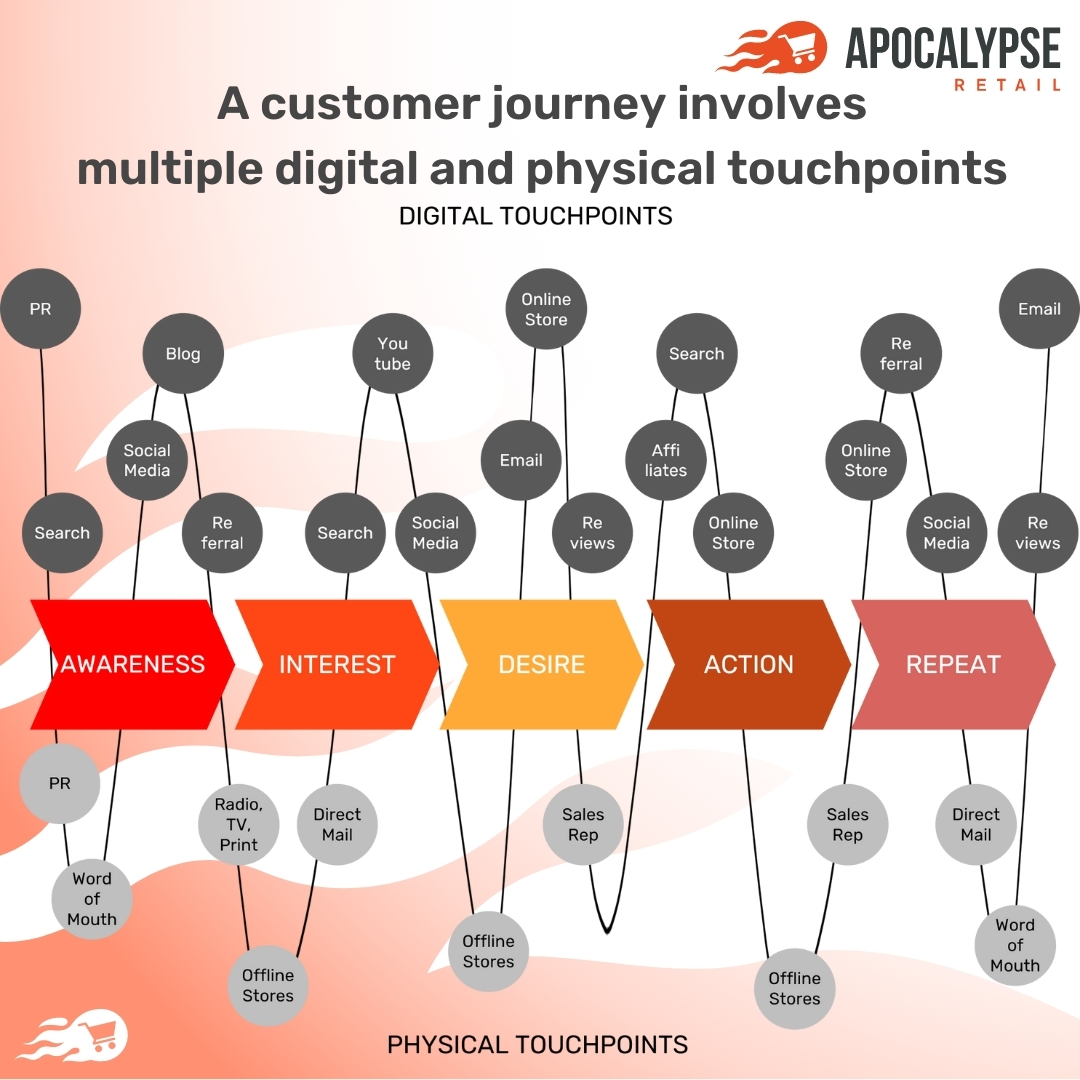
The problem is that very few companies have a clear strategy for all touchpoints. And even fewer companies have a strategy to provide a unified experience between touchpoints.
Below is a list of touchpoints that customers can have with a brand in their path to purchase.
The end goal for any brand should be to provide a unified and seamless experience across all touchpoints. This is what is known as Omnichannel Retail.
These are the primary customer touchpoints in modern Retail:
- Physical Stores
- Sales representatives or store associates
- Public Relations
- Direct mail
- Word of mouth
- Traditional marketing channels: TV, Radio, Print
- Company website and blog
- Social Media
- Search Engines
- Youtube
- Affiliates
- Customer reviews
Physical Primary Customer Touchpoints
1. Physical Stores

The physical store is the backbone of the Retail industry. It is the most traditional of primary customer touchpoints.
A store is a physical touchpoint where customers engage and interact with brands.
In a store, the customer interacts with the clearest value proposition from a product or service. But the physical store offers so much more than this.
Today, the store is a key touchpoint to offer everything that digital channels cannot provide.
Retailers who are thriving today have understood this. They are creating the store experience around essential, value-added services for their customers.
The store is not just a place where you can get the product immediately. Touching, feeling, smelling, trying a product are value-added experiences provided by physical stores.
These are real experiences that matter to consumers.
The sensory experience that a physical store provides to a customer is a massive part of the interaction. The smells, noises, colors, and displays within the store significantly impact how customers perceive the brand.
Within their merchandising strategy, brands must consider the sensory experience. In addition, they must consider how they want to set up the customer journey within the store to maximize product sales.
There is a lot of talk today about the sensory experience in the store, but there is nothing new about it.
Brands such as Disney or Starbucks have done a tremendous job working every detail of the physical store experience. And they have done it for more than 30 years.
2. Sales representatives or store associates:

There is a crucial touchpoint that can make or break a long-term relationship with a brand. This crucial touchpoint is the sales representative (sales rep) or store associate.
The sales rep is the human interaction that a customer can get with a brand. They are the human side of primary customer touchpoints.
How a store associate talks, dresses, behaves and helps is a representation of the brand.
Store associates are a key channel to drive a value proposition from the brand to the customer. The value of the store associate in the store is not by stocking shelves or working the checkout.
These are all tasks that have little value and will eventually be automated.
The real value of a store associate is to build trust and help the customer in their decision process once they enter the store.
It’s not just a matter of increasing the basket size. It is a matter of engagement with the customer to promote loyalty.
Many retailers pay bonuses to their sales reps only by the revenues they generate. Unfortunately, this leads to some sales reps sacrificing a long-term relationship for a short-term payout.
Companies must consider KPIs that promote customer loyalty and not just a one-off purchase to get the most out of a sales rep.
Focusing on KPIs that promote customer experience is better to motivate store associates.
These KPIs include:
- the store NPS,
- return rate within 90 days,
- or new members to the loyalty program.
Off-course, this measure must be implemented with the proper training for store associates.
Measuring and training store associates to follow these KPIs has an immediate payback. Not only by increasing revenues but also by reducing customer acquisition costs!
3. Public Relations

Public Relations is how a brand controls (or tries to) how other outlets will discuss them.
Companies very often neglect this role due to budget constraints.
Still, if done effectively, PR can significantly reduce branding expenses for a company. Thus, PR must be considered as one of the primary customer touchpoints.
An effective PR team can build momentum with the press and other outlets about a new product launch or opening a new store.
Good PR can drive tons of “free” traffic to your stores by relaying and distributing news about your brand.
Of course, news about your brand needs to be exciting or positive.
That is the role of a PR team: to get “control” of how a brand is perceived and talked about in mainstream channels.
4. Direct Mail

With email and digital channels, direct physical mail has lost a ton of budget, in the same vein as print media. But in 2021, many retailers are still doing Direct Mail and sending physical letters to their customers.
Just go and take a look at the trash near the post box in buildings. Restaurants and many retailers still rely on physical mail as a marketing channel.
Despite what you just read, we’re not against Direct Mail; we’re just against spamming in general, whether it’s online or offline.
There are few things as damaging to a brand than to be considered spammy. But if it’s done correctly, direct mail can still be a value-added channel to reach customers.
Direct mail can yield great returns when it’s done with good copywriting, great visuals, and proper customer segmentation.
5. Word-of-Mouth

The ultimate goal of all the touchpoints in this list is to increase word-of-mouth about your brand.
Getting people to talk positively about your brand is the holy grail for any Retailer. It is extremely hard and can only happen when companies provide a great experience in your primary customer touchpoints.
A great experience resets the expectation level from the customer. It becomes the point of comparison for all experiences to come and talk about with their friends.
People talk about products, brands, and experiences daily.
Companies that understand this aspect will create fans instead of just customers.
Suppose all your customers only had positive things to say about your brand. How many more customers could you get without investing a single euro in extra marketing?
6. Traditional marketing channels: TV, Radio, and Print

Traditional marketing channels are also known as offline marketing channels. For decades, the ad industry focused on creating brand awareness through the three big channels: TV, Radio, and Print.
Think about traditional marketing channels.
You can immediately think of Don Draper and the Mad Men crew in the golden years of ad agencies of Madison Avenue.
On top of the big three, traditional channels also include directories, magazines, newspapers, and flyers. You can also have movies or films in this category.
Traditional channels, particularly TV, are great channels to build brand awareness today. But the logistics and foggy attribution of these channels make them very inefficient.
Companies used to measure the efficiency of an ad campaign by total revenue growth. But the reality is that there are multiple factors influencing revenue growth. A good or bad day of weather, for example, can have a massive impact on the income of a physical store.
So brands started seeking channels that gave them more visibility in terms of revenue attribution. Digital channels have slowly but surely changed the face of the ad industry.
Most digital ads have been around since the late 1990s. But the fundamental shift in the ad industry accelerated in the last ten years.
According to eMarketer, ad spending on traditional channels went from almost 75% in 2014 to less than 40% of all spend by 2021.
Since 2019, digital ad spend has represented more than half of all spend.
Think about it. This is before the impact of the Covid19 pandemic!
In only five years, digital ads doubled their market share of the entire ad industry. And this market share is expected to reach two-thirds of all spend in the next couple of years.

Digital Primary Customer Touchpoints
The rise of Digital Marketing is due to its cost efficiency and ease of revenue attribution. Digital channels are incredibly efficient at connecting the right product to the right person at the right time.
This is the holy grail of omnichannel engagement.
Let’s take a look at the channels that are considered within the Digital channels.
7. Company website and blog

A Retailer’s website has become one of the primary customer touchpoints to look for the brand.
The website has different goals for Retailers and depending on how it’s structured. However, it can be a significant asset in helping customers move down the customer funnel.
As of today, any decent website of any Retailer must be completely mobile responsive. Some retailers have launched mobile apps, but this shouldn’t be an excuse to have a crappy mobile design on your main website.
Users must easily and quickly find all the information they need on a website whether they are looking for a specific product or want to find information on stores.
A homepage must be product-oriented, but it must also include all the necessary contact information. The information about customer service or physical stores must be clear, updated, and easily findable.
On top of this, Retailers can also provide additional content for their customers via their blogs. Therefore, if done correctly, a blog has some great benefits for ranking higher in Search Engines.
But before launching a blog, a company must consider that all the content they push becomes a new touchpoint for customers.
All content (posts, videos, or tutorials) must be curated to reinforce the customer experience.
8. Email

Email is one of the channels that has been present since the early days of e-commerce. But in the last ten years, it has evolved significantly with new email marketing tools.
Email marketing is a digital channel built around sending emails to prospects and customers. The key objective of email marketing is to keep a prospect engaged and potentially turn them into customers.
At the same time, it is also used to maintain existing customers engaged with the brand. The aim is to turn them into loyal, returning customers eventually.
Retailers must build and nurture their email lists to unlock the full value of email as a primary customer touchpoint.
In the age of social media and search engines, an email list is one of the most important assets of a brand. But most Retailers don’t take the most advantage of their email lists.
Email marketing is often used only as an outbound marketing channel. Sending weekly newsletters to customers is what most brands include in their email strategy. Still, with the right tools, brands can unlock the full potential of their email marketing strategy.
With the proper segmentation, brands can segment that email list by interest, behavior, or intent. This strategy highly increases the email conversion rate.
Also, the power of automation allows brands to “make money while they are sleeping.”
By setting up the proper triggers and email workflows, brands can automate specific touchpoints. All of this while providing a personalized experience.
The following workflows need to be automated to provide an incredible, cost-efficient experience:
- Welcome email > New account
- Welcome email > Newsletter signup
- Thank you email > Order confirmation
- Thank you email > Account birthday
- Thank you email > Customer’s birthday (if possible)
- Conversion email > Don’t forget the product in the basket
- Conversion email > Other people also viewed/bought
- Conversion email > Reorder the same product (after an estimated consumption time
- Feedback email > NPS
- Feedback email > Order, Product, or store review
- Referral email > Share our email and win X
Setting up these workflows can be time-consuming in the beginning. But once they are set up, they will generate revenues and customer loyalty with little additional marketing spend.
On top of a marketing channel, email is also a key point of contact for customer service.
Email is the most effective channel for customer service as (almost) everyone has an email, and 91% of consumers use email every day. It is challenging to find a channel with as much adoption by customers.
So companies need to consider email as an outbound, automated, and inbound touchpoint.
9. Social Media

The rise of Social Media has been staggering in the last 15 years. Today, social media platforms account for billions of users worldwide.
Social media allows users to talk about their lives, share photos, and find out what friends do. Most users under 60 years old spend time each day on at least one social media platform.
It is no surprise that Retail companies flock to Social Media to build brand awareness and spread marketing messages.
Social media has become one of the primary customer touchpoints as it involves direct communication with brands on an “equal” level.
For a marketing or commercial message to get viral across social media, users must be willing to distribute the content.
So companies have to create communities of fans and make sure they have content that is easy to consume and shareable.
But once you enter the social media game, it’s not just a marketing or branding channel. In social media, users can interact with the brand, ask questions or make complaints.
Brands and Retailers must consider Social Media as a two-way street.
Companies need to provide excellent customer support via social media on top of great content. This support will heavily impact how a brand is perceived through social media networks.
10. Search engines

As we saw before, search engines are THE most-used channel for brand discovery. According to the Global Digital Review, close to 34% of customers use search engines looking for brands.
Digging deeper into the French market, more than 62% of customers use Search Engines for brand research.

Search Engines essentially mean Google, as it accounts for close to 95% of the search engine market in Europe.
Google has become a virtual channel for Retailers to interact with their customers. In other words, Search Engines are the gateway to the internet.
When you make a query through a Search Engine, they have a catalog of billions of pieces of content available online. The algorithm will rank content to determine which has the most chances to answer your particular query.
As we saw before, a third of users will use Search Engines to discover brands. And almost two-thirds will use them to research a brand or product.
This gets complex as there are billions of pieces of content competing in a search engine’s ranking.
This staggering amount of content makes it a necessity to optimize content for better ranking. Therefore, every company needs to have a content optimization strategy regarding search engines.
Optimizing the position in Search Engines is what’s known as Search Engine Marketing (SEM).
SEM includes:
- Search Engine Optimization or SEO: a mix of semantic and technical strategies to optimize your content to rank higher in organic searches
- Search Engine Advertising or SEA: paid ads to optimize your positioning for specific keywords.
11. Youtube

There are debates on whether youtube is a Search Engine or a Social Media. The quick answer is that it’s a mix of both.
Youtube has become the second-largest search engine in the world, according to Alexa Rankings.
In the Global Digital Review of 2021 by WeAreSocial, Youtube came as the second-largest social media platform globally. Just after Facebook, Youtube has close to 2.3 Billion monthly average users.
In the French market, as of January 2021, Youtube became the first social media platform. More than 80% of french users between 16-64 years old declared to have used the platform in the past month.
Youtube has become the dominant platform to share content and interact with customers in video format.
Brands and Retailers need to use this touchpoint as a search engine and a social media platform.
To optimize content to rank higher, but also to interact and engage with its users.
12. Affiliates
Affiliates are some of the most underrated touchpoints a customer can have with your brand.
Of course, it’s a digital marketing channel, so it’s mainly driven to increase sales. Still, you can achieve excellent results in terms of branding by using affiliates properly.
Affiliates are websites or blogs that will direct traffic to your website for a commission (pay per click or sale).
Think of affiliates as influencers.
Instead of having a social media platform, they use their traffic from their website or blog.
The key to excellent affiliate marketing is to work with affiliates that curate their content. The best affiliates are those that create content that doesn’t feel like an ad.
Of course, you need to work with affiliates that have audiences like yours.
When the affiliate has the right incentives (pay per sale), they will create the best content to generate as much revenue as possible on your website.
It’s a win-win for all.
13. Customer Reviews

Customer reviews have become the ultimate digital social proof in today’s Retail. Authentic reviews can be a fundamental asset to generate trust with new customers.
Whether it’s product, store, or service reviews, companies have to nurture and collect as many reviews as possible.
Many platforms like Yelp, Square, or TripAdvisor built their reputation by giving “a voice” to customer reviews.
But in the past few years, Google My Business has become the most effective channel for customer reviews.
Google My Business is integrated with Google Maps and can have a massive impact on your local SEO ranking.
In other words, if you want customers to find your store, you need to have an updated, clear, complete Google My Business page.
As we said, customer reviews are fundamental to build trust for other customers. Companies need to make sure to address and nurture reviews.
Many retailers fail to promote and ask customers for reviews for fear of having a bad review. A bad review is still positive for your company:
- If the customer is right to leave a bad review, you have just identified a problem within the customer journey. You can then make the necessary corrections so it doesn’t affect other customers.
- If the customer is a pain in the ass, a negative review is an opportunity to make sure other customers see how you handle negative experiences. Let other customers know how you treat and reply to all customers, even the worst. Your replies to customer reviews have an audience. They should be treated as a marketing channel: you should never be condescending, aggressive, or petty.
This is a comprehensive list of the primary touchpoints of the customer journey that every company should know.
Do you want more insights into E-commerce, Omnichannel Retail, and Digital Transformation? Subscribe to ApocalypseRetail to get insights sent directly to your inbox. Our content is designed for top business schools, retail managers, and eCommerce entrepreneurs who want to survive in the ever-volatile retail industry. Subscribe to our newsletter to join the fight against the Retail Apocalypse!
The post The Complete List of Primary Customer Touchpoints Every Retailer Must Address appeared first on Apocalypse Retail.
]]>