The post Is Sustainable Retail The New Standard For The Fashion Industry? Some trends to Watch in 2022 appeared first on Apocalypse Retail.
]]>We want to give our special thanks to Fanny Dorisse & Lili Azaroual, the two students who co-authored this post.
The future of Retail has been a hot topic in recent years, and the debate is turning towards sustainable retailers.
More generally, the retail industry’s ethics and corporate social responsibility are being thoroughly questioned. And it’s no wonder with fast-fashion Retailers pumping out new collections every week.
Consumers, on average, throw out 80 pounds of clothes every single year. So it’s no secret that many of our current practices are wreaking havoc on the planet.
None of this is lost on the ethical consumer.
4 Trends Driving Sustainable Retail in the Fashion Industry
There is a growing trend among European consumers that are turning more and more attention to the sustainability of the products they purchase. As of 2020, the average search growth for sustainable shopping terms grew by almost 7x.
More and more people are making purchasing decisions based on Brands’ corporate social responsibility.
They are also developing brand loyalty toward companies that focus on sustainability and ethical business practices.
According to the Forrester Consumer Index, as of 2019, almost half of consumers switched to a different product because a brand violated their personal values.

Businesses that want to survive must know about the rise of ethical consumption. What does it mean in terms of environmental and social responsibility?
And what does it mean to be a responsible business today?
Let’s look at four of the current trends in sustainable Retail:
- Slow shopping
- Fairtrade retail
- Ethical retail
- Recommerce
1. Slow Shopping: Removing Time Pressure From Retail Promotions

Online shopping and “one-click” purchasing have accelerated the pace of the buying experience.
Still, a new trend is emerging, which intentionally slows things down.
Instead of pressuring customers into panic buying, it encourages shoppers to take their time, enjoy browsing, and make considered decisions.
What’s driving this move from convenience and quantity towards curation and quality?
Business savvy and intentional rejection of impulse purchases.
Some of the biggest retail events have been built on flash sales and short-term deals that promote impulse buying. But, like slow food a few years ago, the latest trend in sustainable commerce is slow shopping.
This forces retailers to offer something above and beyond price and promotions. They have to provide an experience and product quality that aligns with rising consumer expectations.
This change offers a massive opportunity for brick-and-mortar retailers to provide shoppers with a more elevated experience and keep them longer within the store.
This approach positions shoppers as guests rather than buyers, effectively fostering brand loyalty from customers.
Stores have found different ways to invite their “guests” to slow down and spend more time on site. For example, they started adding cafes, lounges, libraries, and art spaces. Indeed, they encourage people to take their time and enjoy themselves.
This kind of experience is far different from classical discount stores, which focus on the lowest possible price, no matter the product’s sustainability.
The slow-shopping experience is the antithesis of shepherding customers through overstuffed shelves and fluorescent lights.
2. Fairtrade Retail: How is Fair Trade Retail Sustainable?

Fairtrade is not a new concept, but it’s receiving renewed attention as demand for transparency in business practices is growing.
Consumers want to know how brands treat and compensate their employees.
There are headline-making events, such as the 2013 Dhaka garment factory collapse in India. During this event, thousands of workers were killed, bringing working conditions into the spotlight.
There are also many reports about underpaid and overworked laborers in many industries.
These reports have forced brands outsourcing their manufacturing to conduct corporate social responsibility audits and search for Fairtrade labels.
But the term “fair trade” has come to mean many things. In essence, it means that products are made by workers fairly paid and provided with ethical working conditions.
The demand for fair trade labels spans all industries, from food and beverage to clothing to home decor.
3. Ethical Retail: What is it and what is sustainable about it?

Ethical Retail is an umbrella term that includes fairtrade and much more aspects of corporate social responsibility.
An ethical retailer means you have a business model that provides social, environmental, and political responsibility.
On top of these, materials and product sourcing must meet ethical standards.
Predatory business practices and environmentally destructive operations are no longer benefiting from the blind eye.
There are plenty of ways that consumers can assess how ethical a business is.
Certified B Corporations, for instance, earn that distinction by meeting the strictest standards. B-corp labels certify that companies are true to their social, environmental, transparency, and accountability standards among these standards.
More and more customers look for labels and certifications such as B Corp. But, in general, ethical consumers vote with their wallets, aligning their values to their shopping.
Some retailers have understood that there can be significant growth opportunities as a growing number of shoppers are willing to pay more for goods and services ethically produced.
4. Recommerce: What is Reverse Commerce?

Retail was built on consumers looking for new products to buy.
Buying used or second-hand products were reserved for very few industries like the auto industry, but it has never been mainstream.
That is, until the emergence of Recommerce.
Recommerce, or Reverse Commerce, is one of the most critical trends in Sustainable Retail. It is at the center of the circular economy.
Recommerce consists of buying and selling second-hand products.
With the rise of online shopping, second-hand transactions have found an unparalleled growth opportunity.
The ease and reach of online CtoC commerce has pushed the emergence of online marketplaces focused on Recommerce.
People can sell products directly to other people on these platforms and even make a living out of them.
But this trend is nothing new.
Over the last two decades, platforms such as eBay internationally, CraigsList in the US, Wallapop in Spain, or LeBonCoin in France offered C2C transactions of second-hand products.
But all these platforms weren’t built and designed with a specific focus on the circular economy or Sustainable Retail.
Over the last few years, some actors have emerged in the Fashion and Electronics industries.
These new players are offering security and reassurance in the second-hand market. They do this by providing product or seller verification, guarantees, and even in some cases, refurbishing products.
Back market is a French marketplace that is disrupting the European electronics industry.
Their brand positioning is based on acquiring or selling refurbished products because they are cheaper but more sustainable. This positioning has quickly resonated with European audiences.
In the Fashion industry, players like Vinted or Vestiaire Collective are taking full advantage of the circular economy.
These two marketplaces allow consumers to buy and sell second-hand fashion items. In the same vein as Back Market, their brand positioning is not on finding cheap products but on making the fashion industry more sustainable.
Below is a list of some of our favorite fashion brands pioneers and leaders in sustainable Retail.
Five Fashion Brands Leading the Way of Sustainable Retail
1. Patagonia: The Pioneers Of Sustainable Activewear

Known best for: Activewear and outerwear for all ages
Key sustainability initiatives: Certified B Corp, Fair Trade Certified, Organic Cotton, 1% for the planet member, environmental initiatives, philanthropy.
Patagonia is a California-based activewear company.
They have been at the forefront of the environmental movement for a long time. They were among the earliest companies to prioritize sustainable choices in their products.
Patagonia switched to organic cotton and recycled materials a lot earlier than most fashion brands.
The company’s activism extends from protecting public lands to halting the climate crisis. It even implemented a “self-imposed Earth tax,” which implies they direct 1% of revenue to nonprofits that protect the environment.
This “tax” is the basis for the one percent for the planet initiative, launched by Patagonia founder Yvon Chouinard in 2002.
The brand has been in the news recently as it joined a growing number of brands boycotting Facebook as an initiative to stop the spread of hate content globally.
This highlights the company’s stand, which is ready to lose on one of the major traffic acquisition sources to stand on its moral high ground.
2. Sézane: Curated Apparel For Conscious Consumers

Known best for: Curated Women’s apparel and accessories
Key sustainability initiatives: Ethical labor practices, sustainable materials, recycled packaging, philanthropy, and renewable energy in manufacturing.
Paris-based Sézane creates curated women’s apparel for conscious consumers.
The brand positioned itself away from fast fashion, releasing only four seasonal collections per year, plus smaller monthly capsule collections.
Most of the company’s clothing is made with organic cotton, recycled materials, and vegetable-tanned leather. This enables the brand to increase the sustainability of their produced goods and reduce their environmental impact.
The brand was born as a digital native vertical brand (DNVB), with no intermediaries to drive costs. Instead, materials are sourced with consideration, in particular to the origin and working conditions of the sourcing place.
The quality and design of the clothing make them pretty much evergreen pieces to be worn with a Parisian-chic attached to them.
Sézane also helms a philanthropic initiative called DEMAIN, from which it raises money to support a diverse range of charitable organizations.
3. Veja: Recycled Shoes That Outlast Seasonal Fads

Known best for: Fairtrade footwear for all ages
Key sustainability initiatives: Ethical labor, recycled materials and rubber, transparency regarding carbon impact, and organic cotton.
Veja makes shoes designed to outlast seasonal fads so that they look just as good in ten years as they do today.
One of Veja’s promises is that each pair of shoes has “one foot in design and the other in social responsibility.”
The cotton and rubber used to make Veja shoes are sourced directly from producers in Brazil and Peru.
Those producers use a range of recycled materials made out of 100% recycled plastic bottles. During this process, plastic bottles are collected, turned into flakes, and extruded into polyester fiber.
Veja also earns top marks for its ethical labor and sustainable retail practices, particularly when outsourcing to other countries and their carbon footprint.
There is an astounding level of transparency regarding the Veja Project on the brand’s website.
They explain in detail how all shoes are made in a factory in Brazil, the working conditions in the factory, and the carbon impact of importing their shoes.
4. Ecoalf: Fashion That Recycles Waste From The Ocean

Known best for: Apparel and footwear from recycled plastic bottles
Key sustainability initiatives: Certified B Corp, recycled materials, water conservation, and the Ecoalf Foundation to remove ocean debris
Ecoalf is a Spanish fashion company with the tagline “Because there is no planet B.”
This tagline reflects the brand’s commitment to environmental sustainability throughout its vision and values.
The company uses over 400 recycled fabrics in its product lines to remove debris from the ocean. As a result, its “ocean sneakers” are considered one of the lowest carbon footprints in the market.
Ecoalf was also Spain’s first fashion company to receive B-Corp certification.
In 2015, the Ecoalf Foundation was launched to upcycle ocean waste, reflected in their motto.
The project has collected more than 600 tons of trash from the sea in the past six years. This is a significant action to reduce plastic waste in the ocean.
5. Pact: Organic, Sustainable, Fairtrade Cotton

Known best for: Apparel for all ages made from fairtrade cotton.
Key sustainability initiatives: Fair Trade Certified, organic cotton, carbon-offset shipping
Pact is a US brand that refers to itself as “Earth’s Favorite Clothing Company.”
You could think that this title sets the bar pretty high, yet they manage to meet that bar.
The brand is careful about every link in its supply chain to meet the highest standards in sustainability.
Indeed, they control everything from sourcing their organic cotton to the manufacturing of the pieces. On top of it, they also work to offset the carbon footprint of their shipping options.
They designed their shipping box to be reused to donate your used clothing to nonprofit organizations. This is called the “Give Back Box.”
Pact also participates in a fair trade movement dedicated to improving lives and protecting natural resources in over 45 countries.
The company received a Fair Trade certification regarding their manufacturing lines, respect for safe working conditions, and paying living wages.
Key Takeaways of Sustainable Retail In Fashion

Sustainable Retail in all of its forms is gaining more and more traction with consumers.
Innovative businesses are taking notes and are adapting, especially in the fashion industry.
The global pandemic is accelerating a shift in the public’s values and priorities, and consumers are looking for transparency from brands. In this sense, a lack of transparency is no longer an option for companies.
Consumers are increasingly expecting social and environmental responsibility from the brands they purchase from.
As a result, some brands are prioritizing strong values of sustainable Retail. These brands are leading the way, showing that it is possible to have a sustainable business model with strong values.
The ones that do so will pull ahead and survive the waves of change from Ethical Retail.
Do you want more insights into E-commerce, Omnichannel Retail, and Digital Transformation? Do you want to survive in the ever-volatile retail industry? Subscribe to ApocalypseRetail to get insights sent directly to your inbox. Our content is designed for top business schools, retail managers, and eCommerce entrepreneurs. Subscribe to our newsletter to join the fight against the Retail Apocalypse!
The post Is Sustainable Retail The New Standard For The Fashion Industry? Some trends to Watch in 2022 appeared first on Apocalypse Retail.
]]>The post Live Stream Shopping: How Will This New Popular Trend Empower E-commerce? appeared first on Apocalypse Retail.
]]>We want to give our special thanks to Ambre Kadmiri, Leila Benjelloun & Teseo Dori, the two students who co-authored this post.
Live Shopping, or Live Stream Shopping, sounds like a new term. It’s a mix of a concept we’ve known for years – teleshopping – and one that’s newer – influencer marketing on social media. But, what is Live Shopping exactly? What does it look like, and does it work?
What is the Live Shopping Experience?

Live Shopping is disrupting the E-commerce industry as we know it. An interactive shopping experience where you can buy the promoted items on the spot.
As Coresight puts it, “It’s digitizing QVC and HSN,” and using technology to make sales. Very successful in China, Live Stream Shopping was a $60 billion market in 2019.
This phenomenon is proving to be a big revenue source for brands globally.
We can expect it to become far more popular in the United States as the idea catches on.
Have you ever seen an influencer do a live try-on, or a brand does a live fashion show on Instagram Live? Welcome to Live Shopping!
How to Boost Sales with Live Shopping?

We know that Live Shopping is gaining traction fast and wide, but how does it generate revenue?
Prompted by the COVID-19 crisis, Live Shopping takes advantage of the at-home shopper.
With the pandemic, E-commerce sites have invested in their online shopping experiences. As a result, it’s far cheaper to sell online without having to pay storefront leases.
Live Shopping hosts can expect a dramatic increase in sales and brand awareness.
What do Live Shopping Platforms Look Like?

You can imagine the preparation necessary to make a Live recording without any flaws.
Live Shopping is live, unlike Instagram Stories or television shows.
There’s a lot more preparation behind the scenes than you may expect between the brand and the host.
The host is usually someone famous, like the Kardashian’s. It happens on platforms such as YouTube, Instagram, and Snapchat.
An example would be Kim Kardashian showing herself using a teeth-whitening product on Instagram Live.
Live Shopping is Page Out of China’s E-commerce Playbook.

Many of the big live streaming platforms available in China are unavailable in the US.
Some examples are Taobao, JD.com, and Pinduoduo, an agricultural-based E-commerce site. These companies also provide buyers with same-day delivery and shipping – as good as Amazon.
JD.com and TaoBao have Live Shopping streaming integrations built into their websites. Unfortunately, the live shows don’t show salespeople selling a product that isn’t their own. Still, they are home to independent authors, creators, and emerging artists selling for themselves.
These selling avenues are possible and welcomed on sites like TaoBao in China. This broadens the market and the selling opportunities for all types of businesses.
What makes Live Shopping more profitable is payment platforms such as WeChat Pay. These platforms make live selling even more successful because of how accessible they are to mobile users.
Live Streaming has proven to foster a comparable sense of customer loyalty and engagement to in-person shopping. But, as we know, technology, social media, and anything digital is addictive.
Live Streaming platforms have created communities where hosts share their favorite products. Kim Kardashian shared her teeth-whitening kit with her Instagram audience, for example. The connection they make with their fans increases the chances of sales.
The power of Live Streaming comes from the endorsement of someone they admire. China has jumped on this trend and generates most of this industry’s $60 billion revenue.
How is Live Stream Shopping Beating Traditional Retail?

So clearly, Live Shopping excels in the Chinese Market. But, how does it compare in the US or European markets? How does it impact the Retail industry in other countries?
Live Shopping surprisingly benefits Retail stores that are unsuccessful in physical stores.
Live Shopping is a way to promote fashion brands to create a unique social environment. It’s proving to support Retail brands with many smaller boutiques.
In contrast to in-store retail, the shopper doesn’t have to leave their home, dress up, or interact with a sales associate, unless they’d like to. With Live Shopping, you can join from anywhere and stay for however long you’d like, whenever you’d like.
It benefits the brand or store as well. With E-commerce booming, Retail stores can sell their items online, where most buyers are shopping already. So not only are they meeting their buyers where they already are, but they’re making it easier for themselves as well.
E-commerce stores save on rent, pay staff, and only have to work when they’re making sales. In addition, this type of selling allows merchants to boost brand awareness globally instead of just where the store is.
This awareness can be a crucial distinction between a highly profitable business and a struggling one.
In an increasingly digital world, more and more transactions happen online. However, things aren’t set to change anytime soon, so not only is e-commerce booming, but it is set to expand with services like Live Streaming.
Live Streaming bridges the gap between 1-1, in-person shopping, and quick and easy online sales. It provides a vetted, honest opinion of a product and the ease of an online transaction, all in one. In the world we live in, this type of shopping is here to stay.
What Are the Benefits of Using Live Stream Shopping?

Is the future of sales going to be video? Rebecca Minkoff is convinced, but she is interested in making it an interactive customer experience like many other brand owners and designers.
The benefit of video sales seems to be in the ability of the product in real life and a multidimensional view. On websites, you’ll see on many product pages how there’s often someone modeling the effect through a short video clip, along with photos.
Video promotions are extremely popular and generate higher sales due to the product’s transparency and the shopper’s ability to make a more informed decision on whether or not they like the item.
On Live Stream shopping platforms, this is compounded with the ability of the host to speak about the product and answer questions live verbally. 96% of people who have made online purchases admit that they watch an “explainer” video before purchasing.
This statistic indicates that videos transform the buyer’s journey, and 85% of product marketers have capitalized on using video as a marketing tool and have seen a positive increase in sales revenue.
To build on this, the live video aspect of Live Stream Shopping appears to create a more robust personal engagement than regular e-commerce shopping or even in-person shopping.
Ads on Instagram, Twitter, or YouTube have lost integrity over the years, with influencer’s taking on promotional language and photos that diminish any personal touch. With Live Shopping, hosts can answer shopper’s questions, show the product, and give real-time promotions, adding exclusivity and creating a shopping network.
This type of online purchasing translates a true sense of authenticity, often masked behind edited and photoshopped promotional advertisements that have become too popular elsewhere.
What Are the Drawbacks of the Live Shopping Experience?

Some have pointed out that Live Stream Shopping has a more personal, natural touch than regular e-commerce. Still, it doesn’t have a unique, 1-1 shopping experience.
While the viewer can see the host or merchant, they can’t see the viewers and engage with them the same way they may be at a store.
Unfortunately, some level of interactivity that the in-store shopping experience offers is lost in live shopping. For example, a sales associate telling a buyer that a dress looks fantastic on them isn’t possible like it is in traditional stores.
What are the Most Popular Live Shopping Platforms?

PinDuoDuo, Douyin, Amazon, Instagram, and TaoBao are top contenders in the Live Shopping Market scene.
But there are also smaller sites, apps, and social networks investing in this new shopping trend. While Amazon is certainly investing in the space with AmazonLive, they are not the first to do it.
Smaller E-commerce unicorns include TalkShopLive, BrandLive, CommentSold, and Ntwrk – whose revenue doubled in April and March 2020.
Amazon has a daily live streaming channel, hosting daily live streams selling cooking, health, and fitness products. Facebook is doing a similar platform service.
And if you’re a dedicated QVC fan, don’t worry. The network sees this opportunity as a natural progression of the business. They, too, have begun Live Streaming sessions on Facebook and YouTube and will soon roll out its platform.
Instagram Live Shopping is also kicking off American-based brands. Like Instagram Live, this new integration adds an immediate shopping element where viewers can immediately purchase the products.
These live sessions are mostly product demos that educate and engage buyers to build brand awareness and intrigue. They often collaborate with another influencer, brand marketer, or host to offer even more authenticity.
These experiences ultimately take e-commerce to the next level. They create a human interaction that isn’t possible on a static shopping website.
What is the future of Live Shopping?

We can expect Live Stream Shopping to be the latest, most successful version of e-commerce.
With in-store retail becoming less attractive to buyers and sellers and e-commerce lacking a sense of community, Live Stream Shopping capitalizes on the at-home buyer’s tendency to live online.
We can expect similar growth in the digital shopping space that China has seen in the past few years. Large companies like Amazon and Instagram catch on and look for ways to diversify and innovate social media marketing.
Do you want more insights into E-commerce, Omnichannel Retail, and Digital Transformation? Subscribe to ApocalypseRetail to get insights sent directly to your inbox. Our content is designed for top business schools, retail managers, and eCommerce entrepreneurs who want to survive in the ever-volatile retail industry. Subscribe to our newsletter to join the fight against the Retail Apocalypse!
The post Live Stream Shopping: How Will This New Popular Trend Empower E-commerce? appeared first on Apocalypse Retail.
]]>The post Will Ecommerce in China Dictate the Model For 21st Century Retail? appeared first on Apocalypse Retail.
]]>We want to give special thanks to Varvara Dyudina & Raphaël Delannes, the two students who co-authored this post.
By the end of 2021, more than half of all retail transactions will come from eCommerce platforms.
According to EMarketer, eCommerce in China will account for 52.1% of the country’s retail sales. It is a massive boost from just 44.8% last year.
China will become the first country where most retail purchases come from online platforms. Researchers also forecast 58.1% of Chinese transactions coming from the eCommerce market by 2024.
Huge online shopping and online payment platforms have emerged with the growth of Chinese eCommerce. Companies like Alipay and WeChat Pay are now a payment standard in the Chinese market.
So what does this mean for eCommerce entrepreneurs and retail managers, exactly?
They should look closely at the Chinese market as it could impact global retail.
This guide will cover the state of Chinese eCommerce and the main actors involved. Then we will go over the key dates and trends for eCommerce in China. And later, we will discuss how it could become the blueprint for 21st century retail.
China’s success in developing its eCommerce market is unparalleled.
In the United States, eCommerce purchases in the retail industry only amount to about 15%. European countries are even less involved in eCommerce at 12.8% percent.
Who Are the Main Actors of Ecommerce in China?
![[Image Title alt text: Who Are the Main Actors of Ecommerce in China?]](https://lh4.googleusercontent.com/HJ-kH89mJAq-Am1WPuni2vlrBqzj1im0l4yijE8LskApPThJPB-nUqLo7xJfReBxWzz_NeDihWJkrDq_xv_Sx5uf7EzmyLTHlejCPYUfNVqHoFRrFF4vV76Rx28-GHJNRuTyzBOA)
In the past decade, many platforms have emerged to handle the demand of Chinese consumers who shop via online marketplaces.
There are several actors, but one thing to keep in mind about the Chinese e-commerce market is that it’s highly concentrated.
As of 2020, the top three e-commerce players (Alibaba, JD.com, and Pinduoduo) concentrated 90% of all e-commerce in China. Compared to the US, this is a very high concentration, where the top three players (Amazon, Shopify, eBay) concentrate “only” 50% of the market.

Taobao (Alibaba)

Owned by the e-commerce giant Alibaba, Taobao offers both C2C and B2C sales opportunities for users. That is what sets it apart from many other Chinese eCommerce platforms,
Taobao is a genuine and well-established eCommerce marketplace founded by Alibaba. It allows users to build their online shops and sell through Taobao.
Small and medium businesses can also sell on Taobao. Though large companies are more appropriate for Tmall, a marketplace is covered below.
Tmall (Alibaba)

Also belonging to Alibaba, Tmall is the biggest B2C online retail platform in Asia.
Part of Tmall’s popularity comes down to the fact that you can buy anything on its website. From not-so-great low-quality wholesale items to sophisticated, luxury, high-quality products.
At the same time, the requirements for the merchants to enter the platform are stricter. For example, only “validated” is allowed to guarantee the quality of the service.
Think of Tmall as China’s Amazon.
Pinduoduo

Pinduoduo or PDD is another eCommerce platform rising to fame in China.
This platform is successful because it provides customized recommendations for consumers. Search-based eCommerce platforms do not usually offer personalization features.
Pinduoduo has excelled in providing personalized customer journeys. Users can even use their friends’ lists and favorites to access tailored recommendations.
Another value proposition unique for Pinduoduo is the group buying option. We will cover it in more detail later on.
JD.com

JD.com is one of the largest retailers in China and a Fortune Global 500 company. In addition, it is well known for platforming cross-border sales.
Like Amazon, JD.com is responsible for much of the platform’s inventory. They also fulfill orders in-house through a massive first-party logistics network.
The JD.com business model has lower margins than huge enterprises like Alibaba. However, it also ensures better quality control over products and delivery speed.
Kaola

Kaola is the go-to platform for Chinese consumers purchasing products from Western countries.
This cross-border eCommerce website sells products from foreign brands. In addition, it allows sellers to market their goods through various Kaola-based marketing channels.
These channels include online forums, various portals, and several advertising options.
Little Red Book (Xiaohongshu)

Little Red Book is a Chinese social shopping network based in Shanghai.
This unique and disruptive platform has over 100 million users. It caters to individuals who want to find the hottest beauty and skincare products. It focuses on products from international brands that are not available in China.
Tons of brands around the globe sell on Little Red Book, but it isn’t that much of a shopping platform. Instead, it’s a place where users can post reviews and tips on products they’ve used.
VIP.com

VIP is an eCommerce website based in Guangdong. With an impressive 52 million users, VIP is the third biggest eCommerce platform in China.
There are a few different reasons why VIP is so successful. In particular, its focus on international sales and discount sales models.
VIP Shop, the owner of VIP, is currently also building a financial service platform. The latter’s purpose will be to handle.” online payments and insurance.
Suning

Another example of a large retailer in China is Suning. It is a B2C retailer with a massive online eCommerce platform and 9,000 stores around the country.
Suning sells all sorts of physical products and services and content merchandise.
Douyin (Tik Tok)

A relatively new competitor in the Chinese eCommerce market, Douyin is the sister app to TikTok for the Chinese market.
It’s an eCommerce platform that focuses on live streaming to sell products.
It became famous after staging an offline event, “ecosystem conference.” The event challenged many Chinese Commerce giants, including Pinduoduo and Alibaba’s platforms.
Key Dates for Ecommerce in China
China has its specific holidays and festivals that set the pace for brands to launch their promotional campaigns. Therefore, it is an excellent chance to attract as many customers as possible.
Chinese consumers are particularly attracted to discounts. That fact makes these campaigns truly important for the merchants.
There are a few key dates in the Chinese calendar to consider if you want to succeed in eCommerce in China.
Single’s Day is The Biggest Megasale Event in the World

Single’s day is a 24-hour super discount period on November 11th in China. It was initially launched by Alibaba and followed by all the significant players of e-commerce in China. It’s similar to “Black Friday” in the United States.
“Single’s day” has become a very appreciated and anticipated event in China. It is also a crucial period for local companies.
On 11.11, consumers tend to purchase products they would not in standard time. The practice of buying a year’s worth of ordinary daily life items is also mainstream.
12.12 or Double 12 Festival

The 12.12 festival is a sequel to Single’s Day (11.11 day). It was launched to benefit smaller Alibaba vendors that couldn’t compete against more prominent brands during Single’s Day.
The festival has rapidly become another famous shopping festival in the country.
Chinese New Year

New Year in China is one of the most, if not the most, events of the year. It also has the particularity of being one of the biggest shopping festivals.
It is common to return to your hometown during this festivity to celebrate it with your family. So, weeks before the Chinese New Year, there’s a rise in consumption as people buy presents to bring home to their relatives.
Golden Week

In China, the national holiday is also known as the Golden Week. It is one of the most extended holidays in the country after the Spring Festival and takes place from October 1st until October 7th.
People usually travel during this week, while consumption skyrockets in the country.
This also illustrates itself within eCommerce in China. For example, Tmall Global saw a 79% spike in sales during the golden week of 2020 (compared to the same period in 2019).
How Did Ecommerce in China Grow So Much?

Many factors are involved in the most recent boost in digital transactions. But most evidently, it can be attributed to the COVID-19 pandemic.
Writer Owen Matthews in his article broke down the pandemic’s influence on China’s online market as a whole.
“COVID-19 stay-at-home orders were a huge boost for eCommerce in China as elsewhere,“ the article reads, “Although the country’s overall retail sales are down, Chinese consumers will spend 144.44 trillion yuan ($20.8 trillion) on retail eCommerce in 2020, up 16% from 2019, according to Emarketer.com. Chinese e-commerce companies have also adapted rapidly to the COVID-19 reality, both by supporting government initiatives — for example, JD.com deployed autonomous vehicles to deliver essential medical supplies in Wuhan — and by launching new services such as contactless delivery to make it easier for consumers to continue shopping during lockdowns.“
The growth of Chinese eCommerce companies is simply astounding, seen by the sheer size of numbers during Singles Day.
In 2020, Alibaba and JD.com racked $74B and $41B, respectively. So to give you some perspective taking the combined global revenues from Amazon and during Black Friday 2020, it is 7x and 4x, respectively.
Chinese eCommerce companies have been going above and beyond regarding tech innovations. The aim is to create a more dynamic experience for consumers.
Today Chinese eCommerce companies are as competitive as the whole Chinese market. Alibaba ruled it with an iron fist with a market share of 81% no more than a few years ago.
Now, other online platforms offer innovative technologies and better customer service. As a result, Alibaba’s market share dropped to about 55%, where it currently stands.
Competition has allowed eCommerce companies to take advantage of new technologies.
Chinese companies pushed innovations like live shopping, digital payments, group coupons, and deals. Later, they started merging social media and eCommerce and instant messaging integrations.
While other countries are still sticking to point-and-click eCommerce, China has a thriving and competitive market exploring the boundaries between shopping and real life.
Mcommerce is the Cornerstone of Ecommerce in China

According to the Bernstein Ecommerce Outlook, the Chinese market had around 900M internet users in 2020.
Let that number sink in.
There is no single country in the world with as many internet users. It has almost three times as many users as the US and nearly twice as many as the EU.
But you have to consider that the high growth of internet penetration in China came at the same time with the invention of the smartphone.
China is the world’s leading smartphone market, so smartphone penetration is very high. According to Bernstein, 90% of Chinese users access the internet through their phones.

This, in turn, encourages them to conduct their purchases through their phones. As a result, since 2015, more Chinese consumers have made purchases via phones than via computers.
Several factors make mCommerce particularly popular in China:
- Mobile payment apps such as WeChat Pay and Alibaba’s Alipay. They make it very quick, easy, and convenient for buyers to pay for items using their smartphones;
- Multi-functionality. Social media apps are utilized for many everyday functions. You can book appointments, order food, plan overseas trips and pay bills. WeChat allows to do all these within a single app;
- Cost-efficiency. Investment in mobile has become more attractive in recent years. The reason lies in the lower costs of mobile networks and falling cost of mobile devices;
- Better access. Mobile allows people living outside of the main cities and towns to have brands they would not otherwise have.
Another major factor is that western buyers embraced e-commerce long before smartphones emerged. With the internet being late to come to China, many Chinese netizens have bypassed desktop use.
As a result, mobile internet access has a more prominent position in China than in Australia.
5 Trends Driving Ecommerce Growth in China

We have established that the growth of e-commerce in China is unparalleled anywhere else in the world.
There are specific structural differences with other markets like the US, like the share of mobile e-commerce and market concentration. These differences encourage players in these countries to argue that China shouldn’t be the blueprint for 21st century Retail.
But despite these differences, there is no doubt that underlying innovations are pushing the growth of e-commerce in China.
Let’s look at five of these trends fueling the growth of Chinese e-commerce.
1. Live Shopping

One of the biggest trends shaping eCommerce in China has to be live shopping.
In an interview with Financial Times, technology entrepreneur Dan Dan Li noted the similarities between the old-school American shopping channel and the newly emerged trend of selling products via mobile video demonstrations.
Live video is a massive part of China’s eCommerce apps like Douyin, Taobao, JD.com, and Pinduoduo. But Lin noticed that in the West, the nature of eCommerce is still very static and unchanged.
“Almost everything else is mobile-first,” said Li in the FT interview, “Entertainment is mobile-first, social is mobile-first, but eCommerce [in the US] is in the Stone Age.”
These dynamics can cause a significant change in other countries. For example, China’s growth in eCommerce has been casting a shadow on American and European markets for some time now.
2. Omnichannel engagement

Another quite popular trend in Chinese eCommerce is the use of omnichannel marketing.
Omnichannel marketing is something that marketers are starting to pick up on in the US or Europe.
In China, it’s already been an established must-do for eCommerce entrepreneurs. A cross-channel strategy isn’t just effective, but it could also be inexpensive.
A unified approach to content creation across different marketing channels can result in significant synergies. Thus, reducing the cost of organic social media marketing and search engine marketing.
3. Social commerce

Social media shopping is another hot topic for Chinese eCommerce. Experts forecast such sales to reach $363 billion in 2021, tripling the results of 2018. They are also expected to account for 13 % of total eCommerce sales this year.
Online social networking became an essential part of our lives, and advertisers took over social media platforms. So the latter’s transformation in an ecosystem for eCommerce was a question of time.
The multi-functionality of Chinese social media encouraged the development of social eCommerce.
Mini Programs introduced by WeChat boosted the trend. These subcategories ease the experience for both merchants and customers.
The Programs also became popular with residents of smaller cities who tend to use cheaper mobile data providers. It is preferable to have a single app for them instead of downloading several new ones.
Digital payment options like WeChat pay also contributed to the social eCommerce trend. As a result, customers can have a smooth, unified experience without exiting the platform.
4. Group buying

The growing popularity of group-buying also answers the Chinese eCommerce peculiarities.
Pinduoduo is a significant contributor to the trend. Its unique value proposition made it the fourth largest eCommerce platform in China. One of the key features was the engagement of customers from rural areas.
Group-buying implies bulk purchases by a community. But, first, a community leader creates a WeChat group to disseminate product offerings.
Then, he organizes bulk orders of different products directly from brands and distributors. First, the order arrives on the name of the leader. And later, he distributes individual orders among the community.
Such a method engages around 100-150 customers at once. It allows community members to benefit from low-cost delivery. It also helps to order items not available in the local stores.
5. Low-tier markets

One more trend occurring with Chinese eCommerce entrepreneurs is targeting low-tier markets in China.
It makes sense to market and sell to consumers in big cities like Beijing.
But consumers in smaller towns deal with lower living costs. Thus, they have more disposable income. Therefore, marketing to this demographic is clever as the Chinese market is big enough.
Is Ecommerce in China the Blueprint for Ecommerce in Other Countries?

Here is the million-dollar question: Could China’s eCommerce model become a global trend?
Prominent American and European corporations have often underestimated Chinese companies. So the possibility of them adopting Chinese eCommerce trends seems a bit iffy.
It doesn’t help that the Chinese market has few connections to other markets. But, again, it can be partly explained by the distance and protectiveness from the government.
While this seems grim, a lot is still up in the air. It looks like China could be the blueprint for eCommerce in other countries.
A whopping majority of retail sales are occurring through online platforms. It isn’t only inspiring for eCommerce entrepreneurs. It could very well become a reality in other countries.
As we’ve established, there are structural reasons why the Chinese e-commerce market might be unique. There is an unparalleled penetration of commerce, and the market is highly concentrated.
But players worldwide take a page out of the Chinese e-commerce playbook. Instead, players like Amazon or L’Oreal are dabbing into live shopping or social commerce outside the Chinese market.
So despite the structural differences, it is worth looking towards China for inspiration in the coming years. Or at least the most prominent global players are doing it.
Do you want more insights into E-commerce, Omnichannel Retail, and Digital Transformation? Subscribe to ApocalypseRetail to get insights sent directly to your inbox. Our content is designed for top business schools, retail managers, and eCommerce entrepreneurs who want to survive in the ever-volatile retail industry. Subscribe to our newsletter to join the fight against the Retail Apocalypse!
The post Will Ecommerce in China Dictate the Model For 21st Century Retail? appeared first on Apocalypse Retail.
]]>The post Conversational Commerce: Everything You Need to Know to Implement it in 2022 appeared first on Apocalypse Retail.
]]>We want to give our special thanks to Soyeong Lee & Nicolas Oulianov, the two students who co-authored this post.
Conversational commerce is an e-commerce trend that has gained lots of traction lately. Since 2015, when Chris Messina from Uber coined the term, it has become omnipresent. However, conversational commerce is no longer a trend but an industry standard.
As a retail professional, you may not know what conversational commerce is. But as a customer, you sure do. Today, this form of commerce is everywhere. And customers expect companies to use it both in standard and creative ways.
This article tells you what you need to know about the new standard of commerce. We also show you inspiring examples of companies using conversational commerce. Finally, learn how to get started with this new form of commerce right now.
What is Conversational Commerce?
Conversational commerce is when customers can chat directly with your brand from anywhere. For example, from a messaging app, like Whatsapp, Facebook Messenger, Wechat, KakaoTalk… Or through a voice assistant: Ok Google, Amazon Alexa, Siri.
Customers can initiate a conversation with a company via a real human or a robot to engage or complete a transaction:
- Ask questions about the product
- Get a custom pricing
- Order products and pay securely
- Follow their delivery
- Ask for help or customer support
And much more.

The exact format of conversational commerce varies from company to company. For example, a live chat on your website lets the customer talk to a salesperson.
But this form of commerce can also get very technical. For example, it can be a chatbot on Facebook Messenger, from which the customer can order and pay right away.
Chatbots understand users’ intentions with artificial intelligence, machine learning, and natural language processing. Then, with automated responses, chatbots offer quick responses to most queries.
For example, Pizza Hut developed a Facebook Messenger chatbot from which you can order food.

Facebook or Twitter users chat and order custom pizzas right from the Pizza Hut chatbot. The bot can remember their previous orders or customization for future purchases.
The Pizza Hut chatbot also keeps customers aware of their latest promotions and provides easy access to the FAQ.
Is Conversational Commerce a Fad?
The short answer is no, all the contrary.
Customers’ expectations of conversational commerce solutions are growing. This is because messaging apps are getting huge.

In China, people are already chatting with 1.5 billion businesses on the messaging app WeChat. Today, Whatsapp has 2 billion users, and Facebook Messenger has 1.2 billion.
The demand for conversational commerce is real. Customers expect to reach out to your brand like they do with anyone on the messaging apps they use daily. Not through contact forms or phone calls.
Messaging apps are more casual and convenient. 71% of consumers say they are willing to spend more time with a brand on messaging apps than on the phone.
Is Conversational Commerce a Threat to Retail?
This form of commerce increases personalization in the shopper’s experience. And Brick and mortar lose some of its key advantages. A customer noFor example, a longer has to go to the store to get the customized recommendations of a connoisseur.
Conversational commerce’s ubiquity sets new standards for the whole retail and e-commerce industry.
Customers are likely to complain if no instant messaging is available. They will publicly unleash their outcry on social media and destroy a brand’s reputation in a flash.

But conversational commerce is also an incredible opportunity for traditional retailers. For example, the popular clothing retailer H&M created a chatbot to promote its e-commerce and physical stores.
H&M sells many different clothes, and customers can quickly get lost on the website. So H&M developed the Kik chatbot, which recommends different clothes based on the user’s taste and preference.

The chatbot asks customers to choose photos of clothing they like and to describe their aesthetic with keywords, like Boho or Grunge. Then, the chatbot suggests articles to buy according to their style profile.
Notice H&M’s use of conversational commerce is much more visual. This sort of commerce doesn’t mean you’re limited to text. You can use visual cues like emojis, gifs, and pictures to engage with customers.
How Conversational Commerce Can Make E-commerce Websites Stand Out?
With conversational commerce, you can increase conversion rate, customer retention, and brand advocacy. Indeed, this sort of commerce provides highly desired customization of the whole shopping experience.
But you have to do it right.
Conversational commerce can improve and ease out any step of the customer’s journey. The most standard ones help customers get information about the product and handle customer support after the sale.
For example, L’Oréal, helped by Haravan, added an automated virtual assistant called Mr. Bones. The bot embodies its brand Kiehl’s Vietnam. On Facebook Messenger, the bot took care of customers’ inquiries, and shoppers could buy right from the chat.

L’Oréal Kiehl’s Vietnam solution to generate conversations increased revenue by 22%. As a result, it became the first conversational commerce retail channel in South East Asia.
Is Voice Commerce the Future of Conversational Commerce?
In the future, a transaction initiated via a conversation will be using voice commerce.
With voice commerce, everything is done with voice by talking to a voice assistant like Ok Google, Siri, or Alexa.
But this is not something for the future. It is a very real solution we have at our disposal, which is only waiting to become a mass adoption solution.
For example, with Amazon Echo, shoppers can track their delivery. Then, with a voice command, the voice assistant Alexa will reply by listing their ordered items. They can also order a Domino’s pizza without having to take out their credit card.

Voice commerce is relatively new. But it’s expected to grow as people use voice assistants more and more, especially since they are already available on any smartphone.
In 2020, 38,5% of the US population used a voice assistant at least monthly. It’s 12% more than the year before. This is the highest growth in the use rate ever, caused mainly by the lockdowns in the US.
The customer behavior is shifting. As a result, voice commerce will likely become very, very big.
How to Get Started?
You don’t have to be a big company to start doing commerce via automated conversations. Small e-commerce businesses can begin with conversational commerce right now. All they need is to create an account on social media and chat with customers.

But as you get more customers, tracking every conversation becomes near impossible. So instead, you can use more advanced solutions to reduce your workload and improve customer satisfaction.
These advanced solutions also let you be present on many channels. Like Facebook Messenger, Whatsapp, or voice assistants. Then, a bot or your salesperson replies to them from a single interface.
Here are six solutions to get started with conversational commerce as an e-commerce store:
- Zendesk: customer support and B2B sales
- Intercom: Facebook Messenger and bots for marketing & support
- Birdeye: customer feedbacks and reviews
- Tidio: enhanced and personalized live chat
- Botnation AI: DIY Facebook Messenger chatbot

Conversational Commerce is Not a Silver Bullet
To deploy a successful conversational strategy for commerce, you should first think of its purpose. For example, when and why would a customer want to talk to your brand? What is the level of service the customer would expect?
Once the purpose is clear, map out the existing communication channels you have. See how you can already improve existing touchpoints with your users or even remove them. But to be sure to succeed, you need solid fundamentals and an omnichannel strategy.
Likewise, don’t put poor conversational experience for the sake of it.
Everyone hates bad chatbots and no customer will buy more just for having a chatbot.

To prevent this outrage against your chatbot, be open about what the bot can and cannot do. If there is an issue, allow the customers to reach out to a human.
Conversational commerce solutions can make a good customer service experience even better. But it will not fix your internal operational issues.
Using chatbots and creating conversations with customers, you can create new opportunities for your business. But to be sure to succeed, you need strong fundamentals and an omnichannel strategy.
Do you want more insights into E-commerce, Omnichannel Retail, and Digital Transformation? Subscribe to ApocalypseRetail to get insights sent directly to your inbox. Our content is designed for top business schools, retail managers, and eCommerce entrepreneurs who want to survive in the ever-volatile retail industry. Subscribe to our newsletter to join the fight against the Retail Apocalypse!
The post Conversational Commerce: Everything You Need to Know to Implement it in 2022 appeared first on Apocalypse Retail.
]]>The post The Growth of Direct To Consumer is One of the Root Causes of the Retail Apocalypse appeared first on Apocalypse Retail.
]]>Today, more and more established product brands bypass traditional distribution and take a shorter route to put their products directly in consumers’ hands.
In particular, Consumer Product Goods (CPG) brands and Fast-Moving Consumer Goods brands are growing their share of direct-to-consumer sales.
To explain this, one could argue it’s only about profitability, but as we’ll explain in this article, there’s much more to it.
Starting with detailed definitions of DTC, CPG, and FMCG, we’ll then dive in and explore why DTC is an excellent strategy for brands dealing with CPG or FMCG.
By explaining this strategy, we’ll cover how the growth of direct to consumer is one of the root causes of the Retail Apocalypse.
What is Direct-to-Consumer, DTC or D2C?

Direct-to-consumer is a retail strategy that brands can use to access consumers directly, without going through distributors.
These distributors can be online or offline, but they will generally take a margin to sell the products in exchange for their services and access to consumers.
In a direct-to-consumer business model, a brand will control the entire purchasing experience with the customer without any middlemen or distributors.
Direct-to-consumer can also be referred to as DtC, DTC, or D2C.
What is the difference between DNVB and DTC?

You’re likely familiar with Peloton, Bonobos, Dollar Shave Club, or Casper.
Who hasn’t thought about sampling the five pairs of glasses Warby Parker allows consumers to try before buying?
Whether you need designer glasses or a fresh razor to show up in your mailbox, these digital native vertical brands (DNVBs) offer textbook examples of how DTCs should operate.
DNVBs are products of the digital age and, by definition, are DTCs. In other words, DNVBs are just direct-to-consumer companies born in the digital age.
Here’s how a DNVB model starts:
- Born on the internet
- No initial brick-and-mortar storefront
- Source products directly
- Sell products directly to consumers
- Uses technology to scale
Unlike traditional retail businesses, DNVBs control everything about product distribution in a vertically integrated company. So, to sum it up, it’s Direct-to-Supplier and Direct-to-Consumer or D2SD2C if you like to shorten words.
Today, instead of solely describing a method, the term DTC defines a specific distribution channel. In this case, DNVBs are part of the DTC business, but they do not stand alone in the DTC space.
More and more established brands are joining the DTC party!
What are Fast-Moving Consumer Goods (FMCG) or Consumer Packaged Goods (CPG)?

Let’s start with the basics: do you eat Oreos or Pringles? or have you purchased toothpaste, deodorant, or dog food?
All of these are classic examples of consumer packaged goods (CPG), but only some are examples of fast-moving consumer goods (FMCG)
Overall, you could use the same term in retail, but if you want to get technical, the main difference is the purchase frequency.
FMCGs are technically a subset of the CPG category. However, FMCGs are, by definition, consumer products that are purchased with a relatively high frequency as consumers use them every day.
Great examples of FMCG are toothpaste, potato chips, or shampoo, which are products that consumers tend to repurchase frequently for daily consumption.
On the other hand, CPG includes a broader scope of products with a short shelf life but is not as fast as FMCGs.
For most people, these two categories include the same types of products, and the only nuance is in how short is the shelf life.
CPGs and FMCGs include products consumers use every day and need to restock regularly, including the following categories:
- Food items
- Beverages
- Cleaning products
- Personal care items
- Over-the-counter drugs
From a retail standpoint, CPG and FMCG products have a few characteristics:
- High volume
- Short shelf life
- Low price per unit with low contribution margins per unit
- Low engagement and effort to choose the product
- High repurchase frequency
The Growth of Direct-to-Consumer Removes the Toll of Middlemen in Traditional Retail Distribution

In a nutshell, every CPG or FMCG goes through a similar process.
These products go through multiple channels before consumers ever see them on a store shelf.
Here’s what the CPG supply chain looks like:
- Manufacturer
- Importer
- Distributor / Wholesaler
- Retailer
- Consumer
The path from the brand to the consumer reads like a long and winding road.
Eventually, products will get to the consumer, but many middlemen are involved in the journey.
Of course, you have to consider that every middleman in the process takes a cut of profits, reducing margins for brands.
This is where direct-to-consumer increases margin by streamlining the entire process.
When a brand moves away from the traditional third-party method of getting products to the marketplace, they eliminate all middlemen involved.
- Manufacturer
- Own Store (online or offline)
- Consumer
As you can see, you’ll find no middlemen as products get to consumers directly from the manufacturer via the brand’s own store network.
Today’s Consumer is Ready for a Direct Relationship with Brands

DNVBs do many things right, but their obsession with the consumer’s experience is an area that established brands are looking at closely.
Modern consumers have much broader access to brands thanks to online shopping and technology.
The modern consumer is omnichannel in their behavior, meaning that they jump seamlessly from one channel to the other.
In this sense, the traditional retail experience is not enough to attract consumers and generate long-term retention.
Consumer values continue to evolve, along with their expectations. And today’s consumers value convenience and unique experiences more than anything.
So, to make them happy, brands should strive to reach consumers in every channel and offer them a unique experience to ensure repurchase.
Customer studies, focus groups, and other types of market research cannot substitute for regular real-world consumer interactions.
In a more traditional retail distribution approach, CPG and FMCG brands have limited interactions with customers. Instead, it’s the retailer that develops a direct relationship with consumers through its distribution network.
In other words, brands are removing the middlemen, the big box stores, the discount department stores, or the hypermarkets.
By creating a direct relationship with consumers, brands get first-party high-value data to deliver value to each unique consumer. This is the foundation of a 360 view of the customer.
E-commerce is Paving the Way for the Growth of Direct to Consumer

We’re no longer living in the dawn of the digital age.
Companies that haven’t embraced the power of digital channels are missing out on a new kind of relationship with consumers.
It’s no longer about having an online presence.
Having a website is not just about brand awareness and storytelling. Most brands realize that their websites are a powerful tool to build a direct relationship with their customers.
In this sense, brand websites are becoming their online store-fronts to interact and engage directly with their customers. In other words, brands are building an omnichannel engagement strategy.
Not only because brands have built their e-commerce stores, but also they have started selling through online marketplaces.
Marketplace commissions are a fraction of the margins that traditional retailers take when selling to consumers.
So brands can sell through online marketplaces and increase their profits, even if they don’t own the relationship with the customer.
In the old model, a brand company needed brick-and-mortar stores to reach consumers. The retailer, who played the gatekeeper, controlled what brands and products they allowed shoppers to buy.
The physical store became the focal point, which meant the retailer, not the brand, owned everything about the consumer’s shopping experience.
Through the help of e-commerce, brands are embracing the growth of Direct-to-consumer to control the entire narrative.
Direct to Consumer is a Smart Move for CPG and FMCG Brands

There is an undeniable advantage for any brand of cultivating a relationship with end-consumers. By focusing on gathering data from customer touchpoints, a brand can better understand its customers.
According to a study from Brandshop, 88% of consumers prefer buying directly from a brand if they are given the option.
Consumers expect an engaging shopping experience when they buy from the brand’s online store and physical stores.
But for CPG and FMCG, there is a strategic advantage to growing their D2C business.
When they cut out the middlemen, they take away their tolls and increase their margins.
Sourcing products directly from the manufacturer and selling them directly to consumers can significantly increase their margins.
Those additional margins mean a CPG or FMCG brand can invest more in marketing than they could if they remained tied to regular retail distribution.
These brands can increase their customer acquisition costs, as they have all the data they need to understand their customers and increase their lifetime value.
In turn, a higher lifetime value pays for the increase in customer acquisition costs.
It is no coincidence that CPG and FMCG brands are embracing the growth of direct to consumer.
As we’ll see below, some of the most established global brands like L’Oréal, Adidas, Nike, Unilever, and Nestlé are investing massively to scale their D2C business.
These brands alone expect to generate more than 50% of their revenues from DTC by 2025, if not sooner!
In summary, a DTC business model improves the following aspects for brands:
- Increase revenue
- Increase gross margins
- Minimizes the brands’ dependence on third parties
- Allows deeper relationships with consumers with higher lifetime value
That last point is what drives the success of digitally native vertical brands.
The Growth of Direct to Consumer is Impacting Traditional Retail

When a CPG brand moves to market directly to end consumers, there are many clear advantages.
However, there are multiple casualties in the process. As you guessed, those casualties are the middlemen or traditional retail distributors.
Traditional retailers are watching their entire business model crumble.
More than 135 big retailers have filed for bankruptcy since 2015 in the great Retail Apocalypse. Of course, the impact of the Covid19 pandemic accelerated the end of traditional retail, but it’s not the root cause of the Retail Apocalypse.
These companies built their entire business model upon being the point of distribution between brands and consumers.
If consumers go right to the source and purchase directly from brands, it means they’re not buying from retailers anymore.
Here’s something else suggested by a 2018 study of DTC models—manufacturers no longer send their hottest new products through retail channels. Instead, they reserve those hot commodities for their direct-to-consumer channels.
This is a process called selective distribution, in which brands keep the best products within their D2C channels.
So, if traditional retailers want to survive the Retail Apocalypse, they must lose their dependency on branded products.
They can either start their private labels and implement a direct-to-consumer approach. Or they can build stronger relationships with customers by offering better retail experiences so that customers continue to purchase from a distributor.
We’ve discussed DNVBs as an example of D2C, but the growth of Direct to Consumer is everywhere in retail.
Many established retail brands are investing massively to develop their DTC business.
Five Examples of Established Brands Embracing the Growth of Direct to Consumer

Established brands moving to DTC channels include both big and small players. As we’ve said before, embracing DTC channels is a brilliant move for brands.
Here are five established brands that are taking full advantage of the growth of direct to consumer business:
L’Oréal

L’Oréal is a global hair and skincare company with many top-of-mind brands.
The company owns brands like its namesake brand L’Oréal Paris and some global brands like La Roche-Posay, The Body shop, Biotherm, Lancôme, or Garnier.
L’Oréal is also dedicated to continued expansion in the DTC market. Currently, the brand offers consumers tools designed to help them customize makeup colors online. L’Oreal is also committing to market on Amazon due to the platform’s status as the beginning point for consumers to shop for cosmetics.
L’Oréal is massively investing in its e-commerce infrastructure. In a 2020 interview, former CDO Lubomira Rochet said the company went from zero to 25% of sales from e-commerce since 2010.
The company has also set a very ambitious target to reach 50% of e-commerce sales by 2023.
This is a really impressive share of sales to reach in such a short time.
Nike

Everyone knows Nike. It’s the world’s largest sports brand and is not precisely a CPG brand, but it perfectly fits this list.
By the end of 2020, after a year in a global pandemic accelerating the retail apocalypse, Nike is thriving, and its share price hit an all-time high.
Over the last years, Nike has implemented a “Consumer Direct Offense” strategy, moving from third-party retailers to having a direct-to-consumer approach.
Nike’s strategy is summed up in the following lines:
- Cut back on wholesale distribution and raise the bar for brand experience with wholesalers, which remained in the network.
- Invest massively in content on digital channels
- Focus on community building with native Apps
- Deploy customization, data analytics, and logistics
In 2020, Nike generated 35%, more than a third of its revenue, from DTC. This share is up from 15% back in 2010. Now that is a steep acceleration!
Adidas

The second-largest sports brand in the world refuses to be left behind by competitors such as Nike.
Adidas has set up a strategy to generate half of its revenue from DTC by 2025. This threshold is no easy task, but the brand is investing massively to get there.
The brand has set its sights on doubling e-commerce sales and strengthening its data analytics and loyalty programs. Adidas also promises to refocus on women’s apparel and recently announced a new supportive activewear line designed for women.
Overall, the brand is trying to catch up with the DTC strategy implemented by its largest competitor.
Unilever

Unilever is one of the world’s largest CPG producers within different categories, from food to cosmetics.
Among the major brands from Unilever, they own Dove, Q-tips, Lipton, Tresemmé, Knorr, Maille, Hellmann’s, Magnum, or Ben & Jerry’s.
In 2016, Unilever wowed the world with their $1 billion acquisition of DNVB Dollar Shave Club in the U.S. This acquisition marked a complete strategy of moving into the direct-to-consumer arena from razors to mustard.
Speaking at a conference, Unilever’s former CMO stated that “Direct to consumer – whether that be content or direct-to-consumer sales – has changed significantly. The opportunity for a company like ours to serve consumers directly is very exciting.”
Nestlé

Along with Unilever, Neslé is one of the biggest CPG producers globally, from food to cosmetics.
Nestlé owns some of the most influential brands like Nespresso, Nescafé, Gerber, Nesquik, Perrier, San Pellegrino, Nestea, Kitkat, or Purina.
Nestlé has made two significant acquisitions in the last couple of years, signaling their intent to move into DTC, especially in e-commerce.
With the acquisition of the U.S. meal delivery company Freshly in 2020, Nestlé moved to have a “better understanding of what and how people eat at home.” You value collecting data in a DTC strategy, considering that Neslé paid $950m for Freshly.
Continuing in this move, in February 2021, Nestlé completed the acquisition of SimplyCook, a U.K. recipe kit company.
Do you want more insights into E-commerce, Omnichannel Retail, and Digital Transformation? Subscribe to ApocalypseRetail to get insights sent directly to your inbox. Our content is designed for top business schools, retail managers, and eCommerce entrepreneurs who want to survive in the ever-volatile retail industry. Subscribe to our newsletter to join the fight against the Retail Apocalypse!
The post The Growth of Direct To Consumer is One of the Root Causes of the Retail Apocalypse appeared first on Apocalypse Retail.
]]>The post Six Steps to Deploy an Omnichannel Strategy to Survive the Retail Apocalypse appeared first on Apocalypse Retail.
]]>Every retailer, whether online or offline, must deploy an omnichannel strategy to unlock the full value of the omnichannel customer.
The goal of an omnichannel strategy is not simply having an online and a physical store. It is providing a unified and consistent experience across touchpoints in the customer journey to increase customer retention.
Over our last posts, we’ve covered in detail the five pillars of an Omnichannel Strategy, but we’ll do our best summary on this post.
These are the Five Pillars of an Omnichannel Strategy
A bulletproof omnichannel strategy requires addressing the five pillars of Omnichannel Retail.

The five pillars of Omnichannel Retail are:
- Omnichannel 360º View of the Customer
- Omnichannel Customer Engagement
- Omnichannel Fulfillment & Logistics
- Omnichannel Product Offering, and Merchandising
- Omnichannel Backoffice: Finance, IT & HR
A company must understand its customers and their journeys deeply, which can only be achieved with a 360º view of the customer across all their company touchpoints.
Once the company has built this view of the customer, they can start deploying the following pillars.
They can build an Omnichannel customer and content engagement strategy to offer excellent customer experience and scalable personalization.
Then, with an omnichannel fulfillment strategy, the company can offer fulfillment options to meet the customer when and where they want.
To complete this, with an omnichannel product offering strategy, a company builds trust with its customers.
Finally, an omnichannel back-office structure ties everything together with the proper organization, systems, and structure for omnichannel retail.
After this recap, it is essential to understand that an omnichannel strategy implies a complete transformation of the company.
The Omnichannel Transformation Must Be Met At Every Level Of The Company
We’ve discussed the need to implement an omnichannel back office for companies that want to survive the retail apocalypse.
We’ve discussed a complete change in the culture, organization, technology, and KPIs.
The final step is that a company must make sure that the transformation happens at every company level.
From top to bottom, every single company employee must be aligned with the omnichannel vision and have the right processes, technology, and metrics to deploy it.
The problem is that, according to research, most retailers fail to cover these last steps. As a result, they fail to implement the omnichannel back office, despite the management having the right vision.

As the poll among retail professionals suggests, most retail company CEOs and C-level have understood the need to implement an omnichannel strategy.
But only about half of professionals believe they have the right processes, technology, and metrics to implement the strategy.
Companies must understand that management and vision will only get them so far.
If they don’t implement the proper omnichannel back office, they won’t lead the company towards a true omnichannel strategy.
Six Steps To Implement An Omnichannel Strategy in Retail

We have provided over a dozen posts explaining the need to implement an omnichannel strategy.
In each post, we have provided detailed guidelines covering the five pillars of an omnichannel strategy.
When we advise companies on their omnichannel transformation, we find it very helpful to sum everything into six steps every company must follow.
- Build a deep understanding of your customer
- Gather, unify and structure your data
- Build a detailed map of your customer journeys
- Build your own omnichannel roadmap
- Establish OKRs aligned with your omnichannel roadmap
- Continuous improvement
1. Build a Deep Understanding of Your Customer: A 360 View Of The Customer

Deeply understanding your customer is the foundation of an omnichannel strategy.
A company must understand who their customers are, how they shop when they buy, and what channels they use?
In the end, they need to understand what is the number one reason why customers buy from them.
2. Gather, Unify and Structure Your Customer Data for Scalable Personalization

Companies must bring the total value of their first-party data. Therefore, they need to have a customer data-gathering strategy across channels. A loyalty program is handy for this.
On top of gathering customer data, they need to structure and unify all the data and connect it to the right content.
The end goal is to provide relevant, meaningful interactions with customers at every step of the journey.
A Customer Data Platform, Data Management Platform, and Digital Asset Management solution are IT tools that can make the whole process scalable.
3. Build a Detailed Map of Your Customer Journeys

Once the company clearly understands their customers and has analyzed the data, they can build detailed maps of their customer journeys.
Customer journeys identify behaviors and patterns that will improve the chances of a visitor becoming a shopper. Or a shopper becoming a regular customer.
A detailed map of the customer journeys helps provide the right interactions for customers. The company sends the right messages to move the customer closer to a transaction at every step of the trip.
For this, you must answer questions about your customers and the channels they use to engage with your company:
- What is the number one reason a customer buys from you instead of your competition?
- How do customers discover your brand?
- Ho do they research your producs or services?
- What channels or touchpoints do they use?
- How often do they make a purchase ?
- How much does it cost to acquire a customer, and how profitable are they?
- Would the recommend or refer you to their friends?
4. Build Your Own Omnichannel Roadmap

Every single company will have a unique omnichannel roadmap according to its context and resources.
They will need to assess which features they lack regarding customer engagement, fulfillment options, product offering, and BackOffice.
They can design a roadmap to tackle each of these features in terms of investment and the resources they require.
To build the roadmap, we generally advise two things:
- First, organize tasks on what can be done now, in twelve months or three years. Some tasks will require significant resources, so this helps companies focus on quick wins without skipping longer tasks.
- Second, focus on existing customer pain points rather than providing new experiences. Before launching a shiny new experience, companies should focus resources on ensuring that existing channels provide a great experience.
5. Establish OKRs Aligned with Your Omnichannel Roadmap
Management by Objectives and Key Results is one of the best methodologies to ensure that all teams are aligned.
Once you have designed your omnichannel roadmap, ensure that your entire organization is focused on deploying that roadmap and measuring the positive effects it generates.
This methodology helps teams prioritize projects and focus on the right objectives.
6. An Omnichannel Strategy Reuires Continuous Improvement

As you continuously gather data and analyze your customer behavior, you can constantly improve your omnichannel experience.
An omnichannel strategy is not just something you deploy once and forget. It’s a process to continuously make changes in the customer journey according to the customer’s context.
With this process, companies can quickly identify changes in consumer behavior and adapt to them. In turn, they are providing the best possible customer experience.
Adding value to the customer experience is a continuous improvement process. If you don’t keep on improving your processes, your competitors will.
In today’s retail, this is the key to surviving the retail apocalypse.
Do you want more insights into E-commerce, Omnichannel Retail, and Digital Transformation? Subscribe to ApocalypseRetail to get insights sent directly to your inbox. Our content is designed for top business schools, retail managers, and eCommerce entrepreneurs who want to survive in the ever-volatile retail industry. Subscribe to our newsletter to join the fight against the Retail Apocalypse!
The post Six Steps to Deploy an Omnichannel Strategy to Survive the Retail Apocalypse appeared first on Apocalypse Retail.
]]>The post The Real Value of the Physical Store in an Omnichannel Strategy appeared first on Apocalypse Retail.
]]>People often assume that an omnichannel strategy depends entirely on digital channels. But this completely misses the real value of the physical store in an omnichannel strategy.
As we said in one of our previous posts, Omnichannel is one of the most frequently used buzzwords in retail today.
But, the reality is that a true Omnichannel strategy for traditional retailers is not launching a website and selling online. Or, if you are a pure player, opening a physical store doesn’t make you an Omnichannel company.
Selling online or offline are just traits of a Multichannel strategy.
A Multichannel strategy is where a company meets the customers where they are, whether on their website, social media, email, or physical stores.
The key difference with an Omnichannel strategy is the consistency of the customer experience.
An Omnichannel strategy unifies a consistent customer journey across every single channel.
Let’s cover again why all retailers need to implement an omnichannel strategy.
An Omnichannel Strategy is Needed to fill the Existing Friction of the Mobile Experience

A lot of e-commerce pure players can see exponential growth during the years. This has led some to believe they can be pure online players indefinitely.
But if we look closer at those e-commerce players that are a bit more “senior,” most have started opening physical stores.
Amazon and Alibaba, the world’s e-commerce juggernauts, have aggressively expanded offline. Even some Digital Native Vertical Brands (DNVB) have jumped offline in recent years.
The reality is that even if online retail penetration is growing fast, the offline part of the market is still huge.
As Jeff Bezos put it in a letter to Amazon shareholders back in 2019:
“Amazon today remains a small player in global retail. We represent a low single-digit percentage of the retail market, and there are much larger retailers in every country where we operate. And that’s largely because nearly 90% of retail remains offline, in brick and mortar stores.”
Even if we consider that a quarter of global retail sales will be online by 2030, that still lets 75% of transactions offline.
So what is slowing online retail penetration?
Mobile sales are lagging relative to traffic share.
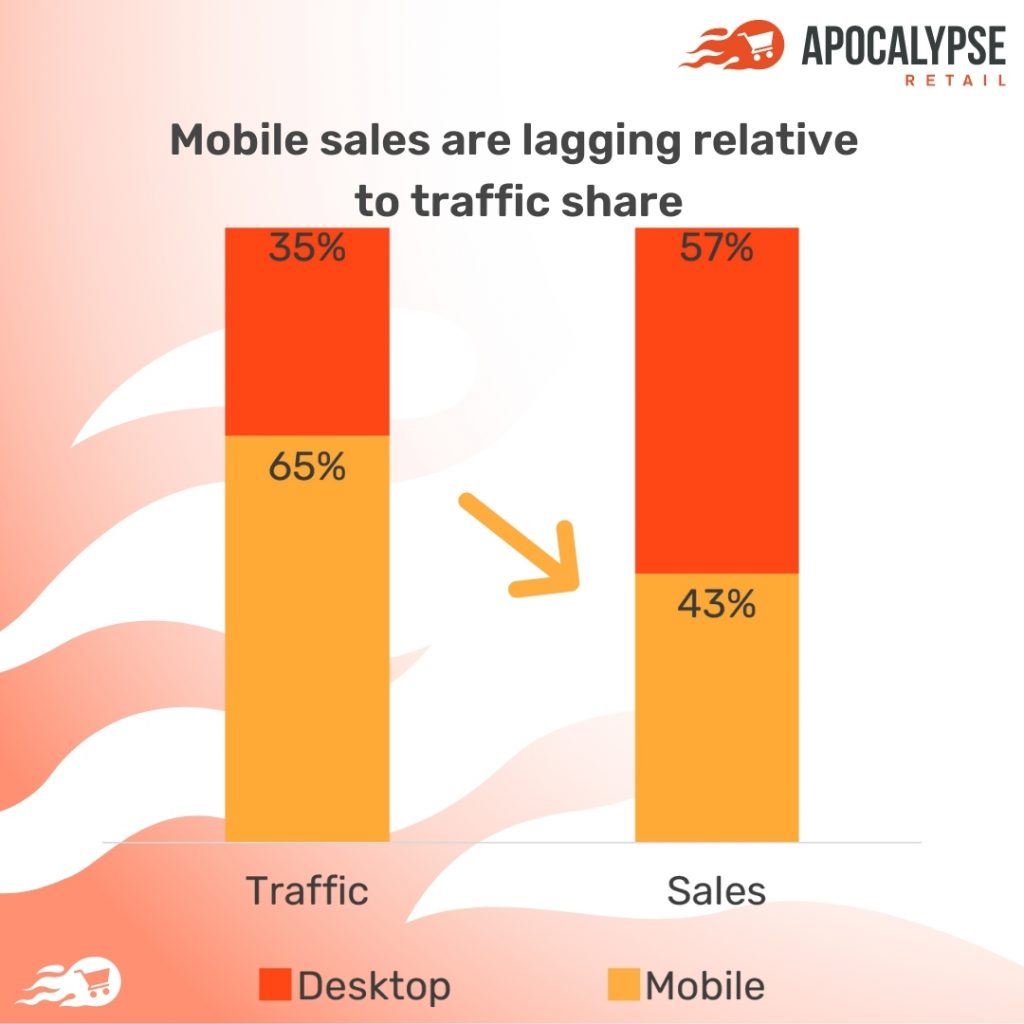
Today, everyone and their mother has a smartphone. Both in developed countries and emerging markets, most adult consumers have a smartphone.
And they use those smartphones to go online to research and discover products or information. Or to chat or browse on social media.
As of 2020, mobile visitors represent almost two-thirds of global online traffic. But the problem is that it only represents 43% of global online transactions.
There is a clear drop in transactions relative to traffic.
Mobile conversion is also lagging relative to other devices.

Image Source: Apocalypse Retail 2021. Why do Retail companies need to implement an Omnichannel Strategy? Bernstein E-commerce Outlook September 2020
The drop in transactions relative to traffic is essentially due to much lower conversion rates than other devices.
If we deep dive by device, mobile conversion rates are meager compared to other devices. And this trend has been sustained for almost a decade.
Let’s compare conversion rates between devices from 2013 to 2019. In both years, conversion rates are almost 3x lower than desktop and 2x lower than tablet conversion rates.
Indeed, smartphone conversion rates improved more during that period than the other devices. But mobile conversion rates remain way too low.
The reality is that most websites are not designed for mobile-first.
Most websites are designed for a larger, easier-to-use desktop screen. And when users try to use it on mobile, it doesn’t respond in the same way.
The hard truth is that the mobile user experience is very hard to improve. At least to reach the same conversion rates as other devices.
So there will continue to be friction in the mobile customer journey which affects almost two-thirds of all online visitors and rising.
But how does mobile fare compared to the physical experience?
Customers still prefer in-store experience compared to mobile.

If the mobile experience is worse for purchase than other devices, the same can be said compared to physical stores.
Mobile traffic has increased exponentially, but the shopping behavior still favors offline stores.
Customers prefer to discover and shop for products in offline stores. Most product discovery is still offline, and customers will do most of the research on mobile devices.
In the end, even if mobile transactions are on the rise, most customers still prefer to shop offline.
The reality is that the physical experience offers something unique.
The value of the physical store and why all retailers must implement an omnichannel strategy
The Physical Store has a Unique Value Proposition

The most bullish e-commerce advocate will say that the physical store is dead. But when we started Apocalypse Retail, we were convinced this statement is wrong.
We don’t mean to give false hope to traditional retailers.
A lot, if not most, of legacy retailers, will perish in the Retail Apocalypse. But this doesn’t mean the end of brick-and-mortar Retail. Instead, it means the end of legacy brick-and-mortar Retail.
When analyzing online and offline retail customer journeys, it is clear that companies don’t have to choose between one or the other.
Both have entirely different value propositions.
The online experience offers convenience more than anything while the offline experience offers… the physical experience.
The offline experience offers human interaction, touching, trying on, seeing, smelling a product. These are all real, value-added experiences that profoundly impact customers.
The physical store has a unique value proposition that is not going to disappear.
The physical store must reinvent itself.

Most legacy retailers have been overconfident about the value of the physical store. And this has led them to keep using the same brick-and-mortar strategies that worked for the past 30 years.
But by doing so, they have been ignoring a massive shift in consumer behavior.
Consumers crave convenience more than anything. And the online experience is built to provide consumers with convenience.
The physical experience, by definition, requires a physical effort. So the physical store will never be able to compete in terms of convenience.
To survive the Retail Apocalypse, the store must reinvent itself. The physical store must be built and designed on everything that won’t be able to be provided online.
The unique value proposition from the store is its core strength.
As we said before, physical stores offer human interaction, touching, trying on, seeing, smelling a product. Retailers that understand this will change the way they approach physical stores.
But unfortunately, legacy retailers still approach the physical experience as they’ve always done. They continue looking at the store as a point of sale measured in terms of Sales/m2.
This completely fails to understand that customers are not exclusive to single-channel journeys. Retailers try to cram as much stock as possible in stores to maximize profitability per m2.
But a physical store is, above everything else, a customer touchpoint. And thus, it should be treated as a marketing channel. Marketing in the sense that it should be designed to attract visitors.
Whether the visitor completes the purchase online or offline is irrelevant. It should be a seamless customer journey.
The physical store provides a showroom where the customer can get everything they can’t get online. The whole package to try, test, and experience the product.
The rest of the journey will always be more convenient online. So, stores must be built and designed to maximize the customer’s physical experience.
Pure Players are Jumping Offline with a Different Approach to the Physical Store

As we said before, most e-commerce pure-players are jumping offline once they reach a certain point.
Amazon, for example, has invested massively in its offline expansion. Not only the Whole Foods acquisition but opening multiple Amazon Go stores with connected carts.
But the approach to physical retail is completely entirely different from the one used by traditional retailers.
Off-course, e-commerce players are looking to increase revenues when they jump offline. But this is only part of the offline strategy.
The offline strategy from e-commerce players is built on two things:
- The physical store is a data acquisition channel
- The physical store is a marketing channel
1. The Physical Store as a Data Acquisition Channel

Amazon is one of the best examples of this strategy.
Imagine you have one of the most powerful customer-data-gathering empires in the world. But this empire is built exclusively for online transactions.
As Jeff Bezos stated, Amazon only represents a fraction of the entire Retail market. And almost three-quarters of all retail transactions will still be done offline by 2030.
So even if they perfected an online data-gathering platform, Amazon “only” has access to a small part of the customer journey.
Now, imagine tracking a customer in your offline store with the same level of detail you can track them in an online store.
Knowing which products they viewed, which ones they added or removed to their cart, when they entered or left, etc. And connect this offline data with the online data you already have of the same customer.
The potential to have an accurate 360º view of the customer is limitless.
This is the way a company can offer relevant, consistent content across channels. And increase their customer retention rates, revenues, and profitability in the long run.
This explains why Amazon is aggressively expanding offline and, as of 2021, the company already operates more than 600 physical stores in the US.
2. The Physical Store as a Marketing Channel

E-commerce pure players much smaller than Amazon are also opening stores.
DNVBs such as Casper, Bonobos, or Le Slip Français in France have opened physical stores. But they have centered the entire offline experience on everything that their online stores could not offer.
The stores are designed as showrooms that offer a consistent value proposition to customers.
In the same way that these brands have disrupted their consumer categories, they are doing the same thing for offline retail.
For a DNVB, the physical store is, above all, a marketing channel. And they will treat it with the same data-driven approach that they use for every digital marketing channel.
The end goal of physical stores is to acquire more potential customers and raise brand awareness.
If the visitor converts offline, it’s a win-win, but if the visitor at least gives their contact info, it’s also a win.
They have just captured a lead. And they will use their deep understanding of the digital funnel to try and convert that lead into a customer.
In the end, it’s all about making sure that the Lifetime Value (LTV) of the Customer is higher than its customer acquisition cost (CAC).
If the CAC also includes the cost of a physical store, it’s because these brands are betting the LTV will also be higher.
DNVBs have understood the fundamental truth about Omnichannel Retail: The value provided by a unified customer experience across channels is greater than the sum of its parts.
Do you want more insights into E-commerce, Omnichannel Retail, and Digital Transformation? Subscribe to ApocalypseRetail to get insights sent directly to your inbox. Our content is designed for top business schools, retail managers, and eCommerce entrepreneurs who want to survive in the ever-volatile retail industry. Subscribe to our newsletter to join the fight against the Retail Apocalypse!
The post The Real Value of the Physical Store in an Omnichannel Strategy appeared first on Apocalypse Retail.
]]>The post An Omnichannel Backoffice Completes a Bulletproof Omnichannel Strategy to Survive the Retail Apocalypse appeared first on Apocalypse Retail.
]]>It is the last of the five pillars that we’ve explained in our previous posts.
What are the Five Pillars of an Omnichannel Strategy?
To deploy a true Omnichannel strategy, a company needs to address the five pillars of Omnichannel Retail.
The five pillars of Omnichannel Retail are:
- Omnichannel 360º View of the Customer
- Omnichannel Customer Engagement
- Omnichannel Fulfillment & Logistics
- Omnichannel Product Offering, and Merchandising
- Omnichannel Backoffice: Finance, IT & HR
In our previous posts, we’ve covered the first four pillars extensively.
A company must understand its customers and their journeys deeply. This can only be achieved with a 360º view of the customer across all their company touchpoints.
Once the company has built this view of the customer, they can start deploying the following pillars.
They can build an Omnichannel customer and content engagement strategy. With it, they can offer the holy grail of customer experience: scalable personalization.
In parallel, the company can implement an omnichannel fulfillment strategy. With it, they can offer fulfillment options to meet the customer when and where they want.
Another pillar is to deploy an omnichannel pricing and product offering strategy. With this strategy, the company offers consistent prices and products to build trust with its customers.
So no matter the channel, the customer knows the company is reliable and trustworthy.
Finally, the company will have to ensure its entire back-office structure is ready for an Omnichannel strategy. This means deploying an omnichannel back-office structure for Finance, IT, and HR teams.
This is the backbone that makes everything work together.
In this post, we’ll deep dive into what is an omnichannel backoffice and why it’s the final step to a proper omnichannel strategy.
An Omnichannel Backoffice Requires a Complete Transformation of a Company

We have covered why companies need to deploy an omnichannel strategy to survive the Retail Apocalypse. However, to deploy it, a company must address the five pillars of an omnichannel strategy.
The last pillar, the omnichannel Backoffice, is the only pillar we haven’t addressed in detail yet.
We left this pillar for the end because it’s the pillar that ties everything together. Deploying an omnichannel backoffice means pushing a complete transformation of a company.
This transformation must impact the very core of the company. It must impact its Culture, Organization, Technology, and Reporting.
In other words, a company must implement its digital transformation at every level.
An Omnichannel Backoffice Requires the Transformation of the Company’s Culture

There is a significant human impact from digital transformation, which legacy retailers most heavily feel.
Companies that lived through the golden years of brick-and-mortar retail but are now struggling to cope with the changes in consumer behavior.
To transform a company’s culture, the company’s management must:
- Upskill and train when possible
- Hire new talent and skills when needed
- Make sure cultural integration goes both ways
- Adapt company policies
- Invest in change management
So let’s look at these five steps in detail:
1. Upskill and train when possible
Companies fail when they try to put people in new roles that they don’t fully understand. Or they simply lack the technical skills required for the position.
Ideally, a company will invest in training its employees to learn new skills through a process that is called up-skilling or re-skilling.
The biggest benefit of upskilling is that it allows the company to internalize skills with existing resources. Very often, the financial cost of training will be cheaper than the cost of a new hire.
But companies need to understand when they can train and when they need to hire.
The cost of training is not only the money invested in training; it is also the time invested.
Some skills in digital roles or IT can only be mastered through years of experience.
A company’s worst mistake is assuming that employees will be fully operational in new roles with some training.
The company must then decide when they have the time to train and when they need to hire.
2. Hire new talent and skills and follow their lead
A company that wants to implement its digital transformation will inevitably need to hire talent.
As we said before, some skills take too long to master.
And in today’s Retail Apocalypse, very few companies have the time to wait for training to yield its benefits.
But hiring talent is only part of the solution.
Many companies think that transformation happens only by hiring new people. But hiring people is useless if new hires are not given the resources and leeway to implement changes.
For example, hiring a data scientist is useless if the company doesn’t have the resources to invest in IT solutions like a customer data platform.
When hiring talent for their digital transformation, companies should follow the advice of Steve Jobs:
“It doesn’t make sense to hire smart people and tell them what to do; we hire smart people so they can tell us what to do.”
Investing in new talent must be accompanied by a willingness to follow their lead.
3. Make sure cultural integration goes both ways
It is paramount for companies and new hires to understand that cultural integration goes both ways.
The people currently in the company must understand the need for new hires. They must understand why these skills are needed and make sure to integrate them into the company.
At the same time, new hires also need to make an integration effort. They must make a significant pedagogical effort to explain their jobs and the need for some things to change. It is much easier to implement change when people fully understand the benefits.
In both cases, new hires and existing employees must understand that digital transformation doesn’t happen in a day.
It takes significant effort and time to implement a digital transformation. But the process is much easier when it is a team effort.
So companies need to nurture an environment where new hires and existing employees can work effectively.
4. Adapt company policies
Legacy companies tend to have legacy company policies.
Company policies can make it extremely difficult to hire new talent, especially for digitally native talent that is used to some perks.
The good thing is that the Covid19 pandemic has forced many companies to adapt to new ways of work, whether it’s remote work or simply the use of certain technologies in day-to-day conversations.
The pandemic has profoundly disrupted company policies. But once things start to get to the “new normal,” companies need to make sure that their company policies align with the times.
5. Invest in change management
Change is hard. And if employees and managers are not prepared, it can be really, really hard.
As human beings, we are programmed to dislike change. It makes us uncomfortable and generates tension to adapt to new behavior.
But change is also a source of opportunities. With proper implementation, we would argue that change can be one of the main growth drivers for the company and people’s careers.
So companies need to embrace change.
But they must make sure it is not disruptive and that employees are ready to embrace it.
A successful Change process cannot be achieved without clear and effective communication.
Thus, companies need to implement the right tools for effective communication and train their managers to deploy a change strategy.
Managers need to have a clear vision and understanding of the change process. And they need to understand how it will impact its internal and external processes.
With it, they can deploy an effective communication strategy with the rest of the employees so that change is accepted and understood.
An Omnichannel Backoffice Requires a Transformation of the Company’s Organization

A proper omnichannel strategy is impossible to achieve with an organization built for single or multichannel retail.
One of the most critical challenges to implementing an omnichannel company transformation is effective communication between teams.
As we said before, it is paramount for managers to be appropriately trained to promote Change management and effective communication.
But effective communication is not only vertical; it is also horizontal.
The organization must be structured to break silos, promote project management methodologies, and put the customer first across the board.
1. Break organizational silos and mindset
When companies are dealing with a single channel, it often makes sense to have vertical organizations.
With a multichannel approach, companies can also keep their organizational silos by channel.
But with an omnichannel approach, it is impossible to create a consistent customer experience without a transverse structure.
Marketing, Sales, IT, Customer Service, Logistic, and Finance teams must be aligned to provide the best possible customer experience.
In this sense, it is not only a matter of breaking the silo organization. It is also crucial to break the silo mindset.
Too often, teams work only to improve their direct impact KPIs, but they don’t care if it creates an issue down the line.
For example, suppose the sales team is only driven by revenues and gross margin. In that case, they will push products with a high chance to generate revenues and healthy gross margins.
But what happens if products are too fragile and break easily in e-commerce logistics? Or the quality of the product is terrible, and it generates a lot of customer service contacts?
In this case, the sales team must have an incentive to drive sales and gross margin. But they also need incentives to ensure the overall customer experience remains excellent.
This is where it is critical to implement transverse Objectives and Key Results (OKR).
The OKR methodology is very efficient in putting different teams to work on common objectives. And drive specific KPI improvements that improve the overall customer experience.
In the end, an omnichannel approach requires teams to work together and put the customer first.
2. Promote project management methodologies
There are plenty of project management methodologies. Whether it’s Agile, Scrum, Kanban, Lean, etc., companies have plenty of choices.
We are pretty much convinced that the OKR methodology is amazing to align transverse organizations.
But regarding project management methodologies, we don’t have a specific one to recommend. Some are great for IT projects, and others are great for logistics projects.
The crucial part is a structured approach to deliver small, iterative results to build a long-term project. And all stakeholders in the project must have a role to play.
Legacy companies used to embark on projects that would take years to complete. And very often, the project is driven by a single team without effective communication with other teams.
With a digital transformation approach, companies must train their employees to understand and deploy project management methodologies.
By doing so, they can cut costs and drive effective, meaningful change within the company.
3. Customer experience prevails over company obstacles
Companies and managers need to understand that omnichannel transformation takes time.
And a transformation of the organization is not done overnight.
The problem is that customers want an omnichannel experience now. And if the company isn’t ready to provide it, other companies will be ready.
So while the company is engaged in its transformation, it must ensure that the current organization is not hindering the customer experience.
This is one of the hardest things for retail managers to get right. Too often, existing flaws in the organization hurt the overall customer experience.
For example, a company that wants to launch a specific discount campaign for customers. But due to legacy systems, they can’t give the same discount rules online and offline. So, they push for a channel-exclusive campaign, whether it’s online or offline.
In this case, the marketing and IT teams should have worked around the company obstacle (legacy systems) to make a discount campaign deployed across all channels.
The solution will not always be so obvious. But the main idea is that the customer experience should always prevail over company obstacles.
If there is an obstacle, the organization must always have the proper communication and objectives to put the customer experience first.
An Omnichannel Backoffice Requires a Transformation of the Company’s Technology Architecture
Move from a monolithic to a microservice tech architecture.

Everyone understands that there is no Digital Transformation without a technology change.
When we say that a company must implement a technology change, we are not saying to change one or two systems.
The company must implement a complete revamp of its technology stack, processes, and project methodologies.
In the 90s and early 2000s, most legacy companies built their entire technology stack around a single system.
The monolithic tech architecture was built as a tool for a single-channel approach, particularly around physical stores. But with the rise of multichannel and now omnichannel retail, a monolithic tech architecture has become obsolete.
Companies that failed to revamp their tech stack a decade ago with the rise of online retail are now rushing to update every system. But if not done correctly, a complete change in the technology stack can bankrupt a company.
What is monolithic tech architecture?

A monolithic tech architecture is essentially one single, multi-use technology platform that is closed to other technologies.
A company may use a few other tools on top of their monolithic platforms, but the monolith is generally the critical tech solution driving its organizational functionality.
In layman’s terms, this means that a single platform with different applications controls a company’s entire technology.
These applications are tightly coupled and cover different needs of a company, from marketing to sales, customer service, finance, or even logistics.
All the company applications are built around four parts which are tightly bound together.
In particular, all applications are built around:
- a single database which concentrates the company’s entire data in many data tables, and
- a single data access layer that connects the database to the internal or external user interface.
Given the amount of data and applications, tech monoliths tend to have huge codebases. Thus, making even the slightest change or adding a feature requires testing and verifying the entire platform.
This makes small iterative tests incredibly difficult, which undercuts a company’s agility and scalability.
What is microservices tech architecture?

A microservices tech architecture involves smaller independent applications that answer to specific business logic requirements.
These microservices are generally connected via application integration (APIs). This allows them to be easily plugged or unplugged to the user interface or other microservices.
This is the basis of a microservices architecture: it is an open tech architecture.
As these applications are smaller in scope and size, it is easier to improve and add features. Which, in turn, makes the entire tech process more scalable.
Given the rapidly changing retail environment, a microservices tech architecture is best suited for companies that want to implement an omnichannel approach.
Six must-have IT solutions for omnichannel retail

An omnichannel strategy requires a microservices tech stack.
But there are specific IT solutions that a company must implement to sustain an omnichannel approach.
To select the right solutions, a company must ensure that the tool answers a business requirement and is easily plugged into the rest of the tech stack.
IT solutions for Omnichannel Engagement:

Omnichannel Engagement is providing consistent engagement and interactions to customers across channels.
The holy grail of omnichannel engagement is to send the right message, to the right customer, at the right time. In other words, make every interaction personal and relevant for customers.
But to make the process scalable, a company will need specific tools to automate hundreds or thousands of interactions.
1. CRM:
Customer Relationship Management software allows a company to offer a unique and seamless experience.
When properly integrated, a CRM can provide a complete picture of all customer interactions, whether pre-purchase or post-purchase.
For pre-purchase interactions, a good CRM tool allows identifying, segmenting, and nurturing leads for potential customers. For post-purchase interactions, the tool enables increased customer engagement and retention, on top of providing better customer support.
In an omnichannel approach, it is paramount for companies to deploy a unique CRM tool for every channel. By doing this, the company will gather invaluable data about customer interactions and behavior across channels.
2. CDP / DMP:
A Customer Data Platform and a Data Management Platform are complementary solutions to generate smarter, scalable customer communications.
A CDP integrates first-party data into a single platform and applies artificial intelligence to search for common customer behavior patterns. Doing so makes it easier for marketing and sales teams to segment and understand their existing customers.
A DMP will enrich first-party data with third-party data to generate smarter customer communications. This third-party data can come via cookies or external databases with demographic, weather, or competitors’ data.
In the golden age of Cookie-web browsing, DMPs allowed for gathering data from third-party websites. This practice is slowly disappearing with data-privacy regulations, but DMPs can still enrich data with external databases.
For example, having accurate weather information can allow a company to send relevant communications to customers. A simple use case would be for a company that sells umbrellas to send communications when it’s raining in a particular city. As a result, the chances of conversion will be much higher.
A CDP will have a broader scope across marketing, sales, and customer service teams. A DMP is more specific to advertising to improve media buying efficiency.
3. DAM:
Digital Asset Management software allows to store, share and organize digital assets efficiently.
Digital assets are essentially digital content: photos, videos, music, documents, and other media. When these files contain rights to use them, they are considered an asset of the company.
A DAM is crucial to easily find and share digital content among teams, which increases productivity But a DAM can also automate workflows to make marketing campaigns easier to deploy
IT Solutions for Omnichannel Fulfillment:
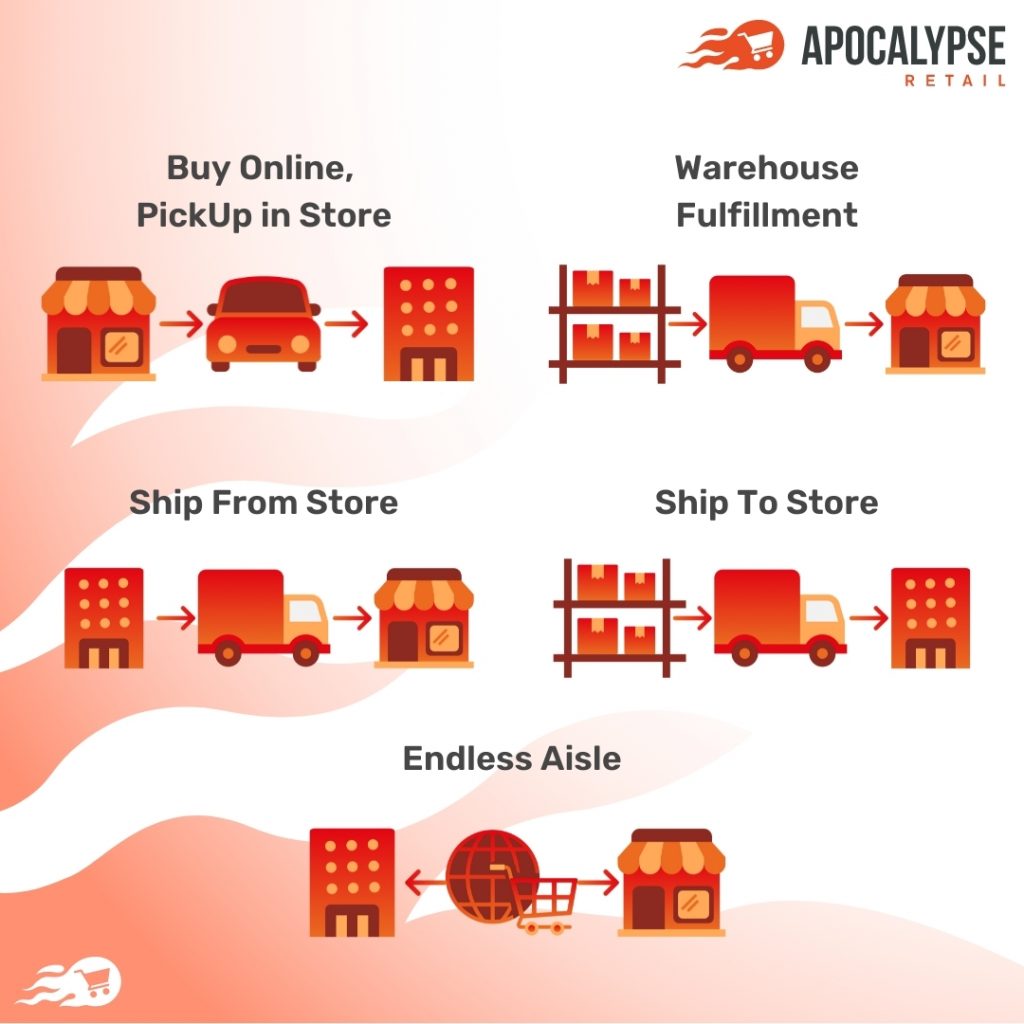
Omnichannel fulfillment allows companies to provide the ultimate customer convenience: serving them when and where they want.
Customers seek convenience above everything, so companies need to deploy different delivery options to meet them across channels.
To implement these delivery options and to preserve the customer experience, a company will need to implement the following IT solutions:
1. OMS:
An Order Management System allows the company to manage the order lifecycle. The OMS allows a company to accept orders and route them to the appropriate fulfillment center.
With an OMS, a company can effectively manage multiple fulfillment centers with a unified view of the company stock.
In an omnichannel approach, an OMS is crucial to effectively handle store-pickup, ship-from-store, or ship-to-store fulfillment options.
2. WMS:
A Warehouse management system allows a company to manage its inventory lifecycle efficiently.
A WMS allows providing accurate real-time data about inventory movements. It also increases picking efficiency by assigning picking tasks and giving clear information on a product’s location.
When connected with an OMS, a WMS can capture and relay real-time data about orders and inventory. The main benefit is to reduce stock-outs and order cancellations.
In an omnichannel approach, a WMS is crucial for handling warehouse fulfillment, store-pickup, ship-from-store, or ship-to-store fulfillment options.
3. TMS:
A Transport Management System allows companies to manage the transport lifecycle efficiently.
A TMS assigns parcels to the right carriers to reduce shipping times and delivery costs. It also allows providing accurate real-time information to track and trace packages during transport.
When connected with an OMS and a WMS, a TMS can provide accurate and relevant updates to customers on each step of the order lifecycle to increase convenience.
The customer knows exactly when and where they will receive their order, which is the basis for omnichannel fulfillment.
An Omnichannel Backoffice Requires a Transformation of the Company’s Reporting and KPIs

Most legacy players have been in the retail business for decades. They have been successful and have optimized their sales and operations for decades.
The problem is that legacy retailers designed their KPIs and reporting structure for single-channel retail. It was specifically built to improve physical store sales and operations.
An Omnichannel Backoffice Requires An Omnichannel P&L

With the rise of e-commerce, legacy retailers started adding complexity to their reporting.
Legacy retailers have often treated their online business as “another store” with an entirely separate P&L.
This separation is, in our opinion, one of the biggest obstacles to implementing a proper omnichannel strategy.
By separating online and offline P&Ls, a company ignores that the value provided from a unified customer experience is greater than the sum of its parts.
In the end, traditional accounting in retail fails to capture the total value of omnichannel retail. It will hinder implementing an omnichannel strategy as the management team will only see half of the picture.
Let’s take an example experienced by many legacy retailers.
The management team of a legacy retailer wants to jump in the e-commerce train and capture some growth.
For this, the company invests in upgrading its technology stack, deploying a digital marketing strategy, implementing store pickup, and revamping its entire website.
They treat it as a separate P&L, so physical store staff has zero incentive to promote the website’s launch. They even see the website as a competitor as any sale in their area is one less for them.
After significant investment and time, the online business takes off and starts generating revenues. But not nearly enough to cover all the spending.
In parallel, physical store sales are increasing more than expected with more visitors than before.
Overall, company managers start reconsidering their online business investment and overall growth stalls.
Sounds familiar?
The main problem with this approach is that it fails to consider that the customer behavior is not mono-channel anymore.
The company is measuring all the investment against online revenues from home delivery. In some cases, they also include buy-online-pickup-in-store revenues.
But they fail to consider the overall impact of a digital strategy on their physical store growth.
After all, with a traditional accounting and reporting structure, how can they measure the positive impact from one channel to another?
Traditional accounting and reporting fail to consider the value of the ROPO effect.
What is the ROPO effect?
ROPO stands for Research Online, Purchase Offline.
ROPO is a consumer behavior where shoppers begin their journey online to gather all the information they need about a brand or product. Then, after they have gathered enough information, they go to a physical store to make a purchase.
Today, customers have all the information they need at the palm of their hands: on their smartphones. As a result, researching a brand or product has never been easier, and customers actively do it.
If you consider the customer journey today, according to the Global Digital Review in 2021 nine out of ten customers visited an online store on any device before purchasing.
Simply having an online presence is crucial to provide information to customers.

Of course, this number also includes online shoppers. But according to Shopify, 69% of consumers webroom, which is another term for the ROPO effect.

But when analyzing the ROPO effect, companies must consider that the effect goes both ways.
In this sense, according to Shopify, almost half of consumers showroom. Showrooming happens when consumers visit a store to check out a product and then purchase it online.

Physical stores have value and help generate additional revenues for the online website as long as the staff has the right incentives.
This means that the company must align KPIs and reporting to improve operations and incentivize cross-channel revenues.
The teams in charge of the online store and offline stores must work together. And marketing campaigns must be designed and measured by an omnichannel approach.
How can the ROPO effect be measured?

By now, it should be clear that every single touchpoint in the customer journey adds value to the company’s bottom line.
This statement is valid as long as those touchpoints are part of a unified positive customer experience.
So to effectively measure the ROPO effect, a company needs to attribute revenues to the right channels.
For online revenues, they can easily be tracked to the initial campaign or traffic source. The problem comes with offline visitors who didn’t log in to the website or even go to the company’s website.
For example, a shopper looking for a decoration store might research Google Maps and see nearby stores. Then, they will probably go to the store without even going to the store’s website.
Tracking 100% of customers offline is impossible.
But companies can get close enough by gathering the correct information from customers when they visit or purchase offline.
A company that can gather data about their offline visitors like an email or a phone number can build a clear view of the customer journey.
So companies must deploy a data-gathering strategy across channels. This strategy should be aligned with their loyalty programs as it’s the best way to offer incentives in exchange for customer data.
If used adequately, a loyalty program can generate tremendous growth in customer retention across channels.
Do you want more insights into E-commerce, Omnichannel Retail, and Digital Transformation? Subscribe to ApocalypseRetail to get insights sent directly to your inbox. Our content is designed for top business schools, retail managers, and eCommerce entrepreneurs who want to survive in the ever-volatile retail industry. Subscribe to our newsletter to join the fight against the Retail Apocalypse!
The post An Omnichannel Backoffice Completes a Bulletproof Omnichannel Strategy to Survive the Retail Apocalypse appeared first on Apocalypse Retail.
]]>The post An Omnichannel Product Offering is How Retailers Build Trust and Customer Retention appeared first on Apocalypse Retail.
]]>Omnichannel commerce is a critical way to give your customers a seamless shopping experience. Whether shopping in a store or online via tablet, mobile, or computer. In every touchpoint, consistency is essential.
When shopping, it is normal for the customer to research their purchase. They may compare different models a few times across devices.
As they research before making a purchase, customers rely on consistency to establish trust. This consistency is required on price and product offering.
To consider implementing an omnichannel strategy, a company must address five key pillars.
The five pillars of omnichannel retail are:
- Omnichannel 360º View of the Customer
- Omnichannel Customer Engagement
- Omnichannel Fulfillment & Logistics
- Omnichannel Product Offering, and Merchandising
- Omnichannel Backoffice: Finance, IT & HR

An omnichannel product offer is one of the five pillars of an omnichannel strategy. In this post, we’ll dive into how you can build your own omnichannel pricing and product offering to meet the omnichannel customer’s demands.
But first, let’s recap the differences between multichannel and omnichannel retail.
Multichannel Vs Omnichannel

The difference between multichannel and omnichannel retail is consistency.
Multichannel retail offers products and services across various channels. But this offering is not connected in a continuous path to purchase.
Omnichannel retail refines the multichannel process. It creates a smooth and seamless customer journey across channels.
Omnichannel retail allows for more accurate and better quality data collection. It also improves customer loyalty and increases traffic and sales.
All these benefits are in addition to providing a better experience for your customers.
The key to success with omnichannel Pricing is to know your customer. Know the behavior to expect, what they look for when researching your product, and what channels they use.
Why should retailers implement an Omnichannel Product Offer?

Humans hate to feel duped.
Feeling like you have been taken advantage of is one of the worst feelings in human psychology.
Customers will never forget how your brand made them feel, especially if it creates powerful emotions.

Most companies focus on creating positive emotions, but every company dreads generating negative emotions.
Today’s shoppers have everything they need to research a product or brand in their pocket.
Asymmetric information is used to benefit retailers, but not anymore. Today, customers have complete control over information, and that gives them significant power.
As of 2019, consumers checked their smartphone instead of speaking to a store associate for the following reasons:
- 69% to check customer reviews on a product or service
- 58% to find comparable products or services
- 55% to check product specifications
- 53% to find deals or discounts on specific products or services
The fastest way to lose a customer is to make them distrust your brand. And you lose trust by having different Pricing and promotions across channels. By doing so, you make customers ask themselves if your brand is worthy of their trust.
Customers do not want to spend time comparing shopping for the lowest cost product.
Convenience ranks right up with the price in helping the consumer make purchasing decisions.
Having an omnichannel product offering is not just a matter of building trust. It’s a matter of convenience.
While online channels have been great for impulsive buys, it has also made research effortless.
What is an omnichannel product offering?

An omnichannel product offering is a strategy to offer consistent content and Pricing for their products. This consistency is enforced across all sales channels.
Consistent product content: Provide the same product description and content across channels. This content includes visual content, product reviews, and user-generated content.
Consistent product pricing: Consistent product pricing has the same pricing strategy across channels. This is not only for regular prices, but also for promotions, discounts, and rewards for customers.
An omnichannel product offering has a unified strategy across channels regarding:
- Pricing
- Loyalty Rewards
- Promotions
- Product Reviews
- Product Information
Ensuring that your product offering is consistent and available across all channels is a great way to keep customers happy. They should feel comfortable when they make their purchasing decisions.
That comfort pays off with greater customer loyalty and lifetime customer value.
Multichannel retailing is a step for retailers that want to avoid the retail apocalypse. They need to understand that 21st-century shoppers are present in multiple channels. So companies must be present on those channels.
However, most traditional retailers fail to understand that shopping behavior has radically changed. Digital channels have made it easier than ever for customers to do research.
Omnichannel retailing understands this.
In the end, finding all the information on a product is just one google search away on the customer’s smartphone.
Some companies don’t do it because they think it means a race to the lowest price. But you can have a higher price than your competitors if you provide additional value.
Omnichannel retailing is not about having the lowest possible price. It is about providing additional value on a unified path to purchase.
The problem is, most retailers still fail to understand the value of Omnichannel Product Offer. According to a panel among retail professionals about the consistency of their product offering:
- 43% of retailers have inconsistent or very inconsistent Pricing
- 57% of retailers have inconsistent or very inconsistent Loyalty rewards
- 60% of retailers have inconsistent or very inconsistent Promotions
- 72% of retailers have inconsistent or very inconsistent Product Reviews
- 75% of retailers have inconsistent or very inconsistent Product Information

What are the Benefits of Providing Omnichannel Product Offering?
1. Building trust with the customer

The most crucial benefit of an omnichannel product offering is building trust with your customers.
Trust is vital for long-term relationships and will yield a positive return on investment. A customer is more likely to pay a higher price for a product if they trust the brand.
Building trust is important for any company, but it is critical for retailers.
2. Lower customer acquisition costs

When customers trust a product or brand, they are more likely to recommend it to their friends.
Companies that implement an omnichannel product offering understand the value of word-of-mouth. Customers can be your most crucial marketing asset… if they have positive things to say about you.
Building trust not only helps you build loyal, long-term relationships with your customers. It also enables reducing customer acquisition costs as existing customers become fans.
3. Higher scalability

An omnichannel product offering also makes for easier internal processes. A consistent price and content strategy makes the product life cycle faster and more scalable.
Consistency helps your teams avoid Pricing or content mistakes. Product teams must gather feedback from their commercial teams on Pricing.
A consistent pricing and content strategy allows commercial teams to focus on selling the product instead of reworking content.
4. More powerful campaigns

Consistent product pricing, promotions, and rewards across channels are crucial to powerful campaigns. It allows retailers to build consistent messages across channels.
Most customers browse multiple channels daily. So a consistent campaign across channels highly increases the chances of customers remembering your message.
5. Better comparisons with your competitors

A retailer must keep an eye on Pricing and promotions from competitors. And it needs to keep an eye on prices across all channels.
By doing so, the company can make adjustments to inventory and forecasted sales.
Consistent Pricing and promotions across all channels allow for better comparisons with competitors. Having different prices and promotions on sales channels makes it very difficult to have an accurate comparison.
What is Omnichannel Pricing?

Today, customers can showroom or webroom in their customer journey.
Showrooming is the practice of looking at something in person, then ordering it online.
Webrooming is when a customer sees a product online and then heads to the store to purchase it.
But a company that offers different prices across channels will lose on both customers. Customers lose faith in retailers that offer different prices across channels.
Before having smartphones, channel-specific Pricing was less of a concern. But as customers become omnichannel, companies must also become omnichannel.
Different prices by channel damage your reputation. And a company that continues doing it will lose the trust-goodwill from customers.
What are Omnichannel Promotions?

Building an omnichannel promotion comes with its own unique set of challenges. Most challenges come from legacy organizations not suited for an omnichannel strategy.
Silo structuring makes it challenging to create continuity across various channels. By having a transversal organization, a company ensures that all parties understand the goals and purpose of a campaign.
Who must be included when launching a promotion? All teams from Marketing, Sales, IT, Product, Customer support, and Local store associates must be included in the discussions.
This sounds messy, but with the right organization, it is fully scalable.
A deep understanding of your customer needs is key to launching the most efficient promotions. Companies need to gather data about their customers and understand their behavior.
For example, a promotion to gather leads from customers can help build a solid first-party customer database.
But most retailers push this type of promotion exclusively online: “10% if you subscribe to our newsletter!”.
This type of campaign is excellent for online lead acquisition. But the true power of omnichannel promotions lies in deploying them across channels.
Expanding this type of promotion to offline channels will increase your lead-gathering capacity.
What are Omnichannel Product Reviews?

Too often, product reviews are handled exclusively by customer service teams. But they should also be considered as a marketing tool between brands and customers.
Social proofing represents a crucial touchpoint to build trust with customers. Product reviews must be nurtured and displayed on all channels to build a powerful reputation. A company that displays positive reviews for products and stores can see an uplift of 18% in revenues.

Product reviews are essential to provide information to customers. And companies can also receive input and have a conversation with their customers.
Consider product reviews a vital source of data as peer-to-peer trust has a tremendous impact on buying decisions.
The local consumer review research shows that almost 9 out of 10 customers value online reviews as they would for personal recommendations. So product reviews and social proofing are almost equal to word-of-mouth. But it is much more scalable!

Treat product reviews as the critical marketing analytics tool that they are.
In an omnichannel approach, product reviews stay in front of the mind of the consumer.
A negative review read online can influence an in-store buying decision. Think carefully about how you will react to negative reviews. Have a policy in place to handle them and don’t make it difficult for the customer.
Trouble resolving the issue encourages negative comments on social media so instead, be ready to reach out personally to the customer to address the situation.
Finally, take each negative review and learn from it. Use it to improve your product, processes, or fulfillment.
What is an Omnichannel Loyalty Program?

A loyalty program is how most legacy retailers built their customer databases. But in today’s retail, loyalty programs need to be adapted for an omnichannel strategy.
A loyalty program where some benefits or rewards are exclusive to a single channel is a thing of the past.
The lifetime value of an omnichannel customer is higher than the lifetime value of a customer exclusive to a single channel. This increase in lifetime value is why retailers must implement omnichannel loyalty programs.
A loyalty program offers access to special discounts, promotions, or events. These benefits must be provided on every channel. In exchange, retailers get the customer’s data. If appropriately used, this data will repay the investment in an omnichannel loyalty program.
An omnichannel loyalty program implies that it is accessible to anyone at any time.
Rewards and benefits from a loyalty program should not be just for customers close to a store. They should be for any potential customer.
It is frustrating to miss out on special deals and discounts as a customer because they are not in every channel.
A company shouldn’t make its loyalty rewards based on pricing discounts only. A loyalty program should offer exclusive or early access to products or events.
This helps build and nurture the relationship with your most loyal customers. When doing this, companies must identify their customers to track and segment their database correctly.
By doing so, companies can identify their loyal customer’s purchasing patterns. And they can also make an effort to “reactivate” customers who haven’t bought for some time.
An Omnichannel Product Offer answers the four factors influencing a purchasing decision

Most legacy retailers have been moving into the digital space at a slow pace. However, 2020 and Covid19 accelerated the need for companies to move online.
Unifying the digital and physical experience has become a crucial consideration.
Customers are already used to buying online. And they expect a seamless online shopping experience.
Delivery options and store pickup have become prevalent in today’s retail. Today’s consumers are jumping from one device to another and from one channel to another.
Consumers today make their purchasing decisions based on four factors:
- Selection
- Price
- Content
- Convenience
Omnichannel Product Offering ensures that these factors are met on a consistent basis at every step of the funnel.
Customers will see a consistent selection, price, and content across channels. All of this, on top of availability on all channels to provide maximum convenience.
Trust is built by offering the same product, whether your customer is shopping online, in person, or clicking through an email. This trust removes the need to check the competition.
There is no need to visit multiple stores and wait for price drops when there is trust.
What are the Difficulties of Implementing an Omnichannel Product Offering Strategy?

An omnichannel product strategy isn’t easy to implement. It requires discipline and continuous improvement.
To implement omnichannel pricing effectively, a company must have a pricing tool.
Omnichannel Pricing is not a strategy where you set it and forget it. It is vital to have accurate forecasts and inventory management.
From significant events, such as Black Friday, to more specific events, such as fluctuations in inventory.
Companies need to factor in any change in competition to adapt stocks across channels. Retailers need robust operational control and suitable systems to manage omnichannel Pricing.
But apart from the complexities, the omnichannel product offering has two main drawbacks
- First, it consumes a lot of time and resources to be implemented. Most of the time, it requires specific skills that can’t be found in-house.
- And second, an omnichannel product strategy is not always flexible enough for seasonal or local shopping habits.
In the time it takes to implement an omnichannel product strategy, companies can implement hybrid pricing.
Hybrid Pricing implements single omnichannel Pricing, but few exceptions in specific situations.
Hybrid Pricing is a good compromise for retailers impacted by seasonal price changes or very local consumer habits.
Just keep in mind that every difference that exists between channels is a step back to multichannel retail.
How to implement omnichannel product offering?
Here are the two main issues every company must address when trying to implement an omnichannel product offering.
Establish seamless communication across your customer touchpoints

Deciding where to offer your product can be a challenge.
A pain point for many retailers over the past year was that they had options for getting their products to consumers. In particular, those companies that only had physical stores or relied too heavily on their physical footprint.
Multiple sales channels allow a continued revenue stream if one channel dries up.
When choosing channels to provide sales, you need to really understand your customers. And meet your customers when and where they are.
Companies should be easily accessible in every channel and customer touchpoint.
The primary customer touchpoints that every retailer must address include:
- Traditional brick-and-mortar stores and pop-ups.
- Sales reps in store
- Mobile or Desktop Website
- Mobile apps
- E-commerce marketplaces
- Social media platforms.
Once you decide what channels you need to use, you must unify your marketing efforts. An advertising strategy for your products must be consistent across platforms.
If a potential customer sees an ad offering a product at one price, then receives an email offering something different, trust is broken.
Another issue is coupon codes and other promotions that don’t work correctly. An email promotion sent with an expired coupon code is a terrible experience.
Commercial teams across channels should be aware of your campaigns to maximize their output.
It is frustrating to go to a store and see that promotion is only available online. Or that the store associate wasn’t even aware of the promotion.
Personalize the Customer Experience

While consistency is key to omnichannel Pricing, that doesn’t mean you should treat all your customers the same.
Segmenting your customers allows you to target each where they are most likely found. Segment by demographics such as generation, income range, online behavior, and region.
Segmentation allows you to create specific marketing plans while maintaining your omnichannel presence.
Once segmented, consider where each group is most likely to look for your product. For some, it may be in-store. Others may perform a Google search. Finally, some may not search for it but would be interested if it popped up on their Instagram page.
After coming up with a plan to market to each segment, think of every step of the customer journey.
Should you have a feature to sign up for email offerings on your website? Or have a banner at the entrance of your store?
The customer journey is not a straight path. Customers move between digital and physical methods seamlessly.
Success will come to companies that meet customers when and where they are.
Do you want more insights into E-commerce, Omnichannel Retail, and Digital Transformation? Subscribe to ApocalypseRetail to get insights sent directly to your inbox. Our content is designed for top business schools, retail managers, and eCommerce entrepreneurs who want to survive in the ever-volatile retail industry. Subscribe to our newsletter to join the fight against the Retail Apocalypse!
The post An Omnichannel Product Offering is How Retailers Build Trust and Customer Retention appeared first on Apocalypse Retail.
]]>The post A Guide to Omnichannel Customer Engagement: What is it and How to Implement it? appeared first on Apocalypse Retail.
]]>An omnichannel retail strategy requires a consistent customer experience across touchpoints. This is easier said than done.
To consider implementing an omnichannel strategy, a company must address five key pillars.
The five pillars of omnichannel retail are:
- Omnichannel 360º View of the Customer
- Omnichannel Customer Engagement
- Omnichannel Fulfillment & Logistics
- Omnichannel Product Offering, and Merchandising
- Omnichannel Backoffice: Finance, IT & HR
Once you have built a 360 view of your customers, you can start deploying an Omnichannel customer engagement strategy.
With this post, you’ll understand what is omnichannel customer engagement, and how it can help your company increase the lifetime value of your customers.
What is Omnichannel Customer Engagement?

Omnichannel customer engagement means a unified and consistent message across touchpoints. It means providing relevant content and experiences at every touchpoint in the customer journey.
This implies that all touchpoints of the customer journey are interconnected and unified.
A unified journey requires that all teams are connected. For example, marketing, sales, supply, and IT teams must be connected to provide consistency across touchpoints.
Today, customers have multiple channels to engage with the brand. And they use all channels available at their disposal.
One could say that today’s customers are omnichannel in their behavior.
Before visiting a store, customers like to do online research before purchasing. Some customers even want to call the brand while they’re doing their research online.
As a result, it becomes a challenge for companies to have consistent content and information across channels.
That’s where the omnichannel customer engagement concept comes into play. Omnichannel engagement means providing relevant content and experiences at every touchpoint in the customer journey.
In other words, it is engaging with the right message, to the right customer, at the right time.
Omnichannel Customer Engagement requires a Customer Data Platform

To provide omnichannel customer engagement, you need to build an interconnected path to purchase. It means connecting all systems, channels, and technologies to gather data in a central location.
This is the basis of a Customer Data Platform or CDP.
In layman’s terms, a CDP is a data repository centralizing all sources of customer data. A CDP allows connecting data gathered in stores, websites, or digital channels to build a complete customer profile.
An omnichannel strategy allows customers to interact with a brand regardless of what channel they prefer.
It doesn’t matter if the customer visits the physical store, the website, or the Instagram profile. However, they should be able to perform, get the same experience and have a continuous path to purchase.
An omnichannel engagement allows customers to pick up where they left off regardless of the platform. This is impossible to do if a company cannot identify the customer across different channels. That is where a CDP brings value.
But a CDP is not a magical tool.
A CDP is useless if a brand doesn’t provide value in exchange for the customer’s data.
To provide value, a company needs to have the right content at the right time. This can only be achieved by having a 360º view of the content.

What is a 360º view of the content?

A multichannel content strategy pushes content and information to touchpoints. On the other hand, an omnichannel content strategy provides a unified content experience across all customer interactions.
Multichannel engagement will generally provide different content for social media or newsletters. For example, a company can have videos and tutorials available on its website. But this content is not used or can’t be used in their stores.
This disconnect happens for two main reasons: First, because teams involved in different channels don’t communicate properly, and second, because the company doesn’t have the systems to unify its cross-channel content strategy.
The first reason is hard to solve but is achievable by aligning objectives and implementing the proper organization.
The second reason is much harder to do without the proper IT solutions.
Omnichannel Customer Engagement requires a Digital Asset Management Solution.

Unifying cross-channel content can be daunting in the age of digital marketing. Tons and tons of content are produced for different digital channels.
As online customers have a shorter attention span, companies need to produce a lot of content. They will produce content for search engines, social media, newsletters, blogs, or websites.
But only a few companies connect content between channels.
This happens because they don’t have a detailed and central view of all the content they produce.
This is where Digital Asset Management (DAM) solutions bring value. Sort of like a digital content library.
Having a content library allows retailers to adequately and efficiently reuse content.
In addition, a DAM enables companies to store, classify and segment their content in the same way they segment their customers.
What are the eight layers of segmentation to have a 360º view of the content?

Implementing a DAM is useless without the proper content segmentation. Here are the most important content segmentations you can use:
1. Product content

One of the most critical pieces of content a retailer needs to work on is the product content.
Product content can be divided into different categories:
- Semantic content: This is the product-page description and written content to help educate customers about a product.
- Visual and video content: Photos and video content built around a product to provide additional information to customers.
- Technical content: technical description that can help categorize products by color, size, gender, specs, etc.
Detailed product content helps build trust with customers and increases conversion. Offline conversion, but especially online conversion.
For omnichannel retailers, having this content accessible in all channels helps increase revenues. For example, a store associate can get detailed product information to help a store customer.
2. Content Campaign

Content campaign segmentation helps companies track content used by campaigns. This is very helpful to identify which content works best for which campaign and at what stage of the funnel.
For example, a detailed how-to guide might work well for top-of-the-funnel campaigns. In addition, this content can help raise awareness or interest in your products from customers.
Understanding which content works best for which campaign will yield higher conversions.
3. Content Semantics

Content semantics includes every written content related to the product, on top of product-page content. So, for example, it includes full-text product how-to guides, blog posts, transcripts, or reviews.
Content semantics is an essential part of Search Engine Optimization (SEO). Using the right keywords can significantly differentiate organic traffic and page views for a website.
4. Content Performance

Content performance is a view of the KPIs used to define whether specific content is working.
KPIs can be impressions or engagement for social media. But it can also be add-to-cart or conversion for product pages or simply the views for a video.
Content segmentation by performance allows companies to adapt and improve their content strategy. However, same as with content campaigns, it is essential to identify if the content is working.
5. Content Components

Image Source: Apocalypse Retail 2021. What is Omnichannel customer engagement?
The key for content repurposing at scale is to make it easy to find. Therefore, it is critical to have a clear view of the components of each content to find content quickly.
For visual content, for example, having the components of a picture makes it easy to find and reuse. If the image displays people, having the number of people, their age, gender, or actions makes content easier to find and reuse.
6. Content Emotion

Like content components, you can also segment content by the range of emotions it displays.
Having a description of the sentiments, tones, or feelings generated is key for content repurposing.
Imagine you want to set up a campaign displaying kids laughing at a birthday or Christmas party. You could shoot new pictures or reuse a photo from a previous campaign of kids playing outside.
Having an organized content view can mean significant savings on content generation.
7. Content Composition

The content composition is used to categorize and segment visual content. Composition aspects include shot type, shutter speed, or filters.
This information is helpful to use the right content for each type of campaign. This, in turn, will help you address the right audiences for each type of content.
8. Content Technical features

Content technical features are the final, more boring step of generating the content. Still, if not done correctly, it can screw up a campaign.
Technical features include the file type, resolution, pixel size, weight, or length. Again, having a clear view of content by technical features provides huge boosts in productivity.
It is easier for marketing or sales teams to find and choose the right content for the right channel.
Having a 360º view of customers and content allows scalable personalization: the full value of Omnichannel Customer engagement

Scalable personalization allows providing a personalized experience to thousands of customers. Having a clear view of customers and content allows building a personalized journey for each customer.
The idea is to provide a personal experience throughout multiple touchpoints in the customer journey. And to numerous customers at the same time.
A company will deploy an omnichannel strategy assuming that it adds extra value to the customer than a multichannel approach.
In other words, the value provided by a unified customer experience across channels is greater than the sum of its parts.
Omnichannel aims to build a better connection with customers than your competitors. And there is no better connection than a personal connection.
When a company can build a 360º view of their customers and integrate it with the 360º of their content, it is ready for scalable personalization.

They will achieve a level of personalization that ensures long-lasting connections with customers. The challenge is to make the process scalable to reach thousands or millions of customers with a personalized approach.
Here is where automation and the right IT solutions are paramount. A Customer Data Platform and a Digital Asset Manager are some of these solutions.
A company needs both to build a scalable and personalized connection with all customers. These tools must be complemented with the right Customer Relationship Management (CRM) tool.
A CRM tool will allow you to reach customers and send them all the content you want.
Omnichannel customer engagement: How to set up a scalable personalization strategy?

Here are all the steps to set up a scalable personalization strategy:
1. Define your buyer personas or ideal customer

Identify who your ideal customer is:
- What are their demographics? Age, Gender
- What is their family situation?
- What are their socioeconomic indicators?
- Where do they live?
- What are their interests?
- What are their habits outside of shopping?
2. Identify the customer journey

Identify what channels your customers typically use in their shopping experience:
- How do they discover you?
- How do they search for your products?
- Which touchpoints do they prefer to use?
- How often do they purchase?
- How profitable are they?
- What is the #1 reason they buy from you?
- Would they recommend you to their friends?
3. Segment your audience by levels

Segmentation your audience from simple to more complex and targeted audiences
- Demographic segmentation
- Socioeconomic segmentation
- Interest-based segmentation
- Behavior and Intent segmentation
4. Create and repurpose content

Implement a content strategy to create content and organize it by each level of segmentation seen before. Once content has been created and organized, you can either make more content or repurpose existing content.
Not all customers are in every channel, which makes it easier to repurpose content without appearing repetitive.
5. Set-up automation workflows to provide personalized messages

Make sure always to identify the target customer for every campaign.
Once you have a clear view of your audience and an organized view of your content, you can make the most out of automation.
A great CRM tool will allow you to set up automation workflows with the following objectives:
- Lead generation: welcome process, content downloads, requests for proposals, add-to-cart.
- Lead nurturing: Lead qualification, lead scoring, interest targeting, or behavioral targeting
- Engagement: Onboarding campaigns, newsletters, reminders, birthdays or special events, seasonal offers, rewards, cart abandonment, re-activation messages
- Retention: Order notifications, immediate or delayed cross-selling or upselling, loyalty program and tips, referral program, feedback requests, customer reviews, etc.

What Are The Benefits Of Omnichannel Customer Engagement?
Companies enjoy a variety of benefits by employing an omnichannel customer engagement strategy.
Here are some of the main advantages that come with using an omnichannel customer engagement strategy.
1. Serve Customers when and where they prefer

Image Source: Apocalypse Retail 2021. What is Omnichannel customer engagement?
An omnichannel strategy allows companies to serve customers on their preferred platform.
The modern consumer craves convenience more than anything so brands have to cater and be present on whatever channel their consumers prefer.
The thing is that today’s customers use multiple channels at the same time. So serving customers when and where they prefer is the way to provide them with a great shopping experience.
An omnichannel experience will improve conversion rates and customer loyalty.
2. Gather better data and get the most out of it

Data is a precious resource and can help improve decision-making significantly. That’s where implementing an omnichannel retail strategy excels.
All channels give access to different layers of customer data. But using an omnichannel customer engagement strategy allows connecting the data from all channels.
It becomes easier to access all data because it’s unified in a customer data platform.
From there, brands can analyze the data and assess which channels provide them with the most revenue. As a result, they can gain critical customer insights even when there isn’t any actual purchase.
Using the data, brands can optimize their conversion rates.
3. Provide A Better Shopping Experience

Customers will gravitate towards brands that provide them with the best shopping experience.
An omnichannel engagement strategy provides customers with the best experience possible. This is a personalized shopping experience.
Having a personalized approach and interacting seamlessly across are unique benefits. These benefits go a long way with customers.
A better shopping experience, of course, helps improve customer retention and revenues.
4. Improve Customer Service

Providing great customer service is a challenge in itself, even if you have a single channel. Now doing it at scale and in every single channel seems like a daunting challenge.
The truth is that very few companies can provide excellent customer service in every channel.
An omnichannel engagement strategy helps provide better customer service.
It provides multiple channels for customers and makes it easier to engage with a company. And it ensures the experience is consistent, no matter the channel chosen by the customer.
On top of this, customer service employees will have all the data they need to provide a great experience.
A customer service rep would know if/what/when/where a customer bought from the company. And also if the customer had previous interactions in other channels.
All this data will allow the customer service rep to improve their answer time.
Great customer service will always yield positive returns for the company. According to Hubspot, 73% of customers stay loyal to brands because of friendly customer service reps.

And, according to the same study, 50% of customers increase their purchasing after a positive customer service experience.

What are the challenges when deploying an omnichannel customer engagement strategy?
Employing an omnichannel customer engagement strategy will provide a lot of benefits.
However, the road to omnichannel engagement is not an easy one to take. It is long, hard, and costly if the company is not prepared correctly.
Below are the two most important challenges a company will face:
1. Unstructured data and metrics are a challenge for Omnichannel Customer Engagement
Omnichannel customer engagement at scale depends on massive volumes of data. Data is what allows the organization to provide customers with a personalized experience.
Companies must ensure they’re gathering and structuring data in a place accessible to any team that needs the data. This place is generally a Customer Data Platform or CDP.
But implementing a CDP is a challenge as each touchpoint has different systems and ways to gather data.
And, very often, different channels mean different teams in charge of operations. Which in turn means different metrics and unstructured data.
In an omnichannel approach, all teams need access to the correct data to gain insights, even if it isn’t native to their channel.
This requires the right systems, data visualization tools, and training.
2. Lack Of Technical Skills And Resources are a challenge for Omnichannel Customer Engagement

Even if a company’s leadership understands the importance of data, they don’t always have the right skills or resources to use it.
Omnichannel customer engagement requires specific technical skills and resources.
Not all companies have these skills in-house, nor have the time or money to pay for them. As a result, companies have to hire specialists or train existing employees to learn new technologies.
If they hire specialists, they need to ensure they are correctly integrated and have the right tools to work with. And training existing employees has its limits, especially with non-digitally native employees.
These are some of the challenges that come with omnichannel customer engagement. However, the benefits definitely outweigh the challenges.
Conclusion
An omnichannel customer engagement strategy is essential for any modern retailer as customers are now more demanding than ever before. They expect brands to offer a seamless experience across multiple channels.
Do you want more insights into E-commerce, Omnichannel Retail, and Digital Transformation? Subscribe to ApocalypseRetail to get insights sent directly to your inbox. Our content is designed for top business schools, retail managers, and eCommerce entrepreneurs who want to survive in the ever-volatile retail industry. Subscribe to our newsletter to join the fight against the Retail Apocalypse!
The post A Guide to Omnichannel Customer Engagement: What is it and How to Implement it? appeared first on Apocalypse Retail.
]]>