The post Amazon Physical Stores: A Successful Game Changer in the Retail Sector? appeared first on Apocalypse Retail.
]]>We want to give our special thanks to Pablo Marcote & Ricard Codina, the two students who co-authored this post.
Sometimes, big isn’t big enough. For Amazon, the world’s most significant e-commerce player, the online world isn’t enough to contain its ambitions.
Amazon physical stores are part of the company’s well-planned entry into the retail landscape. And like everything it has touched, Amazon has all the expertise and financial punch to change the brick and mortar sector.
Shopping and Amazon are synonymous. But for a while now, it’s the company that’s been on a shopping spree.
This shopping spree is different from Jeff Bezos’s post-divorce purchases of a yacht that comes with another yacht or a mansion with a 9-hole golf course. No, this is about the company and not the new bachelor on the scene.
From Whole Foods to PillPack to Ring to Zoox, the online behemoth has acquired companies to build its portfolio, enhance its technological capabilities, and fuel its retail growth. As a result, its strategy is different from other online or big-box retailers.
What is Amazon’s physical store strategy?

The company has been rolling out Amazon physical stores to widen the horizon of its offerings in the retail sector.
Amazon Go, Amazon Go Grocery, Amazon 4-Star, and Amazon Lockers are only some moves to disrupt the market and enhance offline shopping experiences.
After redefining e-commerce, the company, it seems, is now about to redefine commerce as we know it.
Amazon Books, the company’s first venture into the traditional retail sector, was launched in 2015.
Starting in Seattle, it’s now present all across America. The Whole Foods acquisition followed suit. Then came Amazon Go, Amazon Go Grocery, and others. With Whole Foods, the company now has around 600 physical stores worldwide, divided as follows:

The strategy is to be an omnichannel marketplace instead of a single-channel seller.
After a testing phase opening Pop Up stores in 2018 following the acquisition of Whole Foods, Amazon has rolled out a complete physical strategy. However, the company is definitely not in the testing phase regarding its physical-store strategy.
For those interested in knowing, for example, where Amazon Go or Amazon Fresh is available, Amazon stores are mainly located in the US. They can be found in the following Amazon physical store locator. Nevertheless, Amazon plans to expand overseas, with the UK as a testing ground before a full-scale deployment in Europe.
But why the shift? Why is Amazon expanding to formats and delivery modules that are not in natural alignment with its traditional strengths? What’s prompting this retail expansion?
Seven reasons why Amazon is jumping to brick & mortar retail
1. The future of retail is omnichannel

Even though all the talk about the surge in online sales, especially the tremendous spike witnessed during the pandemic, offline commerce isn’t going anywhere.
That’s primarily because the offline shopper behavior of consumers is different from their online behavior. One is driven by experience while the other, by convenience.
This means that there aren’t exclusive groups of shoppers. Instead, most people prefer both kinds of commerce. What they want is a blend – and best – of both online and offline buying experiences.
E-commerce offers an exceptional choice of products, prices, and time-bound discounts that are difficult to find offline. In addition, Offline gives consumers a more immersive shopping experience that’s difficult to replicate online.
The tactile and sensory experience of being in a physical store adds a level of engagement that e-commerce can never compete with.
Amazon knows this and doesn’t want to be seen as just an e-commerce marketplace. They want to be where the customers are.
2. Gathering data on offline shopping behavior

Another reason for the launch and expansion of Amazon physical stores is the enormous data they give the online giant. But, unfortunately, while the company has the shopping data of millions of users, it doesn’t have much on offline shopping behavior.
The online shopping data, while significant, doesn’t tell much about the retail activities of consumers. This isn’t surprising as product search and discovery are different in both spaces.
By focusing only on one, Amazon would be missing out on a completely different set of customer insights.
The Whole Foods deal has to be seen in this context.
This deal gave Amazon detailed data on consumers’ consumption and behavior patterns of a well-established retail brand.
Importantly, it also allowed Amazon to club the benefits of in-store shopping with its Prime membership using refined consumer data.
In that sense, Amazon wasn’t acquiring Whole Foods. It was acquiring its customers.
3. Offline retail offsets shipping costs

Just because they’re a behemoth doesn’t mean rising costs don’t hurt them. Amazon, just like its customers, is always looking to save more. And when your shipping costs are around $61 billion a year, you want to bring it down.
With brick-and-mortar stores, customers would pick up their orders, significantly lowering the shipping costs.
They would also offer easy and inexpensive returns as customers themselves would be bringing back the products.
Also, whenever a customer arrives to either pick up or return a product, an Amazon physical store would be tempting not to check out.
They might find the product they were looking for or a similar one. This, without having to visit another store or open the app and search through several pages.
In other words, an Amazon physical store would double as a retail outlet and a pickup and return center.
4. Rising online acquisition costs

Customer acquisition is expensive whether you’re an independent online brand or the largest marketplace out there. For example, Amazon has to spend significantly on digital marketing to acquire and retain its customers.
And considering the competition and the choices a customer has, it’s a game they have to play repeatedly. As a result, the company has targeted millions of keywords and invested heavily in AdWords and SEO.
But with Amazon physical stores, there won’t be any need to spend to acquire customers repeatedly. Customers are loyal to their convenience or grocery stores and are unlikely to go out of their way to find a new one.
5. Physical store operations are ripe for disruption

If there’s one thing that Amazon’s famous for, it’s disrupting the models and markets it has entered.
And everyone knows that physical stores aren’t exactly known for their efficiency or ease of use. Legacy retailers have some legacy issues.
One could argue that nothing much has changed in the brick and mortar space over several decades.
It’s the same old process of customers locating the products on the shelves, picking them up, heading to a counter, waiting for the cashier to be free, and then checking out.
These are all friction points that Amazon hopes it will be able to solve with its technology.
Automated checkouts, cashier-less technology, and even staff-less stores are just some solutions already part of the Amazon physical store experience.
If those sound innovative, imagine the ability to pay with one’s palm! Now imagine that you can already do it at some Amazon physical stores.
6. A significant share of retail is still offline

Despite the growth of e-commerce, many consumers still prefer their offline shopping experiences.
Contrary to popular perception, online sales have been picking up. Still, they lag behind brick-and-mortar sales in most categories.
According to a PwC Total Retail Survey, 70% of consumers still prefer offline grocery shopping.
While this may not be surprising, what’s notable is that even for clothing and footwear and health and beauty, the majority still would instead buy them from a retail outlet.
So, since Amazon cannot comprehensively change customer behavior, it’s ready to expand its business model.
7. Growing the Amazon ecosystem

Amazon isn’t just the world’s biggest online marketplace.
It’s also an ecosystem of products and services that include everything. From Echo to Alexa to Kindle to payment services to probably self-driving cars in the future.
While the company encourages shoppers to seek its in-house solutions, a retail presence would speed up the process.
Consumers would be more encouraged to buy a Kindle or Echo when they see both in action. Once they roll out the grocery shopping through Alexa, it will elevate their retail game to a whole new level.
Importantly, all these are directed at growing Amazon’s Prime subscriber base. That membership would open up a world of omnichannel benefits to consumers. From shopping to entertainment, all enabled by voice commands.
8 Amazon physical store models you should know about
How has the omnichannel play from the largest e-commerce player worked out so far?
Here are the 9 Amazon physical stores through which the company hopes to revolutionize the retail landscape.
1. Amazon Go

Launched in 2018, Amazon Go relies on advanced machine learning to make shopping seamless for customers. For example, sensors on the shop shelves would inform the system what products a customer has picked up.
The best way to understand the convenience provided by the Amazon Go Concept is to watch this video:
The shopper doesn’t have to check out or approach any counter. Instead, they can head out of the store, and Amazon will automatically charge their accounts. This cashier-less technology is called Just Walk Out and will be explained further in the Amazon Fresh Store section.
This is an excellent example of breakthrough technology. And the company is using it to disrupt an industry notorious for its legacy inefficiencies.
2. Amazon 4-Star

Sometimes it helps to answer questions that no one has asked.
Customers never asked for the highest-rated Amazon products to be available offline.
But that’s precisely what the company did through Amazon 4-Star, which features four-star ratings or above products. These include books, devices, home products, and Echo, to name a few.
Consider it Amazon’s version of a Greatest Hits album.
3. Whole Foods

Whole Foods is perhaps the most high-profile acquisition (before the recent MGM purchase). It was Amazon’s most compelling move to enter the brick and mortar space.
With Whole Foods, Amazon wasn’t just getting close to 500 stores. It also got access to consumers who don’t mind spending extra on organic and sustainable food products.
4. Amazon Fresh Store

If Whole Foods is for more high-end and health-conscious customers, the Amazon Fresh store, previously known as Amazon Go Grocery, is targeted at those consumers who are used to shopping at Walmart or Target. The stores stock a wide variety of products beyond the healthy staples found at Whole Foods.
One of the main innovations implemented by Amazon in its physical stores focuses precisely on Amazon Fresh stores, with the new Just Walk Out shopping technology. Customers opting for the cashier-less technology can use Amazon One to scan their palms, use the QR code with their Amazon app, or insert a credit card linked to the Amazon account. The technology enables Amazon users to shop, pick up the desired items, skip the checkout process, and leave the store freely.
Does this mean that only Amazon users can shop at these new stores? Absolutely not. Anyone can shop at Amazon Fresh, whether using Just Walk Out or the traditional checkout lines paying by cash or a credit card.
5. Amazon Bookstores

No one forgets their first love. And for Jeff Bezos and Amazon, it’s always been books.
Launched in 2015, there are around 25 Amazon Bookstores in the US where customers can enjoy the tactile pleasures of touching and taking in that exquisite aroma that can only come from books.
6. Amazon Lockers

This is one of the finest ways in which Amazon is merging its online and offline brand experiences.
Amazon Lockers can be found in grocery stores, malls, and apartments. After ordering, customers will get a unique code to open the locker and get their product.
Whole Foods has Amazon Lockers which encourage customers to browse their products when they arrive to take their delivery. This is the kind of synergy that Amazon hopes to see across its Amazon physical stores and product portfolio.
7. Amazon Pop-Ups

These are Amazon’s take on casual pop-up stores.
The intent is to make it easy for customers to quickly browse trending products unavailable in stores through interactive displays. Unfortunately, in 2019, Amazon decided to close all its pop-up stores, terminating the experiment.
Nevertheless, later in 2020, Jeff Bezos communicated the strategic decision to reopen the pop-up tests to better understand the physical customer experience and leverage the new data gatherings.
8. Hair Salons

Yes, we, too, were surprised. But at its only location in London, customers can use augmented reality mirrors to know how a style or hair color would look on them.
They will also be given Amazon Fire tablets to entertain themselves. But, of course, they can also buy any cosmetic or beauty product by merely scanning a QR code.
We’re not saying it isn’t a riveting success, but the company doesn’t have plans to open more salons.
Amazon physical stores are the next stage in the evolution of a company with unprecedented domination in one space.
As they get popular, customers would also expect such tech-enabled services from legacy retailers.
It will also emphasize the divide between traditional big-box outlets and a technology-first company like Amazon, precisely what the company wants through its brick-and-mortar stores.
Do you want more insights into E-commerce, Omnichannel Retail, and Digital Transformation? Subscribe to ApocalypseRetail to get insights sent directly to your inbox. Our content is designed for top business schools, retail managers, and eCommerce entrepreneurs who want to survive in the ever-volatile retail industry. Subscribe to our newsletter to join the fight against the Retail Apocalypse!
The post Amazon Physical Stores: A Successful Game Changer in the Retail Sector? appeared first on Apocalypse Retail.
]]>The post DNVB: 11 Digital Native Vertical Brands That Are Disrupting French Retail appeared first on Apocalypse Retail.
]]>We want to give our special thanks to Benjamin Lechtman & Gaspard Alcalde, the two students who co-authored this post with us.
Digitally native vertical brands or DNVBs are exploding in popularity. This new generation of highly disruptive brands is changing the world of Retail.
These brands are direct-to-supplier and direct-to-consumer companies that design, build, sell, and ship their products in-house.
While they only became popular over the last decade, we can expect DNVBs and other forms of Direct-To-Consumer commerce to be the new norm in Retail over the coming decade.
Brands that manufactured FMCG (Fast Moving Consumer Goods) and CPG (Consumer Packaged Goods) depended entirely on retail distributors to access their market.
But the rise of online shopping and smartphones opened multiple new channels for brands to access their customers.
This is why DNVBs are becoming such a big deal.
They are at the crossroads of two of the root causes of the Retail Apocalypse: the rise of direct-to-consumer and the rise of e-commerce.
In this article, we’ll guide you to understand how digitally native vertical brands work, where they come from, and give you some examples specific to the French Market.
What is a Digital Native Vertical Brand (DNVB)?

A Digital Native Vertical Brand in Marketing is a brand created online with a honed-in focus on customer experience across the entire customer journey.
DNVBs always start online, and many will evolve into opening physical stores. However, unlike your average e-commerce company, a digitally native vertical brand controls its entire manufacturing and distribution process.
The three critical aspects of a Digital Native Vertical Brand are:
- Vertically integrated business
- Deep focus on understanding the customer
- Growth hacking at the core of their marketing strategy
1. A DNVB is a Vertically Integrated Business

These brands have total control over the business model, using technology to cut out the middlemen in their manufacturing, supply chain, or sales processes.
DNVBs often boast a significant price advantage over their competitors in the same industry since they have successfully cut out the middlemen to reduce in-between commissions.
By taking this D2S (direct-to-supplier) and D2C (direct-to-consumer) approach, they significantly increase their margins while providing better prices than their competitors.
An e-commerce company tends to have a deeper understanding of its customer journey than an offline company. What separates DNVBs from general e-commerce is that they use this deep understanding of the customer to adopt changes in their manufacturing, supply chain, and sales processes.
DNVBs can implement product design changes according to their wants and needs vertically integrated. And they can do it much faster than their competition, which gives them a competitive advantage.
2. A DNVB Focuses On a Deep Understanding of The Customer
Another element of DNVB is the approach they have to understand their customers to increase retention.
As we’ve said before, e-commerce companies tend to have a much deeper understanding of the customer journey than offline companies.
What is different about DNVB’s is they use this understanding at all moments of the customer journey to create a bond with the customer that transcends a single purchase.
The focus is felt across the customer journey, especially in customer service, significantly better than the average brick and mortar Retailer.
The fundamental aim is not to acquire customers but to create fans of the brand. This fan-like status ensures retention and referral, thus reducing future customer acquisition costs.
A DNVB will use its websites or blogs and social media platforms to create a community of fans. As they control every aspect of the product, they can provide a unified experience across the customer journey.
They successfully offer scalable personalization for the customer, which allows them to create intimacy with their customers and increase retention and referral chances.
3. Growth Hacking is The Core of the DNVB Marketing Strategy

A DNVB will generally handle all of its marketing internally, often relying on growth hacking techniques to increase its audience through cost-efficient campaigns.
Digitally native vertical brands in France and worldwide are often created with limited marketing budgets, which forces them to get creative with their marketing budgets.
As a result, they generally use targeted ads on Social Media or Search platforms, like any other Retailer.
What makes DNVBs unique is that they consider every single touchpoint across the customer journey, online or offline, as a marketing channel.
By doing so, they approach every touchpoint with a test-and-learn approach to measure its effectiveness for customer acquisition and retention.
As they have a deep understanding of their customers, DNVBs efficiently use their budget to launch campaigns across the customer journey to maximize customer retention and referral.
This approach allows them to build significant fan bases at a fraction of the cost of a traditional Retailer to reach the same results.
The Origins of the Name DNVB or “Digital Native Vertical Brands”

The term “Digital Native Vertical Brand” was coined by Andy Dunn, the founder of US clothing company Bonobos.
In a blog post in 2016, Dunn described the growing emergence of companies created online and sell and ship their products.
He specifically focused on why these companies can’t be considered typical e-commerce companies. Instead, he argued that these brands have a unique approach by managing their end-to-end distribution processes, giving them a specific edge over general e-commerce.
A DNVB Is Not Ecommerce, It’s Vertical Commerce

Dunn noted in the Medium post the competitive advantages of having a vertical integration: “The product gross margins are at least double that of e-commerce (e.g., 65% versus 30%). The contribution margins can be 4–5x higher (e.g., 40–50% versus 10%).”
For Dunn, we are not simply talking about e-commerce; we are talking about vertical commerce.
This competitive advantage in unit economics represents a radical difference from e-commerce: “Vertical commerce can make money. E-commerce, not so much.”
A DNVB Is Maniacally Focused On The Customer Experience
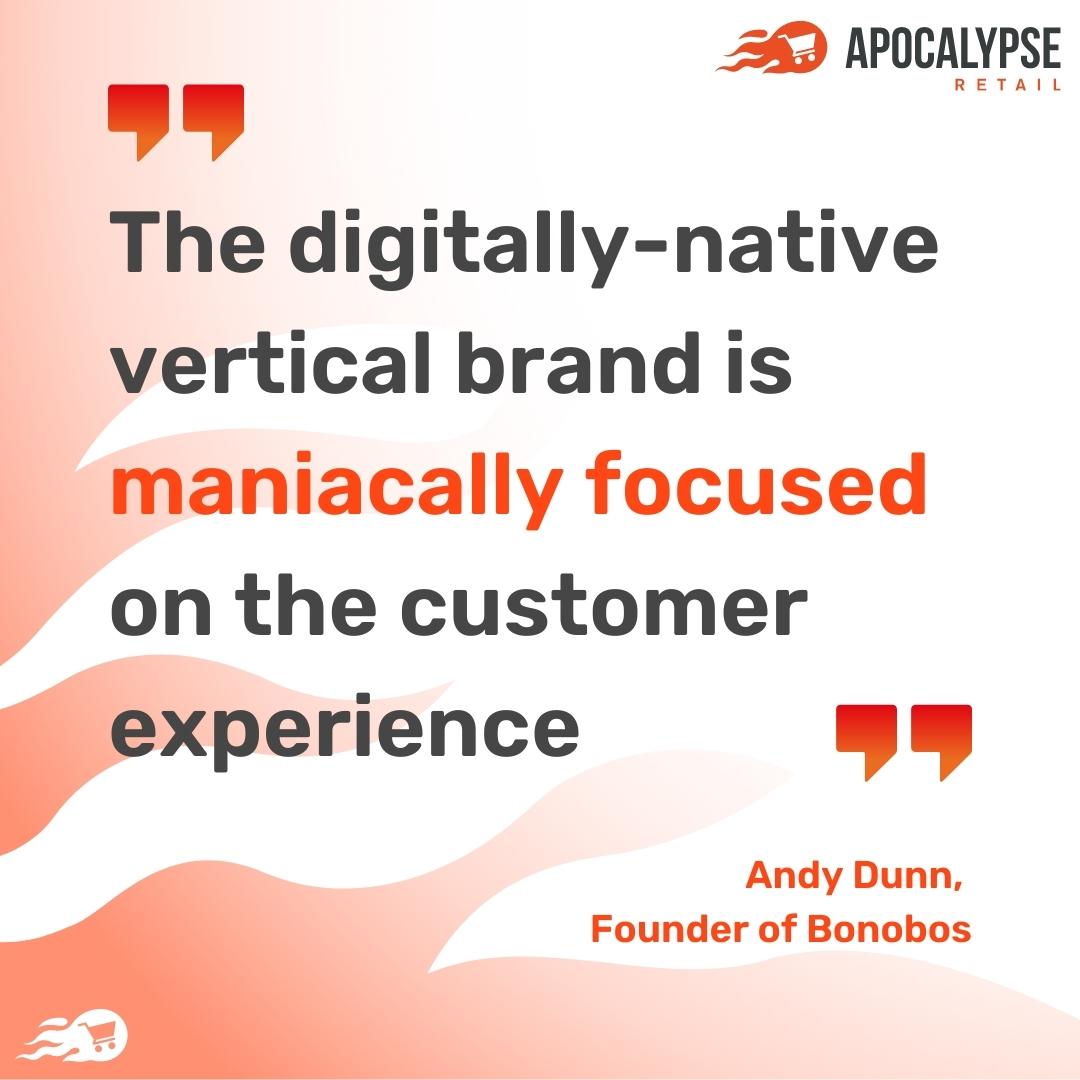
Another key trait of these companies, according to Dunn, is the focus on the customer. In the post, Dunn explained that a “maniacal focus” on customer experience is another common trait of DNVBs.
These companies have an unprecedented focus on the customer as they are obsessed with customer experience. It begins with the quality and design of the products they sell and is constant across the customer journey providing a solid service experience before and after the purchase.
For Dunn, it is also vital to consider that DNVBs should not be viewed as tech companies.
They are indeed brands born online, and they mostly use digital channels. But what they are fundamentally disrupting is the Retail sector as they are Retail companies with a different approach to technology.
What Is The Difference Between DNVB and D2C?

“Digital Native Vertical Brands” companies and “Direct-to-Consumer” companies are phrases that are often used interchangeably. Still, there are some significant differences between the two.
A DNVB is essentially a D2S (direct-to-supplier) and D2C (direct-to-consumer) mixed: a D2S2D2C, if you will.
Direct-to-consumer refers to companies that sell their products directly to consumers without relying on wholesale Retailers (online or offline).
For example, a DNVB is a direct-to-consumer brand, but they also have integrated their supply-side to cut out middlemen such as importers or distributors.
In this sense, a DNVB is a D2C, but not every D2C is a DNVB.
Success Stories: 11 DNVB or Digital Native Vertical Brands in France

Focusing on the French Market, DNVBs work similarly to other countries.
As of 2021, french DNVBs had an estimated annual turnover of €640M and were growing at 3x the average growth of e-commerce players.
With these numbers, it’s undeniable that DNVBs are becoming highly popular in France.
According to the digital native study, as of 2021, there were almost 450 brands identified within the DNVB collective in France, adding more than 100 brands only in 2021.
The one thing where French DNVBs are highly different is that most of them have a solid corporate social responsibility message.
Impact and sustainable Retail is part of the DNA of most of these brands. As we’ll look through examples, most success stories among french DNVBs players are highly focused on making retail more sustainable.
Le Slip Français: Local Manufacturing For Chic French Underwear

Le Slip Français made its mark by creating gender-neutral underwear using 100% french textile manufacturers. This 100% Made-in-France approach has been a critical differentiator for the brand to sustain local manufacturing.
Their motto, “Change fashion, change the world,” really exemplifies the products they make and how they are socially charged.
They’re currently disrupting the fashion industry with a complete catalog of products from underwear to socks and pajamas.
The brand was created in 2011 by Guillaume Gibault, a former HEC Paris student, and, as of 2019, generated more than 24M€ in sales.
They started with a pure online focus selling from their website and currently operate 16 stores in France and sell through Retail wholesalers to generate additional volume.
As of November 2021, the brand had 138k followers on Instagram.
Jimmy Fairly: The French Warby Parker

Jimmy Fairly is a famous French eyewear brand similar to Warby Parker in the US, but with a special french touch. The brand was created in 2011 by Antonin Chartier and Sacha Bostoni, a former HEC Paris student.
They even contacted Warby Parker founders to look for synergies initially but got no reply. So they focused on growing in the french market and concentrated on high-quality eyewear and social consciousness.
For every pair purchased, the company will donate another to someone in need.
Using this social-impact practice, the brand gained significant traction online and built up a reputable brand presence among its followers with the Buy-One-Give-One program.
Back in 2012, Sacha Bostoni said in an interview, “People say we’re a hipster brand, but when we look at our customers, they really love that we’re a brand with convictions.”
As of 2019, the brand had sold more than 280k pairs of glasses and donated the same amount.
This Digital Native Vertical Brand is also an example of a brand that started online but rapidly found the benefits of having physical stores.
The “cosy store” concept is considered one of the fundamental parts of their growth. Currently, Jimmy Fairly has 52 different storefronts around France and 3 in London.
As of November 2021, the brand had 165k followers on Instagram.
Tediber: The French Casper

Tediber is another French brand heavily inspired by another American DNVB, Casper, and a special French touch.
The brand quickly built a reputation with its mission statement: make buying an “Incredible Mattress” affordable and accessible for everyone.
The notion of an “incredible” product has been a trademark of the company as they expanded their catalog with the “incredible bedspring,” the “incredible pillow,” or the “incredible bed sheets.”
The company was launched in 2015 by Julien Sylvain, Juan Pablo Naranjo, Jean-Christophe Orthlieb, and Aude du Colombier.
They’ve found a ton of success by focusing heavily on the purchasing experience. In addition, their 100-day return policy is very generous and helped them build trust with their customers (as a disclaimer, this was the same strategy Casper used in the US).
But the execution in the European markets is what has set Tediber apart, as they’ve harnessed strong support from existing customers. As a result, they boast more than 35k positive reviews on their website.
In the Covid era, the mattress industry was significantly impacted, as mattresses are typically sold in showrooms where consumers can physically try out beds for their comfort level. Tediber offers a more digital experience at an affordable price by cutting out the middleman.
Tediber has jumped to the physical world by opening three different storefronts in Paris, Toulouse, and Lille in the last few years. These stores are showrooms for the brand’s products where customers can effectively test the quality of their “incredible mattress.”
As of November 2021, the brand had 100k followers on Instagram.
Gemmyo: The Jewelry Brand of the Rose Kitten

Gemmyo was created in 2011 to disrupt the jewelry industry.
The company was founded by Pauline Laigneau, former HEC Paris Student, Charif Debs, Malek Debs, Alexis Joseph, and Fanny Boucher.
In the beginning, the brand was exclusively using digital channels to grow.
They smartly used funds raised in 2013 to launch a marketing campaign that significantly increased their brand awareness. They put billboards in the Paris Metro displaying a rose kitten wearing a ring in its right ear.
Gemmyo has implemented technology across its customer journey to provide scalable personalization. Which has become one of their critical differentiators as it is not a common trait in the jewelry industry.
Traditional Retailers in the jewelry industry fail to provide accessible personalization in their products. Using instant messaging like WhatsApp, 3D technology, and Lean Manufacturing, Gemmyo offers unique pieces for their customers according to their needs.
Currently, the company operates four stores in France, which they use as showrooms for their products. They have also launched an online video platform where consumers can speak with a jewelry adviser to ask questions and get answers—a perfect solution in Covid times.
As of November 2021, the brand had 126k followers on Instagram.
Veja: French Sustainable Sneakers with a Brazilian Touch

Veja is one of the “senior” brands on this list.
The brand dates back to 2005 when founded by François-Ghislain Morillion, a former HEC Paris student, and Sébastien Kopp.
Veja is a footwear brand with substantial success in Europe, mixing a clear commitment for ethical Retail and fair trade.
The company has been involved with several Brazilian associations to finance fair trade extraction, ethically sourced cotton, rubber, and leather to make the sneakers.
The brand is exceptionally transparent about the project. It openly discusses the limits of pushing ethical Retail within a digitally native brand that strives to be profitable.
On their website, they openly challenge themselves: “While we’re proud of our sneakers and the way we make them, other questions beg to be answered. Do we really need to buy so many pairs of shoes?”.
Perhaps it’s this honesty and level of transparency that their customers love, as the brand made over 65M€ in sales in 2019, almost doubling the revenues from 2018.
The brand operates three stores in Paris, New York, and Bordeaux and has started selling through multiple online and offline wholesalers.
As of November 2021, the brand had 714k followers on Instagram.
Bobbies: Footwear With a Parisian Chic

Bobbies is another successful French DNVB that sells footwear with a Parisian chic.
The brand was established by Alexis Maugey and Antoine Bolze back in 2010. Since its inception, the brand has focused on designing and producing high-quality leather shoes with a particular “parisian touch” and made-in-Europe.
In addition, the brand’s vertical positioning allows them to offer these products at a much lower price than the competition of luxury leather shoes.
The “parisian chic” has been at the heart of the branding strategy, which has worked very well. The company reported more than 8M€in revenues by 2017 and exceeded the 20M€ bar in 2020.
Many DNVBs use social media to spread brand awareness, as it is relatively inexpensive and does not require the use of a third-party marketing firm.
Bobbies, for example, consolidated a strong community of fans on social media, particularly on Facebook and Instagram. As a result, they have almost half a million combined fans on both platforms.
The brand has jumped to physical Retail by opening three directly owned stores in Paris and Lyon.
The brand controls the entire experience in these stores and provides a unified approach to the “Parisian chic” journey.
They also had a rapid international expansion via wholesale Retailers and other websites. As a result, their shoes are now sold in more than 50 countries.
As of November 2021, the brand had 321k followers on Instagram.
Joone: Baby Care Products That Are Good For The Planet

Joone is a brand that has focused on disrupting the baby care market with a strong sustainability message.
Launched by Carole Juge Llewellyn in 2017, the brand has concentrated on providing the highest quality baby care and skin care products while promoting “radical transparency” in environmental impact.
The brand has taken a radical approach to sustainable Retail, making local production and close-manufacturing circuits a key selling point for their diapers.
The brand boasts that every product in the catalog is manufactured in France, keeping their carbon footprint as low as possible.
In the same vein as German DNVB Lillydoo, founded in 2015, Joone started with a subscription model for diapers that worked.
Amazon had already disrupted the diaper industry with subscriptions, but what set Joone apart is the transparency regarding the sustainability of its products.
This transparency has appealed to many French parents looking for less polluting diapers for their kids.
This brand also focuses on a transparent DNVB that utilizes a subscription model rather than your typical browse-and-buy D2C approach.
Joone is very transparent about its pricing and requires no commitment to use its service. Parents can enjoy a whole month’s diapers supply regularly. The service is set up to be customizable according to use and the number of children consumers have. If you purchase a product that isn’t a good fit, you can easily send it back.
Even if baby care products have been at the core of their catalog, Joone has expanded to women’s skincare products. Following the brand’s mission about transparency, they are aggressively expanding to disrupt the sustainable skincare market.
As of November 2021, the brand had 79k followers on Instagram.
Respire: Bringing Sustainability to the Skincare Industry

Respire is another brand disrupting the skincare industry with an ethical approach.
This success story is a favorite of ours as it combines excellent story-telling with the right mix of personal and company branding—all of this, of course, with fantastic execution to sustain scalable growth.
The brand was founded in 2018 by Justine Hutteau and Thomas Méheut, a former HEC Paris student. The company launched via crowdfunding focused on creating a natural made-in-France deodorant.
The crowdfunding quickly gained traction using a compelling story of how Justine Hutteau was diagnosed with a benign tumor.
After being diagnosed, she started paying attention to the ingredients and components of her skincare products. She quickly realized that there was no product made from natural products, so she decided to create it.
Justine already had a strong community of Instagram followers, which she used to provide traction for crowdfunding. As a result, the crowdfunding had raised more than 200k€, selling 21k products in just a month.
After the initial success with the crowdfunding, Respire has built a fantastic community in just under two years. They started selling through big Retail wholesalers like Monoprix and Sephora, building solid brand awareness.
The brand sold 800k products in its first year and added products to the catalog, from shampoo to sunscreen.
It has efficiently used a subscription-based model as consumers can automatically deliver their products at a specified frequency. In addition, by subscribing instead of directly buying, customers can enjoy percentage-based discounts.
Their ambition is to become the leading skincare company in Europe by 2030, which may seem far-fetched. But given the initial success, it shouldn’t be impossible.
As of November 2021, the brand had 157k followers on Instagram.
Bergamotte: Digitalizing The Flower Revolution To Make it Sustainable

Bergamotte is a digitally native vertical brand created and launched in Paris in 2016 by Romain Raffard and Loïc Reperant.
In the same vein as Colvin, which launched in Spain in 2015, Bergamotte intends to disrupt the flower industry. This industry historically struggled to grow in e-commerce due to the complexity of distribution and shipping for its products.
What has set Bergamotte apart in brand positioning is its push to make the flower industry more sustainable. The brand’s mission is to build a “greener future,” which they follow with impressive transparency about their carbon footprint.
The company has a clear commitment to reducing its products’ carbon footprint, and since 2020 commits to selling European-only plants and flowers.
This approach is radically different from the rest of the french flower industry, as 85% of flowers sold come from abroad.
This approach to making the industry more sustainable has found an audience within french customers. The brand has built a community of close to 200k followers on social media.
As of November 2021, the brand had 190k followers on Instagram.
Tiptoe: Sustainable Furniture With Modular Table Legs

Tiptoe is a sustainable furniture manufacturer and distributor founded in Paris in 2015 by Matthieu Bourgeaux and Vincent Quesada.
The two founders launched the brand via crowdfunding to create a well-designed, sustainable, modular table leg that made furniture affordable.
Then, building on their impeccable table leg design, they added new products to the catalog, including dining tables, bedside tables, desks, and chairs.
They found significant success in the furniture sector by providing an excellent online shopping experience that does not require a physical showroom.
In addition, the brand focused on having fantastic product photography and showcasing its sustainability practices in all its communications.
In an industry that focuses on delivering fast furniture or “disposable” furniture cheaply made, Tiptoe takes an approach to create timeless furniture pieces affordable and high-quality.
The brand has found a large audience in Europe by educating consumers about the environmental impact of mass-scale furniture disposal.
As of November 2021, the brand had 207k followers on Instagram.
Tikamoon: Made To Order French Decoration

Tikamoon is another furniture and home goods brand that successfully became a digitally native vertical brand in France.
Like Tiptoe, this brand focuses on designing furniture that lasts, rather than disposable, cheap items.
The brand was founded in Lille in 2007, and after several years it was acquired by the Adeo Group, one of the largest home improvement companies globally. In 2021, the founders regained complete control of the company separating from the Adeo Group.
Despite being part of a large group for some time, Tikamoon kept significant autonomy and boasted its Digitally Native Vertical Brand status since inception.
The brand is exclusively sold online, and most of the brand’s products are made-to-order. This feature could be limited in lead times, but the brand has done a great job explaining longer lead times to their customers.
As of November 2021, the brand had 104k followers on Instagram.
If you know other players to include in this list, drop us an email, and we’ll add them.
Do you want more insights into E-commerce, Omnichannel Retail, and Digital Transformation? Subscribe to ApocalypseRetail to get insights sent directly to your inbox. Our content is designed for top business schools, retail managers, and eCommerce entrepreneurs who want to survive in the ever-volatile retail industry. Subscribe to our newsletter to join the fight against the Retail Apocalypse!
The post DNVB: 11 Digital Native Vertical Brands That Are Disrupting French Retail appeared first on Apocalypse Retail.
]]>The post Six Steps to Deploy an Omnichannel Strategy to Survive the Retail Apocalypse appeared first on Apocalypse Retail.
]]>Every retailer, whether online or offline, must deploy an omnichannel strategy to unlock the full value of the omnichannel customer.
The goal of an omnichannel strategy is not simply having an online and a physical store. It is providing a unified and consistent experience across touchpoints in the customer journey to increase customer retention.
Over our last posts, we’ve covered in detail the five pillars of an Omnichannel Strategy, but we’ll do our best summary on this post.
These are the Five Pillars of an Omnichannel Strategy
A bulletproof omnichannel strategy requires addressing the five pillars of Omnichannel Retail.

The five pillars of Omnichannel Retail are:
- Omnichannel 360º View of the Customer
- Omnichannel Customer Engagement
- Omnichannel Fulfillment & Logistics
- Omnichannel Product Offering, and Merchandising
- Omnichannel Backoffice: Finance, IT & HR
A company must understand its customers and their journeys deeply, which can only be achieved with a 360º view of the customer across all their company touchpoints.
Once the company has built this view of the customer, they can start deploying the following pillars.
They can build an Omnichannel customer and content engagement strategy to offer excellent customer experience and scalable personalization.
Then, with an omnichannel fulfillment strategy, the company can offer fulfillment options to meet the customer when and where they want.
To complete this, with an omnichannel product offering strategy, a company builds trust with its customers.
Finally, an omnichannel back-office structure ties everything together with the proper organization, systems, and structure for omnichannel retail.
After this recap, it is essential to understand that an omnichannel strategy implies a complete transformation of the company.
The Omnichannel Transformation Must Be Met At Every Level Of The Company
We’ve discussed the need to implement an omnichannel back office for companies that want to survive the retail apocalypse.
We’ve discussed a complete change in the culture, organization, technology, and KPIs.
The final step is that a company must make sure that the transformation happens at every company level.
From top to bottom, every single company employee must be aligned with the omnichannel vision and have the right processes, technology, and metrics to deploy it.
The problem is that, according to research, most retailers fail to cover these last steps. As a result, they fail to implement the omnichannel back office, despite the management having the right vision.

As the poll among retail professionals suggests, most retail company CEOs and C-level have understood the need to implement an omnichannel strategy.
But only about half of professionals believe they have the right processes, technology, and metrics to implement the strategy.
Companies must understand that management and vision will only get them so far.
If they don’t implement the proper omnichannel back office, they won’t lead the company towards a true omnichannel strategy.
Six Steps To Implement An Omnichannel Strategy in Retail

We have provided over a dozen posts explaining the need to implement an omnichannel strategy.
In each post, we have provided detailed guidelines covering the five pillars of an omnichannel strategy.
When we advise companies on their omnichannel transformation, we find it very helpful to sum everything into six steps every company must follow.
- Build a deep understanding of your customer
- Gather, unify and structure your data
- Build a detailed map of your customer journeys
- Build your own omnichannel roadmap
- Establish OKRs aligned with your omnichannel roadmap
- Continuous improvement
1. Build a Deep Understanding of Your Customer: A 360 View Of The Customer

Deeply understanding your customer is the foundation of an omnichannel strategy.
A company must understand who their customers are, how they shop when they buy, and what channels they use?
In the end, they need to understand what is the number one reason why customers buy from them.
2. Gather, Unify and Structure Your Customer Data for Scalable Personalization

Companies must bring the total value of their first-party data. Therefore, they need to have a customer data-gathering strategy across channels. A loyalty program is handy for this.
On top of gathering customer data, they need to structure and unify all the data and connect it to the right content.
The end goal is to provide relevant, meaningful interactions with customers at every step of the journey.
A Customer Data Platform, Data Management Platform, and Digital Asset Management solution are IT tools that can make the whole process scalable.
3. Build a Detailed Map of Your Customer Journeys

Once the company clearly understands their customers and has analyzed the data, they can build detailed maps of their customer journeys.
Customer journeys identify behaviors and patterns that will improve the chances of a visitor becoming a shopper. Or a shopper becoming a regular customer.
A detailed map of the customer journeys helps provide the right interactions for customers. The company sends the right messages to move the customer closer to a transaction at every step of the trip.
For this, you must answer questions about your customers and the channels they use to engage with your company:
- What is the number one reason a customer buys from you instead of your competition?
- How do customers discover your brand?
- Ho do they research your producs or services?
- What channels or touchpoints do they use?
- How often do they make a purchase ?
- How much does it cost to acquire a customer, and how profitable are they?
- Would the recommend or refer you to their friends?
4. Build Your Own Omnichannel Roadmap

Every single company will have a unique omnichannel roadmap according to its context and resources.
They will need to assess which features they lack regarding customer engagement, fulfillment options, product offering, and BackOffice.
They can design a roadmap to tackle each of these features in terms of investment and the resources they require.
To build the roadmap, we generally advise two things:
- First, organize tasks on what can be done now, in twelve months or three years. Some tasks will require significant resources, so this helps companies focus on quick wins without skipping longer tasks.
- Second, focus on existing customer pain points rather than providing new experiences. Before launching a shiny new experience, companies should focus resources on ensuring that existing channels provide a great experience.
5. Establish OKRs Aligned with Your Omnichannel Roadmap
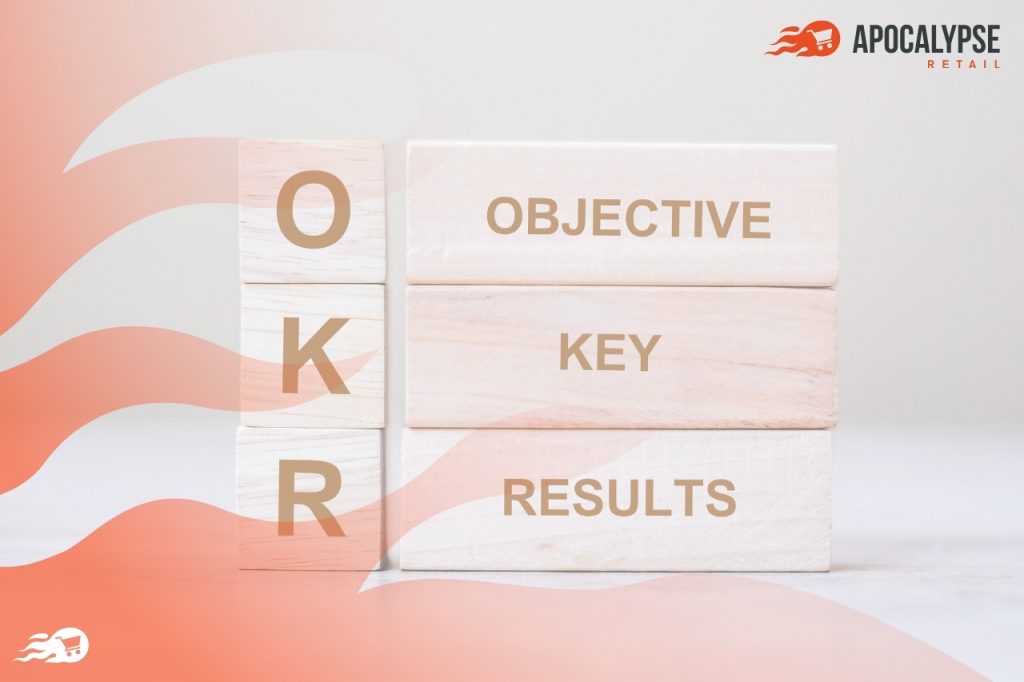
Management by Objectives and Key Results is one of the best methodologies to ensure that all teams are aligned.
Once you have designed your omnichannel roadmap, ensure that your entire organization is focused on deploying that roadmap and measuring the positive effects it generates.
This methodology helps teams prioritize projects and focus on the right objectives.
6. An Omnichannel Strategy Reuires Continuous Improvement

As you continuously gather data and analyze your customer behavior, you can constantly improve your omnichannel experience.
An omnichannel strategy is not just something you deploy once and forget. It’s a process to continuously make changes in the customer journey according to the customer’s context.
With this process, companies can quickly identify changes in consumer behavior and adapt to them. In turn, they are providing the best possible customer experience.
Adding value to the customer experience is a continuous improvement process. If you don’t keep on improving your processes, your competitors will.
In today’s retail, this is the key to surviving the retail apocalypse.
Do you want more insights into E-commerce, Omnichannel Retail, and Digital Transformation? Subscribe to ApocalypseRetail to get insights sent directly to your inbox. Our content is designed for top business schools, retail managers, and eCommerce entrepreneurs who want to survive in the ever-volatile retail industry. Subscribe to our newsletter to join the fight against the Retail Apocalypse!
The post Six Steps to Deploy an Omnichannel Strategy to Survive the Retail Apocalypse appeared first on Apocalypse Retail.
]]>The post The Real Value of the Physical Store in an Omnichannel Strategy appeared first on Apocalypse Retail.
]]>People often assume that an omnichannel strategy depends entirely on digital channels. But this completely misses the real value of the physical store in an omnichannel strategy.
As we said in one of our previous posts, Omnichannel is one of the most frequently used buzzwords in retail today.
But, the reality is that a true Omnichannel strategy for traditional retailers is not launching a website and selling online. Or, if you are a pure player, opening a physical store doesn’t make you an Omnichannel company.
Selling online or offline are just traits of a Multichannel strategy.
A Multichannel strategy is where a company meets the customers where they are, whether on their website, social media, email, or physical stores.
The key difference with an Omnichannel strategy is the consistency of the customer experience.
An Omnichannel strategy unifies a consistent customer journey across every single channel.
Let’s cover again why all retailers need to implement an omnichannel strategy.
An Omnichannel Strategy is Needed to fill the Existing Friction of the Mobile Experience

A lot of e-commerce pure players can see exponential growth during the years. This has led some to believe they can be pure online players indefinitely.
But if we look closer at those e-commerce players that are a bit more “senior,” most have started opening physical stores.
Amazon and Alibaba, the world’s e-commerce juggernauts, have aggressively expanded offline. Even some Digital Native Vertical Brands (DNVB) have jumped offline in recent years.
The reality is that even if online retail penetration is growing fast, the offline part of the market is still huge.
As Jeff Bezos put it in a letter to Amazon shareholders back in 2019:
“Amazon today remains a small player in global retail. We represent a low single-digit percentage of the retail market, and there are much larger retailers in every country where we operate. And that’s largely because nearly 90% of retail remains offline, in brick and mortar stores.”
Even if we consider that a quarter of global retail sales will be online by 2030, that still lets 75% of transactions offline.
So what is slowing online retail penetration?
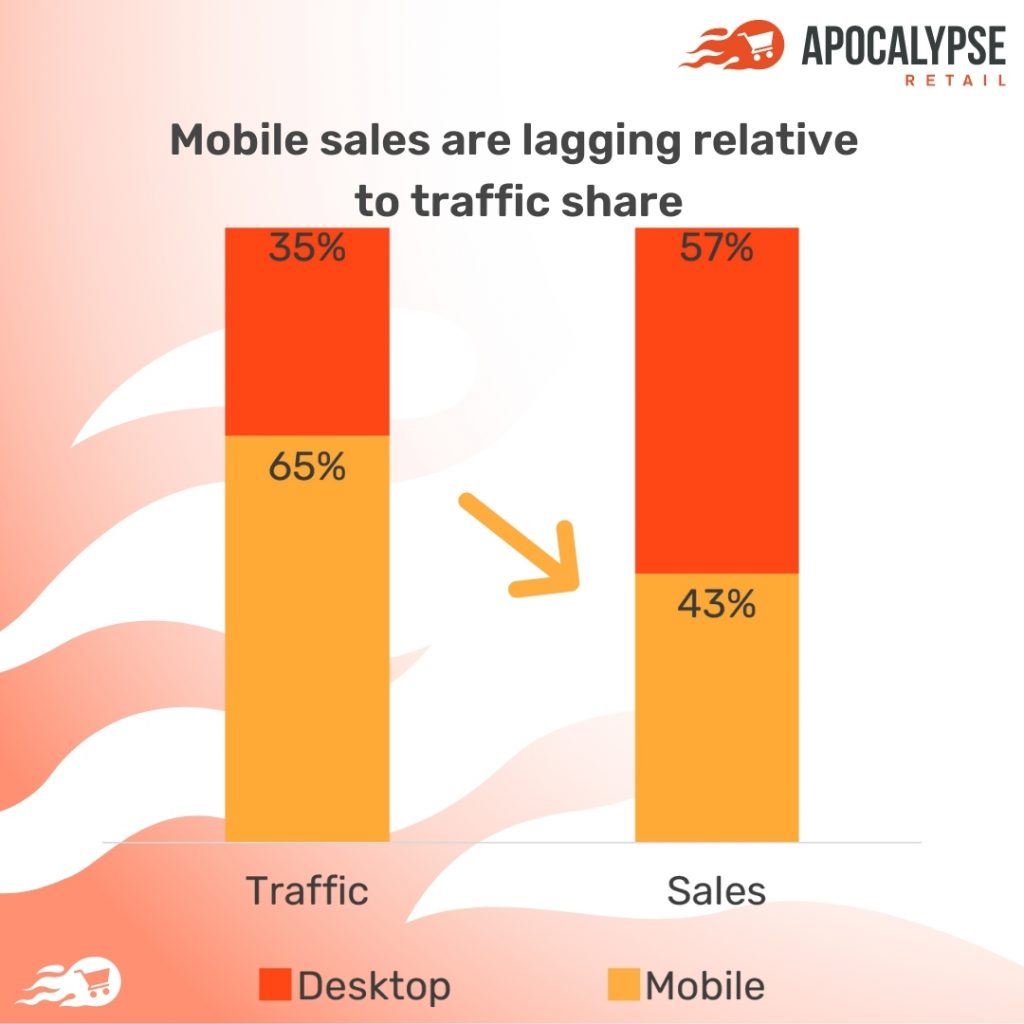
Mobile sales are lagging relative to traffic share.
Today, everyone and their mother has a smartphone. Both in developed countries and emerging markets, most adult consumers have a smartphone.
And they use those smartphones to go online to research and discover products or information. Or to chat or browse on social media.
As of 2020, mobile visitors represent almost two-thirds of global online traffic. But the problem is that it only represents 43% of global online transactions.
There is a clear drop in transactions relative to traffic.
Mobile conversion is also lagging relative to other devices.

Image Source: Apocalypse Retail 2021. Why do Retail companies need to implement an Omnichannel Strategy? Bernstein E-commerce Outlook September 2020
The drop in transactions relative to traffic is essentially due to much lower conversion rates than other devices.
If we deep dive by device, mobile conversion rates are meager compared to other devices. And this trend has been sustained for almost a decade.
Let’s compare conversion rates between devices from 2013 to 2019. In both years, conversion rates are almost 3x lower than desktop and 2x lower than tablet conversion rates.
Indeed, smartphone conversion rates improved more during that period than the other devices. But mobile conversion rates remain way too low.
The reality is that most websites are not designed for mobile-first.
Most websites are designed for a larger, easier-to-use desktop screen. And when users try to use it on mobile, it doesn’t respond in the same way.
The hard truth is that the mobile user experience is very hard to improve. At least to reach the same conversion rates as other devices.
So there will continue to be friction in the mobile customer journey which affects almost two-thirds of all online visitors and rising.
But how does mobile fare compared to the physical experience?
Customers still prefer in-store experience compared to mobile.

If the mobile experience is worse for purchase than other devices, the same can be said compared to physical stores.
Mobile traffic has increased exponentially, but the shopping behavior still favors offline stores.
Customers prefer to discover and shop for products in offline stores. Most product discovery is still offline, and customers will do most of the research on mobile devices.
In the end, even if mobile transactions are on the rise, most customers still prefer to shop offline.
The reality is that the physical experience offers something unique.
The value of the physical store and why all retailers must implement an omnichannel strategy
The Physical Store has a Unique Value Proposition

The most bullish e-commerce advocate will say that the physical store is dead. But when we started Apocalypse Retail, we were convinced this statement is wrong.
We don’t mean to give false hope to traditional retailers.
A lot, if not most, of legacy retailers, will perish in the Retail Apocalypse. But this doesn’t mean the end of brick-and-mortar Retail. Instead, it means the end of legacy brick-and-mortar Retail.
When analyzing online and offline retail customer journeys, it is clear that companies don’t have to choose between one or the other.
Both have entirely different value propositions.
The online experience offers convenience more than anything while the offline experience offers… the physical experience.
The offline experience offers human interaction, touching, trying on, seeing, smelling a product. These are all real, value-added experiences that profoundly impact customers.
The physical store has a unique value proposition that is not going to disappear.
The physical store must reinvent itself.

Most legacy retailers have been overconfident about the value of the physical store. And this has led them to keep using the same brick-and-mortar strategies that worked for the past 30 years.
But by doing so, they have been ignoring a massive shift in consumer behavior.
Consumers crave convenience more than anything. And the online experience is built to provide consumers with convenience.
The physical experience, by definition, requires a physical effort. So the physical store will never be able to compete in terms of convenience.
To survive the Retail Apocalypse, the store must reinvent itself. The physical store must be built and designed on everything that won’t be able to be provided online.
The unique value proposition from the store is its core strength.
As we said before, physical stores offer human interaction, touching, trying on, seeing, smelling a product. Retailers that understand this will change the way they approach physical stores.
But unfortunately, legacy retailers still approach the physical experience as they’ve always done. They continue looking at the store as a point of sale measured in terms of Sales/m2.
This completely fails to understand that customers are not exclusive to single-channel journeys. Retailers try to cram as much stock as possible in stores to maximize profitability per m2.
But a physical store is, above everything else, a customer touchpoint. And thus, it should be treated as a marketing channel. Marketing in the sense that it should be designed to attract visitors.
Whether the visitor completes the purchase online or offline is irrelevant. It should be a seamless customer journey.
The physical store provides a showroom where the customer can get everything they can’t get online. The whole package to try, test, and experience the product.
The rest of the journey will always be more convenient online. So, stores must be built and designed to maximize the customer’s physical experience.
Pure Players are Jumping Offline with a Different Approach to the Physical Store

As we said before, most e-commerce pure-players are jumping offline once they reach a certain point.
Amazon, for example, has invested massively in its offline expansion. Not only the Whole Foods acquisition but opening multiple Amazon Go stores with connected carts.
But the approach to physical retail is completely entirely different from the one used by traditional retailers.
Off-course, e-commerce players are looking to increase revenues when they jump offline. But this is only part of the offline strategy.
The offline strategy from e-commerce players is built on two things:
- The physical store is a data acquisition channel
- The physical store is a marketing channel
1. The Physical Store as a Data Acquisition Channel

Amazon is one of the best examples of this strategy.
Imagine you have one of the most powerful customer-data-gathering empires in the world. But this empire is built exclusively for online transactions.
As Jeff Bezos stated, Amazon only represents a fraction of the entire Retail market. And almost three-quarters of all retail transactions will still be done offline by 2030.
So even if they perfected an online data-gathering platform, Amazon “only” has access to a small part of the customer journey.
Now, imagine tracking a customer in your offline store with the same level of detail you can track them in an online store.
Knowing which products they viewed, which ones they added or removed to their cart, when they entered or left, etc. And connect this offline data with the online data you already have of the same customer.
The potential to have an accurate 360º view of the customer is limitless.
This is the way a company can offer relevant, consistent content across channels. And increase their customer retention rates, revenues, and profitability in the long run.
This explains why Amazon is aggressively expanding offline and, as of 2021, the company already operates more than 600 physical stores in the US.
2. The Physical Store as a Marketing Channel

E-commerce pure players much smaller than Amazon are also opening stores.
DNVBs such as Casper, Bonobos, or Le Slip Français in France have opened physical stores. But they have centered the entire offline experience on everything that their online stores could not offer.
The stores are designed as showrooms that offer a consistent value proposition to customers.
In the same way that these brands have disrupted their consumer categories, they are doing the same thing for offline retail.
For a DNVB, the physical store is, above all, a marketing channel. And they will treat it with the same data-driven approach that they use for every digital marketing channel.
The end goal of physical stores is to acquire more potential customers and raise brand awareness.
If the visitor converts offline, it’s a win-win, but if the visitor at least gives their contact info, it’s also a win.
They have just captured a lead. And they will use their deep understanding of the digital funnel to try and convert that lead into a customer.
In the end, it’s all about making sure that the Lifetime Value (LTV) of the Customer is higher than its customer acquisition cost (CAC).
If the CAC also includes the cost of a physical store, it’s because these brands are betting the LTV will also be higher.
DNVBs have understood the fundamental truth about Omnichannel Retail: The value provided by a unified customer experience across channels is greater than the sum of its parts.
Do you want more insights into E-commerce, Omnichannel Retail, and Digital Transformation? Subscribe to ApocalypseRetail to get insights sent directly to your inbox. Our content is designed for top business schools, retail managers, and eCommerce entrepreneurs who want to survive in the ever-volatile retail industry. Subscribe to our newsletter to join the fight against the Retail Apocalypse!
The post The Real Value of the Physical Store in an Omnichannel Strategy appeared first on Apocalypse Retail.
]]>The post An Omnichannel Backoffice Completes a Bulletproof Omnichannel Strategy to Survive the Retail Apocalypse appeared first on Apocalypse Retail.
]]>It is the last of the five pillars that we’ve explained in our previous posts.
What are the Five Pillars of an Omnichannel Strategy?
To deploy a true Omnichannel strategy, a company needs to address the five pillars of Omnichannel Retail.
The five pillars of Omnichannel Retail are:
- Omnichannel 360º View of the Customer
- Omnichannel Customer Engagement
- Omnichannel Fulfillment & Logistics
- Omnichannel Product Offering, and Merchandising
- Omnichannel Backoffice: Finance, IT & HR
In our previous posts, we’ve covered the first four pillars extensively.
A company must understand its customers and their journeys deeply. This can only be achieved with a 360º view of the customer across all their company touchpoints.
Once the company has built this view of the customer, they can start deploying the following pillars.
They can build an Omnichannel customer and content engagement strategy. With it, they can offer the holy grail of customer experience: scalable personalization.
In parallel, the company can implement an omnichannel fulfillment strategy. With it, they can offer fulfillment options to meet the customer when and where they want.
Another pillar is to deploy an omnichannel pricing and product offering strategy. With this strategy, the company offers consistent prices and products to build trust with its customers.
So no matter the channel, the customer knows the company is reliable and trustworthy.
Finally, the company will have to ensure its entire back-office structure is ready for an Omnichannel strategy. This means deploying an omnichannel back-office structure for Finance, IT, and HR teams.
This is the backbone that makes everything work together.
In this post, we’ll deep dive into what is an omnichannel backoffice and why it’s the final step to a proper omnichannel strategy.
An Omnichannel Backoffice Requires a Complete Transformation of a Company

We have covered why companies need to deploy an omnichannel strategy to survive the Retail Apocalypse. However, to deploy it, a company must address the five pillars of an omnichannel strategy.
The last pillar, the omnichannel Backoffice, is the only pillar we haven’t addressed in detail yet.
We left this pillar for the end because it’s the pillar that ties everything together. Deploying an omnichannel backoffice means pushing a complete transformation of a company.
This transformation must impact the very core of the company. It must impact its Culture, Organization, Technology, and Reporting.
In other words, a company must implement its digital transformation at every level.
An Omnichannel Backoffice Requires the Transformation of the Company’s Culture

There is a significant human impact from digital transformation, which legacy retailers most heavily feel.
Companies that lived through the golden years of brick-and-mortar retail but are now struggling to cope with the changes in consumer behavior.
To transform a company’s culture, the company’s management must:
- Upskill and train when possible
- Hire new talent and skills when needed
- Make sure cultural integration goes both ways
- Adapt company policies
- Invest in change management
So let’s look at these five steps in detail:
1. Upskill and train when possible
Companies fail when they try to put people in new roles that they don’t fully understand. Or they simply lack the technical skills required for the position.
Ideally, a company will invest in training its employees to learn new skills through a process that is called up-skilling or re-skilling.
The biggest benefit of upskilling is that it allows the company to internalize skills with existing resources. Very often, the financial cost of training will be cheaper than the cost of a new hire.
But companies need to understand when they can train and when they need to hire.
The cost of training is not only the money invested in training; it is also the time invested.
Some skills in digital roles or IT can only be mastered through years of experience.
A company’s worst mistake is assuming that employees will be fully operational in new roles with some training.
The company must then decide when they have the time to train and when they need to hire.
2. Hire new talent and skills and follow their lead
A company that wants to implement its digital transformation will inevitably need to hire talent.
As we said before, some skills take too long to master.
And in today’s Retail Apocalypse, very few companies have the time to wait for training to yield its benefits.
But hiring talent is only part of the solution.
Many companies think that transformation happens only by hiring new people. But hiring people is useless if new hires are not given the resources and leeway to implement changes.
For example, hiring a data scientist is useless if the company doesn’t have the resources to invest in IT solutions like a customer data platform.
When hiring talent for their digital transformation, companies should follow the advice of Steve Jobs:
“It doesn’t make sense to hire smart people and tell them what to do; we hire smart people so they can tell us what to do.”
Investing in new talent must be accompanied by a willingness to follow their lead.
3. Make sure cultural integration goes both ways
It is paramount for companies and new hires to understand that cultural integration goes both ways.
The people currently in the company must understand the need for new hires. They must understand why these skills are needed and make sure to integrate them into the company.
At the same time, new hires also need to make an integration effort. They must make a significant pedagogical effort to explain their jobs and the need for some things to change. It is much easier to implement change when people fully understand the benefits.
In both cases, new hires and existing employees must understand that digital transformation doesn’t happen in a day.
It takes significant effort and time to implement a digital transformation. But the process is much easier when it is a team effort.
So companies need to nurture an environment where new hires and existing employees can work effectively.
4. Adapt company policies
Legacy companies tend to have legacy company policies.
Company policies can make it extremely difficult to hire new talent, especially for digitally native talent that is used to some perks.
The good thing is that the Covid19 pandemic has forced many companies to adapt to new ways of work, whether it’s remote work or simply the use of certain technologies in day-to-day conversations.
The pandemic has profoundly disrupted company policies. But once things start to get to the “new normal,” companies need to make sure that their company policies align with the times.
5. Invest in change management
Change is hard. And if employees and managers are not prepared, it can be really, really hard.
As human beings, we are programmed to dislike change. It makes us uncomfortable and generates tension to adapt to new behavior.
But change is also a source of opportunities. With proper implementation, we would argue that change can be one of the main growth drivers for the company and people’s careers.
So companies need to embrace change.
But they must make sure it is not disruptive and that employees are ready to embrace it.
A successful Change process cannot be achieved without clear and effective communication.
Thus, companies need to implement the right tools for effective communication and train their managers to deploy a change strategy.
Managers need to have a clear vision and understanding of the change process. And they need to understand how it will impact its internal and external processes.
With it, they can deploy an effective communication strategy with the rest of the employees so that change is accepted and understood.
An Omnichannel Backoffice Requires a Transformation of the Company’s Organization

A proper omnichannel strategy is impossible to achieve with an organization built for single or multichannel retail.
One of the most critical challenges to implementing an omnichannel company transformation is effective communication between teams.
As we said before, it is paramount for managers to be appropriately trained to promote Change management and effective communication.
But effective communication is not only vertical; it is also horizontal.
The organization must be structured to break silos, promote project management methodologies, and put the customer first across the board.
1. Break organizational silos and mindset
When companies are dealing with a single channel, it often makes sense to have vertical organizations.
With a multichannel approach, companies can also keep their organizational silos by channel.
But with an omnichannel approach, it is impossible to create a consistent customer experience without a transverse structure.
Marketing, Sales, IT, Customer Service, Logistic, and Finance teams must be aligned to provide the best possible customer experience.
In this sense, it is not only a matter of breaking the silo organization. It is also crucial to break the silo mindset.
Too often, teams work only to improve their direct impact KPIs, but they don’t care if it creates an issue down the line.
For example, suppose the sales team is only driven by revenues and gross margin. In that case, they will push products with a high chance to generate revenues and healthy gross margins.
But what happens if products are too fragile and break easily in e-commerce logistics? Or the quality of the product is terrible, and it generates a lot of customer service contacts?
In this case, the sales team must have an incentive to drive sales and gross margin. But they also need incentives to ensure the overall customer experience remains excellent.
This is where it is critical to implement transverse Objectives and Key Results (OKR).
The OKR methodology is very efficient in putting different teams to work on common objectives. And drive specific KPI improvements that improve the overall customer experience.
In the end, an omnichannel approach requires teams to work together and put the customer first.
2. Promote project management methodologies
There are plenty of project management methodologies. Whether it’s Agile, Scrum, Kanban, Lean, etc., companies have plenty of choices.
We are pretty much convinced that the OKR methodology is amazing to align transverse organizations.
But regarding project management methodologies, we don’t have a specific one to recommend. Some are great for IT projects, and others are great for logistics projects.
The crucial part is a structured approach to deliver small, iterative results to build a long-term project. And all stakeholders in the project must have a role to play.
Legacy companies used to embark on projects that would take years to complete. And very often, the project is driven by a single team without effective communication with other teams.
With a digital transformation approach, companies must train their employees to understand and deploy project management methodologies.
By doing so, they can cut costs and drive effective, meaningful change within the company.
3. Customer experience prevails over company obstacles
Companies and managers need to understand that omnichannel transformation takes time.
And a transformation of the organization is not done overnight.
The problem is that customers want an omnichannel experience now. And if the company isn’t ready to provide it, other companies will be ready.
So while the company is engaged in its transformation, it must ensure that the current organization is not hindering the customer experience.
This is one of the hardest things for retail managers to get right. Too often, existing flaws in the organization hurt the overall customer experience.
For example, a company that wants to launch a specific discount campaign for customers. But due to legacy systems, they can’t give the same discount rules online and offline. So, they push for a channel-exclusive campaign, whether it’s online or offline.
In this case, the marketing and IT teams should have worked around the company obstacle (legacy systems) to make a discount campaign deployed across all channels.
The solution will not always be so obvious. But the main idea is that the customer experience should always prevail over company obstacles.
If there is an obstacle, the organization must always have the proper communication and objectives to put the customer experience first.
An Omnichannel Backoffice Requires a Transformation of the Company’s Technology Architecture
Move from a monolithic to a microservice tech architecture.

Everyone understands that there is no Digital Transformation without a technology change.
When we say that a company must implement a technology change, we are not saying to change one or two systems.
The company must implement a complete revamp of its technology stack, processes, and project methodologies.
In the 90s and early 2000s, most legacy companies built their entire technology stack around a single system.
The monolithic tech architecture was built as a tool for a single-channel approach, particularly around physical stores. But with the rise of multichannel and now omnichannel retail, a monolithic tech architecture has become obsolete.
Companies that failed to revamp their tech stack a decade ago with the rise of online retail are now rushing to update every system. But if not done correctly, a complete change in the technology stack can bankrupt a company.
What is monolithic tech architecture?

A monolithic tech architecture is essentially one single, multi-use technology platform that is closed to other technologies.
A company may use a few other tools on top of their monolithic platforms, but the monolith is generally the critical tech solution driving its organizational functionality.
In layman’s terms, this means that a single platform with different applications controls a company’s entire technology.
These applications are tightly coupled and cover different needs of a company, from marketing to sales, customer service, finance, or even logistics.
All the company applications are built around four parts which are tightly bound together.
In particular, all applications are built around:
- a single database which concentrates the company’s entire data in many data tables, and
- a single data access layer that connects the database to the internal or external user interface.
Given the amount of data and applications, tech monoliths tend to have huge codebases. Thus, making even the slightest change or adding a feature requires testing and verifying the entire platform.
This makes small iterative tests incredibly difficult, which undercuts a company’s agility and scalability.
What is microservices tech architecture?

A microservices tech architecture involves smaller independent applications that answer to specific business logic requirements.
These microservices are generally connected via application integration (APIs). This allows them to be easily plugged or unplugged to the user interface or other microservices.
This is the basis of a microservices architecture: it is an open tech architecture.
As these applications are smaller in scope and size, it is easier to improve and add features. Which, in turn, makes the entire tech process more scalable.
Given the rapidly changing retail environment, a microservices tech architecture is best suited for companies that want to implement an omnichannel approach.
Six must-have IT solutions for omnichannel retail

An omnichannel strategy requires a microservices tech stack.
But there are specific IT solutions that a company must implement to sustain an omnichannel approach.
To select the right solutions, a company must ensure that the tool answers a business requirement and is easily plugged into the rest of the tech stack.
IT solutions for Omnichannel Engagement:

Omnichannel Engagement is providing consistent engagement and interactions to customers across channels.
The holy grail of omnichannel engagement is to send the right message, to the right customer, at the right time. In other words, make every interaction personal and relevant for customers.
But to make the process scalable, a company will need specific tools to automate hundreds or thousands of interactions.
1. CRM:
Customer Relationship Management software allows a company to offer a unique and seamless experience.
When properly integrated, a CRM can provide a complete picture of all customer interactions, whether pre-purchase or post-purchase.
For pre-purchase interactions, a good CRM tool allows identifying, segmenting, and nurturing leads for potential customers. For post-purchase interactions, the tool enables increased customer engagement and retention, on top of providing better customer support.
In an omnichannel approach, it is paramount for companies to deploy a unique CRM tool for every channel. By doing this, the company will gather invaluable data about customer interactions and behavior across channels.
2. CDP / DMP:
A Customer Data Platform and a Data Management Platform are complementary solutions to generate smarter, scalable customer communications.
A CDP integrates first-party data into a single platform and applies artificial intelligence to search for common customer behavior patterns. Doing so makes it easier for marketing and sales teams to segment and understand their existing customers.
A DMP will enrich first-party data with third-party data to generate smarter customer communications. This third-party data can come via cookies or external databases with demographic, weather, or competitors’ data.
In the golden age of Cookie-web browsing, DMPs allowed for gathering data from third-party websites. This practice is slowly disappearing with data-privacy regulations, but DMPs can still enrich data with external databases.
For example, having accurate weather information can allow a company to send relevant communications to customers. A simple use case would be for a company that sells umbrellas to send communications when it’s raining in a particular city. As a result, the chances of conversion will be much higher.
A CDP will have a broader scope across marketing, sales, and customer service teams. A DMP is more specific to advertising to improve media buying efficiency.
3. DAM:
Digital Asset Management software allows to store, share and organize digital assets efficiently.
Digital assets are essentially digital content: photos, videos, music, documents, and other media. When these files contain rights to use them, they are considered an asset of the company.
A DAM is crucial to easily find and share digital content among teams, which increases productivity But a DAM can also automate workflows to make marketing campaigns easier to deploy
IT Solutions for Omnichannel Fulfillment:
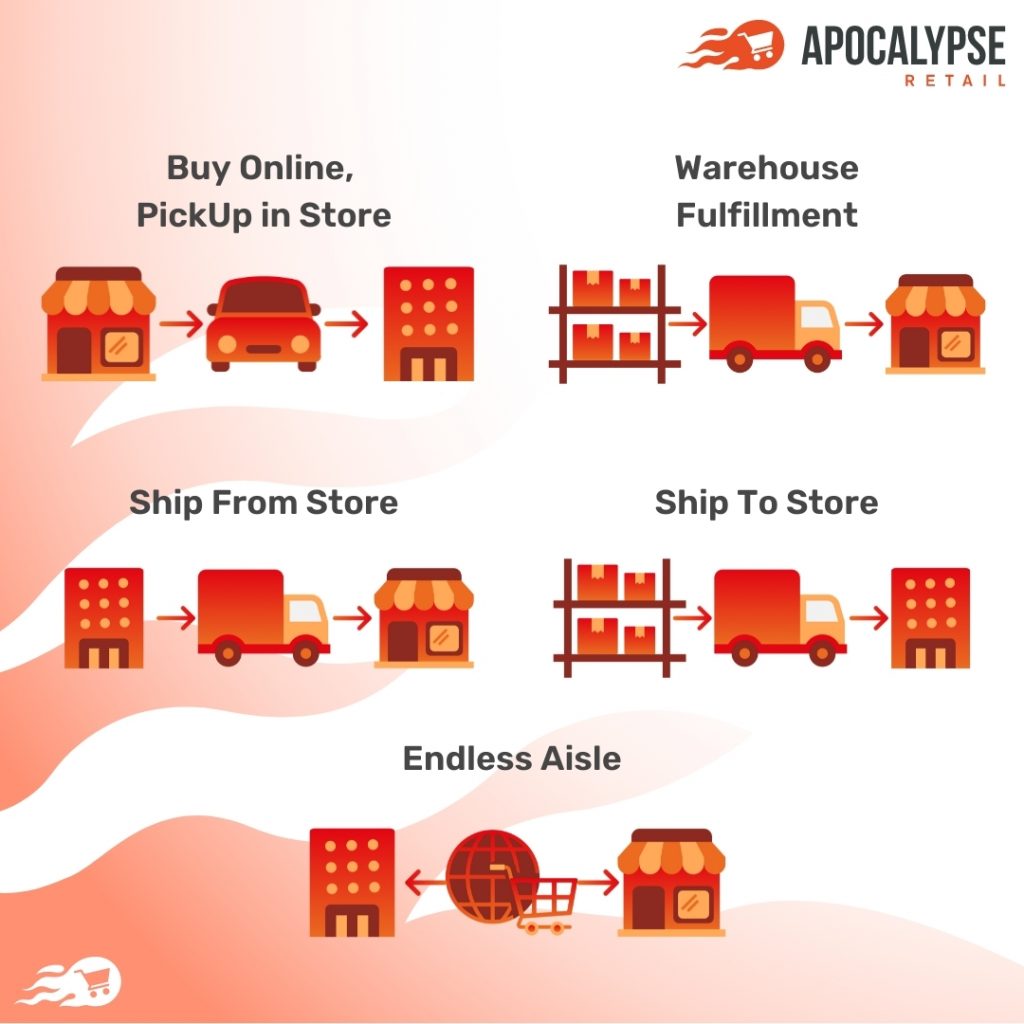
Omnichannel fulfillment allows companies to provide the ultimate customer convenience: serving them when and where they want.
Customers seek convenience above everything, so companies need to deploy different delivery options to meet them across channels.
To implement these delivery options and to preserve the customer experience, a company will need to implement the following IT solutions:
1. OMS:
An Order Management System allows the company to manage the order lifecycle. The OMS allows a company to accept orders and route them to the appropriate fulfillment center.
With an OMS, a company can effectively manage multiple fulfillment centers with a unified view of the company stock.
In an omnichannel approach, an OMS is crucial to effectively handle store-pickup, ship-from-store, or ship-to-store fulfillment options.
2. WMS:
A Warehouse management system allows a company to manage its inventory lifecycle efficiently.
A WMS allows providing accurate real-time data about inventory movements. It also increases picking efficiency by assigning picking tasks and giving clear information on a product’s location.
When connected with an OMS, a WMS can capture and relay real-time data about orders and inventory. The main benefit is to reduce stock-outs and order cancellations.
In an omnichannel approach, a WMS is crucial for handling warehouse fulfillment, store-pickup, ship-from-store, or ship-to-store fulfillment options.
3. TMS:
A Transport Management System allows companies to manage the transport lifecycle efficiently.
A TMS assigns parcels to the right carriers to reduce shipping times and delivery costs. It also allows providing accurate real-time information to track and trace packages during transport.
When connected with an OMS and a WMS, a TMS can provide accurate and relevant updates to customers on each step of the order lifecycle to increase convenience.
The customer knows exactly when and where they will receive their order, which is the basis for omnichannel fulfillment.
An Omnichannel Backoffice Requires a Transformation of the Company’s Reporting and KPIs

Most legacy players have been in the retail business for decades. They have been successful and have optimized their sales and operations for decades.
The problem is that legacy retailers designed their KPIs and reporting structure for single-channel retail. It was specifically built to improve physical store sales and operations.
An Omnichannel Backoffice Requires An Omnichannel P&L

With the rise of e-commerce, legacy retailers started adding complexity to their reporting.
Legacy retailers have often treated their online business as “another store” with an entirely separate P&L.
This separation is, in our opinion, one of the biggest obstacles to implementing a proper omnichannel strategy.
By separating online and offline P&Ls, a company ignores that the value provided from a unified customer experience is greater than the sum of its parts.
In the end, traditional accounting in retail fails to capture the total value of omnichannel retail. It will hinder implementing an omnichannel strategy as the management team will only see half of the picture.
Let’s take an example experienced by many legacy retailers.
The management team of a legacy retailer wants to jump in the e-commerce train and capture some growth.
For this, the company invests in upgrading its technology stack, deploying a digital marketing strategy, implementing store pickup, and revamping its entire website.
They treat it as a separate P&L, so physical store staff has zero incentive to promote the website’s launch. They even see the website as a competitor as any sale in their area is one less for them.
After significant investment and time, the online business takes off and starts generating revenues. But not nearly enough to cover all the spending.
In parallel, physical store sales are increasing more than expected with more visitors than before.
Overall, company managers start reconsidering their online business investment and overall growth stalls.
Sounds familiar?
The main problem with this approach is that it fails to consider that the customer behavior is not mono-channel anymore.
The company is measuring all the investment against online revenues from home delivery. In some cases, they also include buy-online-pickup-in-store revenues.
But they fail to consider the overall impact of a digital strategy on their physical store growth.
After all, with a traditional accounting and reporting structure, how can they measure the positive impact from one channel to another?
Traditional accounting and reporting fail to consider the value of the ROPO effect.
What is the ROPO effect?
ROPO stands for Research Online, Purchase Offline.
ROPO is a consumer behavior where shoppers begin their journey online to gather all the information they need about a brand or product. Then, after they have gathered enough information, they go to a physical store to make a purchase.
Today, customers have all the information they need at the palm of their hands: on their smartphones. As a result, researching a brand or product has never been easier, and customers actively do it.
If you consider the customer journey today, according to the Global Digital Review in 2021 nine out of ten customers visited an online store on any device before purchasing.
Simply having an online presence is crucial to provide information to customers.

Of course, this number also includes online shoppers. But according to Shopify, 69% of consumers webroom, which is another term for the ROPO effect.

But when analyzing the ROPO effect, companies must consider that the effect goes both ways.
In this sense, according to Shopify, almost half of consumers showroom. Showrooming happens when consumers visit a store to check out a product and then purchase it online.

Physical stores have value and help generate additional revenues for the online website as long as the staff has the right incentives.
This means that the company must align KPIs and reporting to improve operations and incentivize cross-channel revenues.
The teams in charge of the online store and offline stores must work together. And marketing campaigns must be designed and measured by an omnichannel approach.
How can the ROPO effect be measured?

By now, it should be clear that every single touchpoint in the customer journey adds value to the company’s bottom line.
This statement is valid as long as those touchpoints are part of a unified positive customer experience.
So to effectively measure the ROPO effect, a company needs to attribute revenues to the right channels.
For online revenues, they can easily be tracked to the initial campaign or traffic source. The problem comes with offline visitors who didn’t log in to the website or even go to the company’s website.
For example, a shopper looking for a decoration store might research Google Maps and see nearby stores. Then, they will probably go to the store without even going to the store’s website.
Tracking 100% of customers offline is impossible.
But companies can get close enough by gathering the correct information from customers when they visit or purchase offline.
A company that can gather data about their offline visitors like an email or a phone number can build a clear view of the customer journey.
So companies must deploy a data-gathering strategy across channels. This strategy should be aligned with their loyalty programs as it’s the best way to offer incentives in exchange for customer data.
If used adequately, a loyalty program can generate tremendous growth in customer retention across channels.
Do you want more insights into E-commerce, Omnichannel Retail, and Digital Transformation? Subscribe to ApocalypseRetail to get insights sent directly to your inbox. Our content is designed for top business schools, retail managers, and eCommerce entrepreneurs who want to survive in the ever-volatile retail industry. Subscribe to our newsletter to join the fight against the Retail Apocalypse!
The post An Omnichannel Backoffice Completes a Bulletproof Omnichannel Strategy to Survive the Retail Apocalypse appeared first on Apocalypse Retail.
]]>The post The Ultimate Guide to Ecommerce Merchandising: Adapting your Website for an Omnichannel Customer appeared first on Apocalypse Retail.
]]>We are all impacted by merchandising and marketing techniques every day.
When you go to the grocery store, you’ll probably have noticed the offers they have on products. These offers are strategically placed to encourage you to buy something.
Online stores need to apply similar tactics on their websites. The goal is to boost their sales through eCommerce merchandising.
Today’s consumer uses multiple devices and multiple channels on their customer journey. They jump from online to offline seamlessly for discovery, research, or to purchase a product.
But there are crucial differences in the way people shop online and in-store. And it is critical to understand these differences to offer the best possible omnichannel experience.
What Is Ecommerce Merchandising?

Any time we make a purchase online, we are buying from an eCommerce business. An eCommerce business is simply a business where the transaction is made online.
E-commerce marketing is the process of attracting visitors to your website. But once visitors enter your website, you need to drive them down a purchase funnel.
This second process is called eCommerce merchandising or E-merch.
E-merch is the sum of processes to keep a customer interested in your website and push them to make a purchase. eCommerce merchandising aims to organize and structure your products or services offered.
The goal is to make it as simple as possible for visitors to find what they want and become paying customers.
Why Is Ecommerce Merchandising Important?

Online shopping is expected to reach 1 in 4 retail transactions by 2030. The growth of e-commerce is tremendous and will continue to grow by double-digit numbers over the next decade.
But the reality is that online shopping still has a fair amount of friction in the customer journey. In particular in the mobile experience.
Most customers still love to get a sense of a product by touching it, feeling it, and trying it. They need this before deciding whether or not to make a purchase.
Other aspects like the shipping fee or delivery times can discourage potential visitors.
Ecommerce merchandising exists to fill the gaps from the lack of a physical experience. It can be a make or break for online businesses. And can have a significant impact on your omnichannel experience.
It is what sets a company apart from others, especially when competition is higher than ever.
Here are some examples of e-merchandising strategies that can help your business:
- Displaying products in a way that draws in the attention of the customer
- Having a search bar to allow customers to find products quickly
- Display filters for customers to find their best-suited products
- Promote particular products
These are some of the strategies that we’ll explain further down in the article.
But first, let’s deep dive into the most important differences between online and offline shopping behavior.
What are 9 Differences in Online vs. Offline Consumer Behavior?
Customers are omnichannel in their approach to the purchase journey, meaning they jump from one channel to another seamlessly.
But this doesn’t mean they behave exactly the same on every channel. So companies must understand the differences in consumer behavior between online and offline channels.
Here are the 9 key differences in consumer behavior between online and offline channels:
- Effort
- Entry and Exit Points
- Audience
- Duration Of The Visit
- Content Renewal
- Product Availability
- Visit Frequency
- Conversion rates
- Interaction
1. Effort: Traveling To The Store vs. One Click Away

When it comes to everything in life, we tend to prioritize convenience. We want to access the products we need quickly and from the comfort of our own homes.
Convenience is where online shopping is preferable to visiting a physical store.
The things we need are simply a click away without us having to leave our homes and travel anywhere. There are times when traveling to the store implies too much effort, or you just don’t feel like doing it.
Online shopping, on the other hand, is usually straightforward. If done correctly, it can be effortless.
2. Entry and Exit Points: One or Two vs. Multiple

There will typically be only one way in and one way out when shopping at a physical store.
With an online store, however, this is entirely different.
Customers can enter or leave your online store from any page they want. In other words, you have as many entries and exits as you have pages on your website.
There are offline merchandising techniques with much better results for this reason. Techniques like placing products at entryways have much better conversion offline.
If 100% of offline visitors enter through a single entry point, the chances of converting on that product are very high.
Suppose that you use the same technique online by displaying the products on your homepage. But only about 30% of your visitors enter via your e-commerce homepage.
In this case, the chances of converting on that product are much lower. This is what happens with e-commerce conversion rates.
3. Audience: Local vs. National or International

Most of us won’t travel too far to visit a store.
Physical stores will only attract customers located within a relatively small radius. People will move within 20-25 km from their home unless they look for something specific or niche.
On the other hand, online stores can attract a national or even international customer base.
So long as customers can have a product delivered to them without too much cost or wait, it doesn’t matter where the business is.
Thus, e-commerce businesses have a much broader reach than physical store retail.
4. Duration Of The Visit: 1 hour vs. 4 minutes

Browsing in a physical store is one of the perks of the physical experience.
Some consumers love to see the products and touch them even if they are not making a purchase.
Customers like to visit a store because of the experience they get. The average consumer can spend around an hour or so in a physical store.
But, online behavior is much shorter. As we said before, in the online experience, everything is one click away.
The average visit time in an online shop is between 3 and 4 minutes so online stores need to grab the customers’ attention as fast as they can.
5. Content Renewal: Once a month vs. Once a Day

Merchandising helps businesses deploy their marketing strategy and messages in each channel.
In an offline store, changing the store layout to adapt to marketing messages requires significant effort. Most retailers will only change the layout every 4 to 8 weeks because of this. Since visits are less frequent, it is not crucial to change the layout faster.
Regarding online, customers have a shorter attention span and more frequent visits. For this reason, it is recommended for e-commerce websites to change messages and content every day. If not possible, at least every week.
To change the content, an online store only needs to upload pictures or content. The most intense part is content creation, but the technical process is very easy.
Visit frequency has an impact on the need for updated content.
Customers will be less inclined to visit physical stores regularly whereas e-commerce businesses can entice them with constantly updated content and layout.
In every online visit, the customer should always see something new.
6. Product Availability: Getting the product immediately vs. Waiting

One of the benefits of shopping in a physical store is that you can get your hands on the product you want immediately.
No matter how fast shipping is online, it’s simply impossible to offer the same service. Even with q-commerce (quick commerce), you still have to wait around 10 minutes.
Some consumers no longer have the patience to wait for things they want.
Whenever you buy something online, there’s always a risk it won’t come on time or that delivery will take a long time which makes immediacy a considerable benefit from offline stores.
7. Visit Frequency: 3-4 times per year vs. 3-4 times per month

As we discussed before, visit frequency is very different online than offline.
Customers will visit physical stores less often than they will online stores.
This difference is due to two main reasons:
- Time and effort to visit the store
- Content and merchandising are not renewed fast enough for customers to make a trip worthwhile
The difference can be significant.
Customers might visit an online store the same number of times a month as they would visit a physical store in a year. Around 3 or 4 times. If your marketing plan is strong, the online visit frequency can even be higher than this.
Today it is effortless to check a store from your mobile whether it’s from an organic search, email, ad, or simply a direct visit.
The effort difference just makes visit frequency much higher online.
8. Conversion rates: 50% vs 2-3%

Every single difference in behavior that we highlighted until now has a massive impact on conversion rates.
The effort, entry/exit points, visit duration, and immediacy increases offline conversion rates.
A customer that makes the effort of going to a store is much more likely to make a purchase.
On the other hand, an online store addresses a much larger audience, with multiple entry/exit points and shorter visit duration.
In these conditions, it is much more challenging to convert a visitor into a paying customer.
Offline stores conversion rates are around 50%, compared to 2-3% for online stores.
An offline store has 15x to 25x higher chances to convert a visitor into a customer. But its reach is much lower than an online store.
9. Interaction: Human vs. User Interface / Chatbot

In physical stores, there will almost always be store assistants on hand to help. Store associates or sales reps are there to help you find things you need or give you advice about products.
At the very least, there will be someone waiting to welcome you into the store. When you need assistance, you will usually be able to find someone to help you relatively quickly.
The help is then immediately and is there within the store operating hours.
Human interaction is something much more challenging to get online.
The closest thing is talking to customer service, but it doesn’t have the same “human” feeling. And it is rarely available during the 24/7 online store operating hours.
On top of a phone number, online stores can also provide live chat features on their website. But for phone or live chat to be successful, it needs to be immediate communication.
The problem is that this can be very costly, and not many retailers can afford to do it properly.
What is Omnichannel Merchandising?

Omnichannel merchandising is a way of bridging the gap between online and offline customer journeys.
Most of us like to spend some of our time online and enjoy going to the store.
Omnichannel merch creates a unified experience across all touchpoints in a customer journey. Customers can jump seamlessly from a channel to another. In other words, customers are omnichannel in their behavior.
With an omnichannel merchandising strategy, a company helps customers move from one channel to another without friction. The main goal of omnichannel merch is to remove any frictions from the customer journey.
Some essential features of omnichannel merchandising are:
- A great mobile responsive website
- High quality and detailed product content
- Consistent product offers and discount across channels
- Delivery or pickup options according to the customer needs
- Unified loyalty rewards across channels
11 Ways Retailers Can Adapt To E-Commerce Merchandising

Most companies already have a multichannel strategy with functioning online and offline stores. Here’s a complete rundown of e-commerce merchandising best practices.
1. Change Content And Deals Daily

Customers are looking for deals and products to be changing all the time.
As part of your e-commerce marketing strategy, it is essential to keep images fresh and update your deals regularly. Daily if possible.
This ensures customers always have something new to see. In addition, it encourages more frequent visits, which increases the chances of a purchase.
2. Ecommerce Merhandising Requires a Powerful Internal Search Engine

Most people think of Google when you use the words “Search Engine.”
Improving your website to rank higher on Google is very important and is taken care of by SEO, which means search engine optimization.
But in e-merch, the internal Search Engine is equally or more important as an e-commerce store can have hundreds or thousands of items available in its catalog.
Because online customers are lazy and impatient, they must be able to easily search for products and quickly find them.
A customer that is looking for a specific product is much more likely to complete the purchase so every retailer should make it a priority to have a robust and reliable internal search engine.
3. Ecommerce Merhandising requires Mobile-First Design

Mobile traffic now exceeds desktop traffic as everybody and their mother has a smartphone.
And m-commerce or mobile commerce is rising quickly which is unsurprising as people like to shop while they are on the go, from the couch, or even from bed.
Online stores must ensure their websites are mobile-friendly, in particular, the product page and checkout funnel.
The best way to do this is to design your user experience and campaigns first for mobile. In terms of UX and design, it is much easier to go from mobile to desktop than vice-versa.
4. Ecommerce Merhandising implies to Make Contact Easy

Customers trust companies that make it easy to contact them.
It is very frustrating to have to do a deep search around a website looking for contact information.
Make customer contact as easy as possible. This will generate more contacts but will also help you solve more customer doubts or issues.
5. Promote Product Discovery with cross-sell and up-selling

A homepage is a great place to highlight the products you want your customers to engage with and see first.
These products must be relevant to the customer to provide a maximum chance of conversion. But when an online store has hundreds or thousands of products in its catalog, it is difficult to show them all.
An online store can promote product discovery with collections. Collections are great to cross-sell or up-sell products.
Cross-selling is offering similar products to customers. For example, showing the same product from another brand.
Up-selling is offering complementary products to a product. For example, showing a belt to a person that added a pair of pants to its cart.
The idea is to show the customer similar and relevant products that they can discover.
Well-placed products will grab the customer’s attention which can be on the homepage or a product page.
You can make the process scalable with automation, whether similar to previous purchases or previously seen products.
The most crucial part is that product collections must be relevant to the customer.
6. Personalization At Scale is a powerful tool of ecommerce merhandising

Personalization and customization are essential to e-commerce merchandising.
Customers want to feel valued, and few things make a customer feel more valued than having a personal experience.
An online store can do this by gathering and analyzing data on its customers.
For example, you can make relevant recommendations with data on what products a customer saw or purchased. Or, with data about the date of birth, you can send a relevant message to a customer on their birthday.
Online stores must use data to understand what their customers like or dislike. By doing so, they gather insights on their shopping habits to create a more personalized shopping experience.
7. Use Social Proofing And User-Generated Content

User-generated content or UGC is all content that comes from users. For example, it can be a consumer review of products or stores, but it can also be photos or videos with products.
The main objective of UGC is to provide social proof to other customers to build trust with a company.
According to research, 79% of customers will trust an online review as much as they would a friend’s feedback so social proof must be nurtured and displayed as often as possible.
If the reviews are negative, at the very least, you have valuable insights to improve your processes.
8. Be Clear About Delivery Lead Times and Cost to improve your Ecommerce Merhandising

The most frustrating thing about online shopping can be waiting times for delivery.
Research shows that 19% of people said that they abandon their cart at checkout because delivery is too slow.
The best thing you can do is be open and honest about how long the products will deliver rather than overpromising on delivery. And when it comes to delivery it is also essential to be honest about delivery costs.
According to research, 53% of online shoppers will abandon their carts because of unexpected extra costs.
9. Use Product Bundling to reinforce your Ecommerce Merhandising

Product bundling is suggesting complementary products as a pack of items sold together.
Product bundles are great to increase the average basket size. More often than not, they also help increase profitability as they reduce fixed costs per unit economics.
There must be a perceivable value for the customer. For this reason, bundles should be cheaper together than the sum of products if bought separately.
10. Marketing Automation To Increase Repurchase

Automating your marketing can help to increase the number of customers who will become returning customers.
Marketing automation is easier than ever today. There are plenty of solutions to help automate your marketing strategy.
Automation will help you increase your customer retention rate. With the proper automation workflows, you can send relevant messages to existing customers.
Building a customer database can take a while, but it is one of the best investments a retailer can make. It allows unleashing the full power of marketing automation.
11. Detailed and Quality Product Pages is the Holy Grail of Ecommerce Merhandising

It cannot be overstated how important it is for a website to have a nice look and feel. In particular regarding Product Pages.
Quality and detailed content on product pages are crucial to increase conversion. They help customers reduce the need to touch and feel a product.
Retailers must invest in high-quality images of products. And they must work on detailed product descriptions with relevant use cases. If the budget allows, some products should also have video content.
The product page content is your online sales pitch so you need to ensure it contains all the valuable information that a customer needs to know about a product.
How to Improve Your E-Commerce Merchandising Strategy?

E-commerce merchandising involves learning how to adapt to an ever-changing environment.
Online stores must do everything they can to compensate for the lack of physical experience. This is the true objective of E-merchandising.
But E-merch must be a continuously evolving process. It needs to be up to date with changes in technology and omnichannel customer behavior.
Some essential features of omnichannel merchandising are:
- Daily change in content
- A powerful internal search engine
- A great mobile responsive website
- Easy contact for customers
- Product discover with cross-sell or up-sell
- Personalize the experience
- Use Social Proofing
- Clear delivery time and costs
- Product bundling
- Marketing automation
- High quality and detailed product content
Overall, retailers need to work harder when going online than in their offline stores to keep online customers engaged.
But those that achieve it will set their business apart from the crowd!
Do you want more insights into E-commerce, Omnichannel Retail, and Digital Transformation? Subscribe to ApocalypseRetail to get insights sent directly to your inbox. Our content is designed for top business schools, retail managers, and eCommerce entrepreneurs who want to survive in the ever-volatile retail industry. Subscribe to our newsletter to join the fight against the Retail Apocalypse!
The post The Ultimate Guide to Ecommerce Merchandising: Adapting your Website for an Omnichannel Customer appeared first on Apocalypse Retail.
]]>The post An Omnichannel Product Offering is How Retailers Build Trust and Customer Retention appeared first on Apocalypse Retail.
]]>Omnichannel commerce is a critical way to give your customers a seamless shopping experience. Whether shopping in a store or online via tablet, mobile, or computer. In every touchpoint, consistency is essential.
When shopping, it is normal for the customer to research their purchase. They may compare different models a few times across devices.
As they research before making a purchase, customers rely on consistency to establish trust. This consistency is required on price and product offering.
To consider implementing an omnichannel strategy, a company must address five key pillars.
The five pillars of omnichannel retail are:
- Omnichannel 360º View of the Customer
- Omnichannel Customer Engagement
- Omnichannel Fulfillment & Logistics
- Omnichannel Product Offering, and Merchandising
- Omnichannel Backoffice: Finance, IT & HR

An omnichannel product offer is one of the five pillars of an omnichannel strategy. In this post, we’ll dive into how you can build your own omnichannel pricing and product offering to meet the omnichannel customer’s demands.
But first, let’s recap the differences between multichannel and omnichannel retail.
Multichannel Vs Omnichannel

The difference between multichannel and omnichannel retail is consistency.
Multichannel retail offers products and services across various channels. But this offering is not connected in a continuous path to purchase.
Omnichannel retail refines the multichannel process. It creates a smooth and seamless customer journey across channels.
Omnichannel retail allows for more accurate and better quality data collection. It also improves customer loyalty and increases traffic and sales.
All these benefits are in addition to providing a better experience for your customers.
The key to success with omnichannel Pricing is to know your customer. Know the behavior to expect, what they look for when researching your product, and what channels they use.
Why should retailers implement an Omnichannel Product Offer?

Humans hate to feel duped.
Feeling like you have been taken advantage of is one of the worst feelings in human psychology.
Customers will never forget how your brand made them feel, especially if it creates powerful emotions.

Most companies focus on creating positive emotions, but every company dreads generating negative emotions.
Today’s shoppers have everything they need to research a product or brand in their pocket.
Asymmetric information is used to benefit retailers, but not anymore. Today, customers have complete control over information, and that gives them significant power.
As of 2019, consumers checked their smartphone instead of speaking to a store associate for the following reasons:
- 69% to check customer reviews on a product or service
- 58% to find comparable products or services
- 55% to check product specifications
- 53% to find deals or discounts on specific products or services
The fastest way to lose a customer is to make them distrust your brand. And you lose trust by having different Pricing and promotions across channels. By doing so, you make customers ask themselves if your brand is worthy of their trust.
Customers do not want to spend time comparing shopping for the lowest cost product.
Convenience ranks right up with the price in helping the consumer make purchasing decisions.
Having an omnichannel product offering is not just a matter of building trust. It’s a matter of convenience.
While online channels have been great for impulsive buys, it has also made research effortless.
What is an omnichannel product offering?

An omnichannel product offering is a strategy to offer consistent content and Pricing for their products. This consistency is enforced across all sales channels.
Consistent product content: Provide the same product description and content across channels. This content includes visual content, product reviews, and user-generated content.
Consistent product pricing: Consistent product pricing has the same pricing strategy across channels. This is not only for regular prices, but also for promotions, discounts, and rewards for customers.
An omnichannel product offering has a unified strategy across channels regarding:
- Pricing
- Loyalty Rewards
- Promotions
- Product Reviews
- Product Information
Ensuring that your product offering is consistent and available across all channels is a great way to keep customers happy. They should feel comfortable when they make their purchasing decisions.
That comfort pays off with greater customer loyalty and lifetime customer value.
Multichannel retailing is a step for retailers that want to avoid the retail apocalypse. They need to understand that 21st-century shoppers are present in multiple channels. So companies must be present on those channels.
However, most traditional retailers fail to understand that shopping behavior has radically changed. Digital channels have made it easier than ever for customers to do research.
Omnichannel retailing understands this.
In the end, finding all the information on a product is just one google search away on the customer’s smartphone.
Some companies don’t do it because they think it means a race to the lowest price. But you can have a higher price than your competitors if you provide additional value.
Omnichannel retailing is not about having the lowest possible price. It is about providing additional value on a unified path to purchase.
The problem is, most retailers still fail to understand the value of Omnichannel Product Offer. According to a panel among retail professionals about the consistency of their product offering:
- 43% of retailers have inconsistent or very inconsistent Pricing
- 57% of retailers have inconsistent or very inconsistent Loyalty rewards
- 60% of retailers have inconsistent or very inconsistent Promotions
- 72% of retailers have inconsistent or very inconsistent Product Reviews
- 75% of retailers have inconsistent or very inconsistent Product Information

What are the Benefits of Providing Omnichannel Product Offering?
1. Building trust with the customer

The most crucial benefit of an omnichannel product offering is building trust with your customers.
Trust is vital for long-term relationships and will yield a positive return on investment. A customer is more likely to pay a higher price for a product if they trust the brand.
Building trust is important for any company, but it is critical for retailers.
2. Lower customer acquisition costs

When customers trust a product or brand, they are more likely to recommend it to their friends.
Companies that implement an omnichannel product offering understand the value of word-of-mouth. Customers can be your most crucial marketing asset… if they have positive things to say about you.
Building trust not only helps you build loyal, long-term relationships with your customers. It also enables reducing customer acquisition costs as existing customers become fans.
3. Higher scalability

An omnichannel product offering also makes for easier internal processes. A consistent price and content strategy makes the product life cycle faster and more scalable.
Consistency helps your teams avoid Pricing or content mistakes. Product teams must gather feedback from their commercial teams on Pricing.
A consistent pricing and content strategy allows commercial teams to focus on selling the product instead of reworking content.
4. More powerful campaigns

Consistent product pricing, promotions, and rewards across channels are crucial to powerful campaigns. It allows retailers to build consistent messages across channels.
Most customers browse multiple channels daily. So a consistent campaign across channels highly increases the chances of customers remembering your message.
5. Better comparisons with your competitors

A retailer must keep an eye on Pricing and promotions from competitors. And it needs to keep an eye on prices across all channels.
By doing so, the company can make adjustments to inventory and forecasted sales.
Consistent Pricing and promotions across all channels allow for better comparisons with competitors. Having different prices and promotions on sales channels makes it very difficult to have an accurate comparison.
What is Omnichannel Pricing?

Today, customers can showroom or webroom in their customer journey.
Showrooming is the practice of looking at something in person, then ordering it online.
Webrooming is when a customer sees a product online and then heads to the store to purchase it.
But a company that offers different prices across channels will lose on both customers. Customers lose faith in retailers that offer different prices across channels.
Before having smartphones, channel-specific Pricing was less of a concern. But as customers become omnichannel, companies must also become omnichannel.
Different prices by channel damage your reputation. And a company that continues doing it will lose the trust-goodwill from customers.
What are Omnichannel Promotions?

Building an omnichannel promotion comes with its own unique set of challenges. Most challenges come from legacy organizations not suited for an omnichannel strategy.
Silo structuring makes it challenging to create continuity across various channels. By having a transversal organization, a company ensures that all parties understand the goals and purpose of a campaign.
Who must be included when launching a promotion? All teams from Marketing, Sales, IT, Product, Customer support, and Local store associates must be included in the discussions.
This sounds messy, but with the right organization, it is fully scalable.
A deep understanding of your customer needs is key to launching the most efficient promotions. Companies need to gather data about their customers and understand their behavior.
For example, a promotion to gather leads from customers can help build a solid first-party customer database.
But most retailers push this type of promotion exclusively online: “10% if you subscribe to our newsletter!”.
This type of campaign is excellent for online lead acquisition. But the true power of omnichannel promotions lies in deploying them across channels.
Expanding this type of promotion to offline channels will increase your lead-gathering capacity.
What are Omnichannel Product Reviews?

Too often, product reviews are handled exclusively by customer service teams. But they should also be considered as a marketing tool between brands and customers.
Social proofing represents a crucial touchpoint to build trust with customers. Product reviews must be nurtured and displayed on all channels to build a powerful reputation. A company that displays positive reviews for products and stores can see an uplift of 18% in revenues.

Product reviews are essential to provide information to customers. And companies can also receive input and have a conversation with their customers.
Consider product reviews a vital source of data as peer-to-peer trust has a tremendous impact on buying decisions.
The local consumer review research shows that almost 9 out of 10 customers value online reviews as they would for personal recommendations. So product reviews and social proofing are almost equal to word-of-mouth. But it is much more scalable!

Treat product reviews as the critical marketing analytics tool that they are.
In an omnichannel approach, product reviews stay in front of the mind of the consumer.
A negative review read online can influence an in-store buying decision. Think carefully about how you will react to negative reviews. Have a policy in place to handle them and don’t make it difficult for the customer.
Trouble resolving the issue encourages negative comments on social media so instead, be ready to reach out personally to the customer to address the situation.
Finally, take each negative review and learn from it. Use it to improve your product, processes, or fulfillment.
What is an Omnichannel Loyalty Program?

A loyalty program is how most legacy retailers built their customer databases. But in today’s retail, loyalty programs need to be adapted for an omnichannel strategy.
A loyalty program where some benefits or rewards are exclusive to a single channel is a thing of the past.
The lifetime value of an omnichannel customer is higher than the lifetime value of a customer exclusive to a single channel. This increase in lifetime value is why retailers must implement omnichannel loyalty programs.
A loyalty program offers access to special discounts, promotions, or events. These benefits must be provided on every channel. In exchange, retailers get the customer’s data. If appropriately used, this data will repay the investment in an omnichannel loyalty program.
An omnichannel loyalty program implies that it is accessible to anyone at any time.
Rewards and benefits from a loyalty program should not be just for customers close to a store. They should be for any potential customer.
It is frustrating to miss out on special deals and discounts as a customer because they are not in every channel.
A company shouldn’t make its loyalty rewards based on pricing discounts only. A loyalty program should offer exclusive or early access to products or events.
This helps build and nurture the relationship with your most loyal customers. When doing this, companies must identify their customers to track and segment their database correctly.
By doing so, companies can identify their loyal customer’s purchasing patterns. And they can also make an effort to “reactivate” customers who haven’t bought for some time.
An Omnichannel Product Offer answers the four factors influencing a purchasing decision

Most legacy retailers have been moving into the digital space at a slow pace. However, 2020 and Covid19 accelerated the need for companies to move online.
Unifying the digital and physical experience has become a crucial consideration.
Customers are already used to buying online. And they expect a seamless online shopping experience.
Delivery options and store pickup have become prevalent in today’s retail. Today’s consumers are jumping from one device to another and from one channel to another.
Consumers today make their purchasing decisions based on four factors:
- Selection
- Price
- Content
- Convenience
Omnichannel Product Offering ensures that these factors are met on a consistent basis at every step of the funnel.
Customers will see a consistent selection, price, and content across channels. All of this, on top of availability on all channels to provide maximum convenience.
Trust is built by offering the same product, whether your customer is shopping online, in person, or clicking through an email. This trust removes the need to check the competition.
There is no need to visit multiple stores and wait for price drops when there is trust.
What are the Difficulties of Implementing an Omnichannel Product Offering Strategy?

An omnichannel product strategy isn’t easy to implement. It requires discipline and continuous improvement.
To implement omnichannel pricing effectively, a company must have a pricing tool.
Omnichannel Pricing is not a strategy where you set it and forget it. It is vital to have accurate forecasts and inventory management.
From significant events, such as Black Friday, to more specific events, such as fluctuations in inventory.
Companies need to factor in any change in competition to adapt stocks across channels. Retailers need robust operational control and suitable systems to manage omnichannel Pricing.
But apart from the complexities, the omnichannel product offering has two main drawbacks
- First, it consumes a lot of time and resources to be implemented. Most of the time, it requires specific skills that can’t be found in-house.
- And second, an omnichannel product strategy is not always flexible enough for seasonal or local shopping habits.
In the time it takes to implement an omnichannel product strategy, companies can implement hybrid pricing.
Hybrid Pricing implements single omnichannel Pricing, but few exceptions in specific situations.
Hybrid Pricing is a good compromise for retailers impacted by seasonal price changes or very local consumer habits.
Just keep in mind that every difference that exists between channels is a step back to multichannel retail.
How to implement omnichannel product offering?
Here are the two main issues every company must address when trying to implement an omnichannel product offering.
Establish seamless communication across your customer touchpoints

Deciding where to offer your product can be a challenge.
A pain point for many retailers over the past year was that they had options for getting their products to consumers. In particular, those companies that only had physical stores or relied too heavily on their physical footprint.
Multiple sales channels allow a continued revenue stream if one channel dries up.
When choosing channels to provide sales, you need to really understand your customers. And meet your customers when and where they are.
Companies should be easily accessible in every channel and customer touchpoint.
The primary customer touchpoints that every retailer must address include:
- Traditional brick-and-mortar stores and pop-ups.
- Sales reps in store
- Mobile or Desktop Website
- Mobile apps
- E-commerce marketplaces
- Social media platforms.
Once you decide what channels you need to use, you must unify your marketing efforts. An advertising strategy for your products must be consistent across platforms.
If a potential customer sees an ad offering a product at one price, then receives an email offering something different, trust is broken.
Another issue is coupon codes and other promotions that don’t work correctly. An email promotion sent with an expired coupon code is a terrible experience.
Commercial teams across channels should be aware of your campaigns to maximize their output.
It is frustrating to go to a store and see that promotion is only available online. Or that the store associate wasn’t even aware of the promotion.
Personalize the Customer Experience

While consistency is key to omnichannel Pricing, that doesn’t mean you should treat all your customers the same.
Segmenting your customers allows you to target each where they are most likely found. Segment by demographics such as generation, income range, online behavior, and region.
Segmentation allows you to create specific marketing plans while maintaining your omnichannel presence.
Once segmented, consider where each group is most likely to look for your product. For some, it may be in-store. Others may perform a Google search. Finally, some may not search for it but would be interested if it popped up on their Instagram page.
After coming up with a plan to market to each segment, think of every step of the customer journey.
Should you have a feature to sign up for email offerings on your website? Or have a banner at the entrance of your store?
The customer journey is not a straight path. Customers move between digital and physical methods seamlessly.
Success will come to companies that meet customers when and where they are.
Do you want more insights into E-commerce, Omnichannel Retail, and Digital Transformation? Subscribe to ApocalypseRetail to get insights sent directly to your inbox. Our content is designed for top business schools, retail managers, and eCommerce entrepreneurs who want to survive in the ever-volatile retail industry. Subscribe to our newsletter to join the fight against the Retail Apocalypse!
The post An Omnichannel Product Offering is How Retailers Build Trust and Customer Retention appeared first on Apocalypse Retail.
]]>The post Omnichannel Fulfillment is How Brands Provide the Ultimate Customer Convenience appeared first on Apocalypse Retail.
]]>Today, customers have complete control of when, where, how, and from whom they want to buy products.
The rise of digital channels has given unprecedented power to customers. This power shift has increased competition for retailers. It has forced them to adopt a strategy that fully satisfies customers at their convenience.
That is where omnichannel fulfillment comes in.
To consider implementing an omnichannel strategy, a company must address five key pillars.
The five pillars of omnichannel retail are:
- Omnichannel 360º View of the Customer
- Omnichannel Customer Engagement
- Omnichannel Fulfillment & Logistics
- Omnichannel Product Offering, and Merchandising
- Omnichannel Backoffice: Finance, IT & HR
Once you have built a 360 view of your customers and you started deploying an omnichannel customer engagement strategy, you can deploy an omnichannel fulfillment strategy.
What Is Omnichannel Fulfillment?

Omnichannel fulfillment is an order fulfillment process executed across multiple channels. At its core, this process ensures a consistent experience across all channels.
Omnichannel fulfillment makes all products and services available in every channel. So whether it’s online or offline, products are available in the most convenient channel for customers.
In other words, in omnichannel fulfillment, a customer can buy and get a product no matter where they are or what channel they are using.
Having all products available across channels is similar to a multichannel fulfillment strategy.
Multichannel fulfillment is fulfilling orders from multiple channels. Whether online or offline, in multichannel fulfillment, a customer can choose from various delivery options.
The critical difference is that omnichannel fulfillment ensures a consistent customer experience across fulfillment options.
Omnichannel fulfillment is adapting the delivery process and options to the customer’s behavior, ultimately making the whole experience convenient and efficient.
All channels and delivery options are interconnected in an omnichannel fulfillment strategy.
They are synchronized to gather a maximum amount of data and provide an equal value to the customer.
What are the five primary options of Omnichannel Fulfilment?
To understand how omnichannel fulfillment works, let’s first understand the options it can take.
There are five primary options of omnichannel fulfillment:
- Store pick-up
- Warehouse delivery
- Ship-from-store
- Ship-to-store
- Endless aisle

Let’s dive into each of them in detail.
1. Omnichannel Fulfillment: Store Pickup

The most common form of omnichannel fulfillment option is store pick-up. This method includes different options such as E-reservation or Click and Collect.
What is E-reservation?
E-reservation is the delivery option where an item is reserved online and picked up in the store. The actual payment and transaction happen at the store.
The main convenience is that the customer ensures the item is in stock before going to the store.
What is Click and Collect?
Click and collect is where the item is reserved and paid online and picked up in the store.
This method is often referred to by the acronyms BOPIS or BOPUS for Buy Online, Pickup In-Store. It can also be written Click & Collect or C&C.
The main convenience is to ensure a fast, efficient process without really needing to enter the store.
What is store pick-up or Buy Online, Pickup In-Store?
Whether it’s E-reservation or Click And Collect, most retailers are deploying store-pickup. It is the preferred option by brick-and-mortar retailers that want to be omnichannel retailers.
In a survey in 2020 by Forrester, 87% of retailers planned to implement buy-online-pickup-in-store before 2022.
Retailers prefer this method because it allows them to leverage their physical footprint. In addition, this option will enable them to drive traffic to their stores from their digital channels.
There is no doubt that the physical store still carries significant value for customers. Touching, feeling, and smelling a product can highly increase the chances of purchasing that product.
What do retailers need to implement omnichannel store pick-up?
By implementing BOPIS, retailers know they can drive traffic to the store. Most of the time, they generate additional sales when the customer is in the store.
But in-store pick-up can also be a form of multichannel fulfillment.
So omnichannel store-pickup requires two additional efforts from the retailer:
- All products and services must be available online and offline.
- Product content must have consistent quality across channels.
- High inventory accuracy
- Transform stores into fulfillment centers
1. Full availability of all products and services online and offline:
Very often, retailers have different inventory for physical or online stores. In turn, they offer products that are exclusive to a single channel. Or are simply available in a single store.
For example, a retailer that has certain products published on its website that can be purchased online. Or that can’t be delivered at home. Or that can’t be found at the store.
This negatively impacts the customer experience and generates frustration among potential buyers.
2. Quality product content across channels
Regarding product content, the logic is very similar.
Omnichannel store pick-up requires that product content must be consistent across channels. When customers are at the physical store, they can touch, feel, and see a product’s details.
The online experience must match the physical store experience.
In other words, omnichannel store pick-up requires having online product pages with:
- Quality pictures
- Detailed descriptions and specs
- If possible, videos or tutorials for the product
3. High inventory accuracy across channels
Store pick-up has tons of benefits for retailers. But, when considered in an omnichannel strategy, it carries some operational complexity.
For starters, retailers need to have high inventory accuracy. This is crucial to avoid disappointments for customers due to stock out.
Inventory accuracy goes hand-in-hand with the full availability of products across channels.
It is one of the biggest challenges for retailers, as real-time and reliable stock count is not easy. And a fundamental principle of working capital is to reduce the days of inventory rotation as much as possible.
4. Transform stores into fulfillment centers to control hidden costs
Like inventory, retailers need to have a higher cost efficiency to make omnichannel store pick-up work.
In-store pick-up has loads of hidden costs of order fulfillment from the stores. A physical store has significant differences from a fulfillment center.
The time to pick and prepare an order in a store is higher than at a specialized fulfillment center. This makes the traditional store less efficient for omnichannel store pick-up.
Retailers who want to implement omnichannel in-store pick-up must rethink the role of the store.
The store must be transformed into a fulfillment center with a showroom. This way, customers can still get the full value of the physical experience, and retailers can offer omnichannel store pick-up.
2. Omnichannel Fulfillment: Warehouse fulfillment:

Warehouse fulfillment is shipping products from a warehouse to the customer’s place of choice.
That’s as easy as it gets.
What is omnichannel warehouse fulfillment?
From an omnichannel standpoint, warehouse fulfillment adds more value. The primary value is that all products are available for delivery at the customer’s convenience.
No matter where the customer is located or when they want a product, they can order and receive it.
In other words, the warehouse can fulfill an order at the time and place desired by the customer.
The warehouse carries the reception, storage, picking, and packaging of orders. Once the order is prepared, it ships it to ensure delivery when and where the customer requested.
This type of delivery is the basis of e-commerce.
Omnichannel warehouse fulfillment provides the ultimate customer convenience.
Omnichannel warehouse fulfillment implies the order can be fulfilled at speed and place the customer wants it.
A customer can need a product in less than two hours or might not mind waiting a few days for delivery. The important part is that they must have all options.
On top of this omnichannel warehouse, fulfillment allows shipping orders placed from a physical store.
Suppose a store doesn’t have an item in stock. The customer can make an order from the store and have it delivered to their house.
Omnichannel warehouse fulfillment is highly cost-efficient.
Omnichannel warehouse fulfillment provides higher inventory management efficiency. In this case, long-tail products can be stored at a central location and have better inventory management.
A central warehouse will always have better unit economics in storage, picking, and packaging costs than a store.
This form of fulfillment has another benefit of increasing higher profitability per m2. This is one of the most important KPIs for traditional retail.
Stores can serve as showrooms where the customer can touch and feel the product before making a purchase.
Once they are ready to purchase, the product can be delivered from the warehouse if it’s not in store.
Speed is vital to make omnichannel warehouse fulfillment work.
The main drawback of omnichannel warehouse fulfillment is the delivery speed for an item.
For some items, customers are willing to wait a couple of days for delivery. But for other items, they want to have the product immediately when making the purchase.
This immediacy is impossible to achieve for all items on a national level from a central warehouse.
Retailers must have a deep understanding of the customer’s needs and wants. They must identify which items need to be in-store and which can be fulfilled from a central warehouse.
In-house or external (3PL) warehouse fulfillment
Regarding warehouse fulfillment, there are two main options for retailers.
They can have a standalone warehouse where they set up and have complete control of the entire process. Or they can use a third-party logistics provider (3PL).
Outsourcing logistics can offer benefits depending on the volume and seasonality of orders. For some retailers, 3PL is generally more efficient in costs-per-order. And it provides a lot more flexibility in high seasonal markets.
But having in-house logistics allows complete control. And full control is critical to provide the best possible customer experience.
3. Omnichannel Fulfillment: Ship-from-store

What is omnichannel ship-from-store?
Ship-from-store is a mix between store pick-up and warehouse fulfillment. Ship-from-store is where the physical store doubles as a proximity fulfillment center.
From an omnichannel perspective, ship-from-store has the same requirements as store pick-up and warehouse fulfillment. It requires consistent product content, high inventory accuracy, and full product availability.
For many retailers, their store network is one of their most important assets. They can leverage this footprint by converting physical stores into fulfillment centers. In turn, they can fulfill proximity orders, whether online or offline.
Shipping orders from stores has considerable benefits in terms of delivery lead times. When the store works as a fulfillment center, it can ensure same-day delivery for orders within its proximity.
Ship-from-store also has value in terms of inventory efficiency. Shipping items from stores increases transactions and provides higher stock rotation.
Omnichannel ship-from-store requires an Order Management System.
The main drawback of ship-from-store fulfillment is the operational complexity. In this sense, managing multiple stocks in stores to fulfill an order requires a unified view of stocks.
But most traditional retailers have legacy systems that are unable to handle these requirements. And they generally struggle with inventory accuracy within stores.
This can only be achieved with an Order Management System (OMS). An OMS provides a unified and accurate view of stocks between stores to define which store will fulfill an order.
Retailers must fix these issues before trying omnichannel ship-from-store.
4. Omnichannel Fulfillment: Ship-to-Store

What is omnichannel ship-to-store?
Omnichannel ship-to-store fulfillment is the next logical evolution of retail fulfillment. In particular, after having implemented in-store pick-up and warehouse fulfillment.
Ship-to-store fulfillment is when the physical store becomes a delivery destination for orders.
This method is used for products not in stock at the store to ensure a proper, omnichannel view of the retailers’ product offers.
Ship-to-store allows the store to double as a pick-up place to receive orders if the product is not in store.
Depending on the physical footprint, ship-to-store also provides convenience for the customer. Especially for those customers that are not always home and want a place to pick up items.
Four steps to implement omnichannel ship-to-store
To properly implement omnichannel ship-to-store, Retailers must tackle certain complexities.
- They must be able to track online and physically store orders once they get to the store.
- Omnichannel ship-to-store requires notifications for customers to know when their order is ready for pick-up.
- Once the customer is in the store, the pick-up experience must be as easy as possible.
- Finally, the retailer must mark an order as picked up and start a return process if the customer requests it.
Ship-to-store fulfillment ties all options together for maximum convenience.
Once ship-to-store and ship-from-store options are deployed, a retailer can implement store-to-store fulfillment. This unifies all point-of-sale inventory to address stock-outs and improve customer experience.
The biggest drawback about ship-to-store is the additional delivery cost it carries with no immediacy for the customer.
One could argue that ship-to-store has the inefficiencies of warehouse fulfillment, coupled with the inefficiencies of in-store pick-up.
Retailers must work to tackle these inefficiencies to offer ship-to-store. Mainly to ensure a consistent experience for customers.
5. Omnichannel Fulfillment: Endless Aisle

Endless-aisle is a concept where a retailer extends its catalog offer with products that are not in stock. The endless-aisle can be internal or external, depending on who stocks the items.
What is an internal endless aisle?
An internal endless aisle occurs when a retailer has stores of different sizes. In this case, some products are only available at the biggest stores or a central warehouse.
Retailers can leverage internal endless-aisle to make products available in all of their stores. The customer can purchase a product from a smaller store, even if that product is not available in the smaller store.
What is an external endless aisle?
External endless-aisle is where retailers leverage products outside of their catalog offer. This can be very efficient for long-tail products from suppliers.
It gives the retailer the flexibility to offer these products without carrying the risk of stock themselves.
External endless-aisle is very similar to dropshipping. The supplier would be fulfilling the order in the name of the retailer that sold the order.
What are the pros and cons of endless aisle fulfillment?
Endless aisle is attractive in inventory management and working capital management as the retailer doesn’t need to carry the stock before it makes the sale of the product.
The biggest drawback of the endless aisle comes from the operational complexity it implies for retailers.
In today’s customer experience standards, a customer doesn’t care who shipped the order. The customer expects the company they are buying from to ensure that everything works perfectly.
Therefore, retailers need to make sure to have the right processes for endless aisle:
- make sure that suppliers are fast and reliable for a consistent fulfillment experience
- have the right systems to track and follow up on orders from an omnichannel perspective.
If they do not implement these steps, an endless aisle can become an operational nightmare.
What Are The Benefits Of Providing Omnichannel Fulfillment?

Omnichannel fulfillment comes with an increase in convenience and a long-term reduction in costs. Here are the most common benefits of omnichannel fulfillment:
1. Better Customer Experience

As mentioned previously, omnichannel fulfillment keeps customers happy. Convenience is the key ingredient to get a happy customer.
Enabling an omnichannel fulfillment strategy to mix delivery options highly increases convenience.
Omnichannel fulfillment enables faster delivery and provides options to meet customers’ needs. Every step of the delivery process for each option is designed to provide a great customer experience.
Omnichannel fulfillment processes the order on time, picks up the goods correctly, and ships the items timely. There is no better way to increase customer satisfaction and retention.
2. Higher cost-efficiency in the long term

Omnichannel fulfillment requires some solutions that can be costly, to begin with. But in the long run, it is the most cost-efficient process to manage multiple sales channels.
In an omnichannel fulfillment view, the company maximizes stock rotation.
The main objective is to reduce idle time for products and have the right quantity of products at the right place and at the right time.
This can only be achieved by having a single, unified view of inventory across channels. This strategy maximizes order accuracy, reducing the costs of mistakes and returns.
3. Better Data and Reporting

An omnichannel fulfillment strategy requires a detailed view of a company’s supply chain.
The company must be able to track and measure the performance of each link of the supply chain. From the time to manufacture an item to the time it is received in-store to the delivery lead time.
The entire supply chain is integrated to collect and gather data. This data allows companies to build detailed reporting to maximize the entire supply chain efficiency.
4. Increased brand awareness and word-of-mouth

An omnichannel fulfillment strategy puts the customer first.
Customers understand that you care about their needs and are making an effort to provide them with convenience. Thus improving the chances of them having a great experience.
In other words, an experience worth talking about with their friends.
With an omnichannel fulfillment strategy, a company caters to the customer’s needs. They don’t see customers as buyers, but they see them as fans.
Fans that will help them attract more fans. And thus, lower acquisition costs and increased brand awareness.
5. Higher revenue and customer lifetime value

Higher brand awareness and word-of-mouth translate directly to higher revenue. But an omnichannel fulfillment strategy also has an underlying benefit to bring more revenue.
The simple fact a company uses multiple channels mechanically increases the sources of revenue.
Making products accessible through different channels increases customer reach and hence, increases revenue.
This premise is true for both multichannel and omnichannel strategies. The single most important premise about omnichannel retail is as follows:
The overall value of a unified experience is larger than the sum of the value from combined channels.
This added value to the customer experience is what promotes loyalty from customers and customer lifetime value.
How are fulfillment strategies changing with COVID?

COVID has had a radical impact on consumer behavior as a considerable portion of customers have tried online ordering.
From a logistics perspective, warehouse workers have had to practice social distancing. And businesses have had to struggle to efficiently manage inventory.
The growth of e-commerce penetration of the total retail market in 2020 has advanced the expected roadmap by two years globally.
The global e-commerce share of retail reached 10.5% in 2020 when it was supposed to get to that figure in 2022 in pre-covid forecasts.

So, e-commerce is on the rise, but how about omnichannel fulfillment options?
Covid19 pushed a profound acceleration to implement omnichannel delivery options. According to a survey from Forrester among retailers:
- 89% of retailers plan to implement Buy online, pickup in-store by 2023
- 81% of retailers plan to implement Endless Aisle by 2023
- 79% of retailers plan to implement Ship-from-store by 2023
- 73% of retailers plan to implement Ship-to-store by 2023

In summary, customer requirements are accelerating the transformation of fulfillment options. The pandemic has only made those requirements more pressing.
Thankfully, a majority of retailers are meeting customer requirements by implementing delivery options.
What are the difficulties of implementing an omnichannel fulfillment strategy?

If not deployed correctly, omnichannel fulfillment can break a company.
There is no denying that implementing an omnichannel strategy requires time and resources. Resources in Capex, technical skills, systems, and software.
All this, with increased and transparent communication between teams.
An omnichannel fulfillment strategy has many long-term benefits, but not all companies are willing to invest.
These are the biggest obstacles to implement an omnichannel fulfillment strategy:
1. Change in culture

Most traditional companies have had success with a single channel approach for several decades. This legacy generates overconfidence in the “old ways” and mistrust in the “new ways.”
A significant culture change needs to be carried out in legacy retailers to shift towards an omnichannel vision.
Most retailers’ senior leadership understands the need to implement an omnichannel strategy. Still, they have struggled to implement a change in culture to deploy an omnichannel vision.
In many cases, there is a lack of resources or skills required to change a culture.
Implementing an omnichannel strategy requires hiring new skills. Hiring new skills must be paired with upskilling existing employees.
These new skills or hires need to be integrated and accepted within the company. And the company, as a whole, needs to create a new culture that integrates both new and existing roles.
2. Change in the organization

A company organization can be a major roadblock to implement an omnichannel fulfillment strategy.
Integrating new skills requires reviewing existing organizations. Retailers need to move from a classic “silo” organization to a transverse organization.
Omnichannel is a transverse strategy that needs to be integrated within all teams. All teams, including Marketing, Sales, HR, Supply chain, Finance, and IT, must work together.
The big mistake retailers make implementing an omnichannel strategy is to have it driven by a single team. Very often, it’s the IT or Marketing teams.
For an omnichannel strategy to flourish within a company, all teams must be aligned. And the organization must be designed to allow transverse projects to prosper.
3. Ressources and Capex

Implementing an omnichannel fulfillment strategy is in no way a quick and easy task.
For a legacy retailer, it is probably an even harder task.
The required technology to support an omnichannel strategy means revamping an entire systems architecture. It implies going from a monolithic system’s structure to a more agile microservice systems structure.
Retailers need to invest in these solutions, and they also need to hire skills to implement these kinds of projects.
On top of this, implementing fulfillment centers can be costly. Whether it’s within physical stores or a central warehouse, a fulfillment center requires Capex.
Setting up a fulfillment center that can handle an omnichannel strategy can be expensive.
Retailers can be put back when considering the investments they need to make. But the reality is they won’t survive the retail apocalypse if they don’t do them.
Of course, they need to make sure implementing this strategy doesn’t bankrupt the company. They can create a roadmap of omnichannel features to add in terms of cost/time to implement.
It is paramount to understand that an omnichannel strategy doesn’t get implemented quickly.
Do you want more insights into E-commerce, Omnichannel Retail, and Digital Transformation? Subscribe to ApocalypseRetail to get insights sent directly to your inbox. Our content is designed for top business schools, retail managers, and eCommerce entrepreneurs who want to survive in the ever-volatile retail industry. Subscribe to our newsletter to join the fight against the Retail Apocalypse!
The post Omnichannel Fulfillment is How Brands Provide the Ultimate Customer Convenience appeared first on Apocalypse Retail.
]]>The post A Guide to Omnichannel Customer Engagement: What is it and How to Implement it? appeared first on Apocalypse Retail.
]]>An omnichannel retail strategy requires a consistent customer experience across touchpoints. This is easier said than done.
To consider implementing an omnichannel strategy, a company must address five key pillars.
The five pillars of omnichannel retail are:
- Omnichannel 360º View of the Customer
- Omnichannel Customer Engagement
- Omnichannel Fulfillment & Logistics
- Omnichannel Product Offering, and Merchandising
- Omnichannel Backoffice: Finance, IT & HR
Once you have built a 360 view of your customers, you can start deploying an Omnichannel customer engagement strategy.
With this post, you’ll understand what is omnichannel customer engagement, and how it can help your company increase the lifetime value of your customers.
What is Omnichannel Customer Engagement?

Omnichannel customer engagement means a unified and consistent message across touchpoints. It means providing relevant content and experiences at every touchpoint in the customer journey.
This implies that all touchpoints of the customer journey are interconnected and unified.
A unified journey requires that all teams are connected. For example, marketing, sales, supply, and IT teams must be connected to provide consistency across touchpoints.
Today, customers have multiple channels to engage with the brand. And they use all channels available at their disposal.
One could say that today’s customers are omnichannel in their behavior.
Before visiting a store, customers like to do online research before purchasing. Some customers even want to call the brand while they’re doing their research online.
As a result, it becomes a challenge for companies to have consistent content and information across channels.
That’s where the omnichannel customer engagement concept comes into play. Omnichannel engagement means providing relevant content and experiences at every touchpoint in the customer journey.
In other words, it is engaging with the right message, to the right customer, at the right time.
Omnichannel Customer Engagement requires a Customer Data Platform

To provide omnichannel customer engagement, you need to build an interconnected path to purchase. It means connecting all systems, channels, and technologies to gather data in a central location.
This is the basis of a Customer Data Platform or CDP.
In layman’s terms, a CDP is a data repository centralizing all sources of customer data. A CDP allows connecting data gathered in stores, websites, or digital channels to build a complete customer profile.
An omnichannel strategy allows customers to interact with a brand regardless of what channel they prefer.
It doesn’t matter if the customer visits the physical store, the website, or the Instagram profile. However, they should be able to perform, get the same experience and have a continuous path to purchase.
An omnichannel engagement allows customers to pick up where they left off regardless of the platform. This is impossible to do if a company cannot identify the customer across different channels. That is where a CDP brings value.
But a CDP is not a magical tool.
A CDP is useless if a brand doesn’t provide value in exchange for the customer’s data.
To provide value, a company needs to have the right content at the right time. This can only be achieved by having a 360º view of the content.

What is a 360º view of the content?

A multichannel content strategy pushes content and information to touchpoints. On the other hand, an omnichannel content strategy provides a unified content experience across all customer interactions.
Multichannel engagement will generally provide different content for social media or newsletters. For example, a company can have videos and tutorials available on its website. But this content is not used or can’t be used in their stores.
This disconnect happens for two main reasons: First, because teams involved in different channels don’t communicate properly, and second, because the company doesn’t have the systems to unify its cross-channel content strategy.
The first reason is hard to solve but is achievable by aligning objectives and implementing the proper organization.
The second reason is much harder to do without the proper IT solutions.
Omnichannel Customer Engagement requires a Digital Asset Management Solution.

Unifying cross-channel content can be daunting in the age of digital marketing. Tons and tons of content are produced for different digital channels.
As online customers have a shorter attention span, companies need to produce a lot of content. They will produce content for search engines, social media, newsletters, blogs, or websites.
But only a few companies connect content between channels.
This happens because they don’t have a detailed and central view of all the content they produce.
This is where Digital Asset Management (DAM) solutions bring value. Sort of like a digital content library.
Having a content library allows retailers to adequately and efficiently reuse content.
In addition, a DAM enables companies to store, classify and segment their content in the same way they segment their customers.
What are the eight layers of segmentation to have a 360º view of the content?

Implementing a DAM is useless without the proper content segmentation. Here are the most important content segmentations you can use:
1. Product content

One of the most critical pieces of content a retailer needs to work on is the product content.
Product content can be divided into different categories:
- Semantic content: This is the product-page description and written content to help educate customers about a product.
- Visual and video content: Photos and video content built around a product to provide additional information to customers.
- Technical content: technical description that can help categorize products by color, size, gender, specs, etc.
Detailed product content helps build trust with customers and increases conversion. Offline conversion, but especially online conversion.
For omnichannel retailers, having this content accessible in all channels helps increase revenues. For example, a store associate can get detailed product information to help a store customer.
2. Content Campaign

Content campaign segmentation helps companies track content used by campaigns. This is very helpful to identify which content works best for which campaign and at what stage of the funnel.
For example, a detailed how-to guide might work well for top-of-the-funnel campaigns. In addition, this content can help raise awareness or interest in your products from customers.
Understanding which content works best for which campaign will yield higher conversions.
3. Content Semantics

Content semantics includes every written content related to the product, on top of product-page content. So, for example, it includes full-text product how-to guides, blog posts, transcripts, or reviews.
Content semantics is an essential part of Search Engine Optimization (SEO). Using the right keywords can significantly differentiate organic traffic and page views for a website.
4. Content Performance

Content performance is a view of the KPIs used to define whether specific content is working.
KPIs can be impressions or engagement for social media. But it can also be add-to-cart or conversion for product pages or simply the views for a video.
Content segmentation by performance allows companies to adapt and improve their content strategy. However, same as with content campaigns, it is essential to identify if the content is working.
5. Content Components

Image Source: Apocalypse Retail 2021. What is Omnichannel customer engagement?
The key for content repurposing at scale is to make it easy to find. Therefore, it is critical to have a clear view of the components of each content to find content quickly.
For visual content, for example, having the components of a picture makes it easy to find and reuse. If the image displays people, having the number of people, their age, gender, or actions makes content easier to find and reuse.
6. Content Emotion

Like content components, you can also segment content by the range of emotions it displays.
Having a description of the sentiments, tones, or feelings generated is key for content repurposing.
Imagine you want to set up a campaign displaying kids laughing at a birthday or Christmas party. You could shoot new pictures or reuse a photo from a previous campaign of kids playing outside.
Having an organized content view can mean significant savings on content generation.
7. Content Composition

The content composition is used to categorize and segment visual content. Composition aspects include shot type, shutter speed, or filters.
This information is helpful to use the right content for each type of campaign. This, in turn, will help you address the right audiences for each type of content.
8. Content Technical features

Content technical features are the final, more boring step of generating the content. Still, if not done correctly, it can screw up a campaign.
Technical features include the file type, resolution, pixel size, weight, or length. Again, having a clear view of content by technical features provides huge boosts in productivity.
It is easier for marketing or sales teams to find and choose the right content for the right channel.
Having a 360º view of customers and content allows scalable personalization: the full value of Omnichannel Customer engagement

Scalable personalization allows providing a personalized experience to thousands of customers. Having a clear view of customers and content allows building a personalized journey for each customer.
The idea is to provide a personal experience throughout multiple touchpoints in the customer journey. And to numerous customers at the same time.
A company will deploy an omnichannel strategy assuming that it adds extra value to the customer than a multichannel approach.
In other words, the value provided by a unified customer experience across channels is greater than the sum of its parts.
Omnichannel aims to build a better connection with customers than your competitors. And there is no better connection than a personal connection.
When a company can build a 360º view of their customers and integrate it with the 360º of their content, it is ready for scalable personalization.

They will achieve a level of personalization that ensures long-lasting connections with customers. The challenge is to make the process scalable to reach thousands or millions of customers with a personalized approach.
Here is where automation and the right IT solutions are paramount. A Customer Data Platform and a Digital Asset Manager are some of these solutions.
A company needs both to build a scalable and personalized connection with all customers. These tools must be complemented with the right Customer Relationship Management (CRM) tool.
A CRM tool will allow you to reach customers and send them all the content you want.
Omnichannel customer engagement: How to set up a scalable personalization strategy?

Here are all the steps to set up a scalable personalization strategy:
1. Define your buyer personas or ideal customer

Identify who your ideal customer is:
- What are their demographics? Age, Gender
- What is their family situation?
- What are their socioeconomic indicators?
- Where do they live?
- What are their interests?
- What are their habits outside of shopping?
2. Identify the customer journey

Identify what channels your customers typically use in their shopping experience:
- How do they discover you?
- How do they search for your products?
- Which touchpoints do they prefer to use?
- How often do they purchase?
- How profitable are they?
- What is the #1 reason they buy from you?
- Would they recommend you to their friends?
3. Segment your audience by levels

Segmentation your audience from simple to more complex and targeted audiences
- Demographic segmentation
- Socioeconomic segmentation
- Interest-based segmentation
- Behavior and Intent segmentation
4. Create and repurpose content

Implement a content strategy to create content and organize it by each level of segmentation seen before. Once content has been created and organized, you can either make more content or repurpose existing content.
Not all customers are in every channel, which makes it easier to repurpose content without appearing repetitive.
5. Set-up automation workflows to provide personalized messages

Make sure always to identify the target customer for every campaign.
Once you have a clear view of your audience and an organized view of your content, you can make the most out of automation.
A great CRM tool will allow you to set up automation workflows with the following objectives:
- Lead generation: welcome process, content downloads, requests for proposals, add-to-cart.
- Lead nurturing: Lead qualification, lead scoring, interest targeting, or behavioral targeting
- Engagement: Onboarding campaigns, newsletters, reminders, birthdays or special events, seasonal offers, rewards, cart abandonment, re-activation messages
- Retention: Order notifications, immediate or delayed cross-selling or upselling, loyalty program and tips, referral program, feedback requests, customer reviews, etc.

What Are The Benefits Of Omnichannel Customer Engagement?
Companies enjoy a variety of benefits by employing an omnichannel customer engagement strategy.
Here are some of the main advantages that come with using an omnichannel customer engagement strategy.
1. Serve Customers when and where they prefer

Image Source: Apocalypse Retail 2021. What is Omnichannel customer engagement?
An omnichannel strategy allows companies to serve customers on their preferred platform.
The modern consumer craves convenience more than anything so brands have to cater and be present on whatever channel their consumers prefer.
The thing is that today’s customers use multiple channels at the same time. So serving customers when and where they prefer is the way to provide them with a great shopping experience.
An omnichannel experience will improve conversion rates and customer loyalty.
2. Gather better data and get the most out of it

Data is a precious resource and can help improve decision-making significantly. That’s where implementing an omnichannel retail strategy excels.
All channels give access to different layers of customer data. But using an omnichannel customer engagement strategy allows connecting the data from all channels.
It becomes easier to access all data because it’s unified in a customer data platform.
From there, brands can analyze the data and assess which channels provide them with the most revenue. As a result, they can gain critical customer insights even when there isn’t any actual purchase.
Using the data, brands can optimize their conversion rates.
3. Provide A Better Shopping Experience

Customers will gravitate towards brands that provide them with the best shopping experience.
An omnichannel engagement strategy provides customers with the best experience possible. This is a personalized shopping experience.
Having a personalized approach and interacting seamlessly across are unique benefits. These benefits go a long way with customers.
A better shopping experience, of course, helps improve customer retention and revenues.
4. Improve Customer Service

Providing great customer service is a challenge in itself, even if you have a single channel. Now doing it at scale and in every single channel seems like a daunting challenge.
The truth is that very few companies can provide excellent customer service in every channel.
An omnichannel engagement strategy helps provide better customer service.
It provides multiple channels for customers and makes it easier to engage with a company. And it ensures the experience is consistent, no matter the channel chosen by the customer.
On top of this, customer service employees will have all the data they need to provide a great experience.
A customer service rep would know if/what/when/where a customer bought from the company. And also if the customer had previous interactions in other channels.
All this data will allow the customer service rep to improve their answer time.
Great customer service will always yield positive returns for the company. According to Hubspot, 73% of customers stay loyal to brands because of friendly customer service reps.

And, according to the same study, 50% of customers increase their purchasing after a positive customer service experience.

What are the challenges when deploying an omnichannel customer engagement strategy?
Employing an omnichannel customer engagement strategy will provide a lot of benefits.
However, the road to omnichannel engagement is not an easy one to take. It is long, hard, and costly if the company is not prepared correctly.
Below are the two most important challenges a company will face:
1. Unstructured data and metrics are a challenge for Omnichannel Customer Engagement
Omnichannel customer engagement at scale depends on massive volumes of data. Data is what allows the organization to provide customers with a personalized experience.
Companies must ensure they’re gathering and structuring data in a place accessible to any team that needs the data. This place is generally a Customer Data Platform or CDP.
But implementing a CDP is a challenge as each touchpoint has different systems and ways to gather data.
And, very often, different channels mean different teams in charge of operations. Which in turn means different metrics and unstructured data.
In an omnichannel approach, all teams need access to the correct data to gain insights, even if it isn’t native to their channel.
This requires the right systems, data visualization tools, and training.
2. Lack Of Technical Skills And Resources are a challenge for Omnichannel Customer Engagement

Even if a company’s leadership understands the importance of data, they don’t always have the right skills or resources to use it.
Omnichannel customer engagement requires specific technical skills and resources.
Not all companies have these skills in-house, nor have the time or money to pay for them. As a result, companies have to hire specialists or train existing employees to learn new technologies.
If they hire specialists, they need to ensure they are correctly integrated and have the right tools to work with. And training existing employees has its limits, especially with non-digitally native employees.
These are some of the challenges that come with omnichannel customer engagement. However, the benefits definitely outweigh the challenges.
Conclusion
An omnichannel customer engagement strategy is essential for any modern retailer as customers are now more demanding than ever before. They expect brands to offer a seamless experience across multiple channels.
Do you want more insights into E-commerce, Omnichannel Retail, and Digital Transformation? Subscribe to ApocalypseRetail to get insights sent directly to your inbox. Our content is designed for top business schools, retail managers, and eCommerce entrepreneurs who want to survive in the ever-volatile retail industry. Subscribe to our newsletter to join the fight against the Retail Apocalypse!
The post A Guide to Omnichannel Customer Engagement: What is it and How to Implement it? appeared first on Apocalypse Retail.
]]>The post A 360 View of the Customer is the Foundation of an Omnichannel Strategy appeared first on Apocalypse Retail.
]]>Today’s shoppers have multiple touchpoints across their customer journey to become shoppers.
These touchpoints used to be traditional marketing channels such as radio, TV, or print media. And they also included direct physical channels such as stores or sales reps within a store.
To deploy a true omnichannel strategy, a company needs to address the five pillars of Omnichannel Retail.
In this post, we’ll cover the first pillar of Omnichannel Retail: a 360 view of the customer. This pillar is the most important and is what will define a company’s entire omnichannel strategy.
But first, let’s understand why companies need to implement an Omnichannel Strategy.
An Omnichannel Strategy is the answer to a massive change in consumer behavior.
From Single Channel Retail…

With the rise of online retail, new actors appeared on the retail market. By the end of the 1990s, several e-commerce pure-players began competing in the retail market.
But they were competing among e-commerce players, as very few traditional retailers made a move online.
Amazon’s biggest competitor in the US was eBay, and vice versa.
Traditional retailers didn’t really see e-commerce players as competition. Instead, they focused on their single-channel strategy which was based on their physical footprint.
It wasn’t until the late 2000s when traditional retailers saw the exponential growth of e-commerce that the first legacy retailers started jumping online.
Some traditional retailers didn’t even start their online sales until the last 5 or 7 years.
So, when online retail first appeared, there was almost a clear separation of single-channel retailers. Those with a physical footprint, and those that were pure online players.
… to Multichannel Retail…

Then came the rise of smartphones, social media, and search engines. With these technological revolutions, digital touchpoints multiplied.
Which, in turn, added complexity to the customer journey.
A majority of shoppers today do research online before making a purchase. They do this research via Search Engines, Social Media, Youtube, or Reviews websites.
Even those who want to visit a physical store will research online before making a purchase.
Retailers must meet potential shoppers in all the channels of their customer journey. This strategy is the basis of Multichannel Retail.
Multichannel retail is when a retailer is present in multiple touchpoints across the customer journey.
The aim is to be present in as many touchpoints as possible to convert as many customers into buyers.
… to Omnichannel Retail

But as we said before, customers have had a radical change of behavior in the last decade. As a result, they use various devices and channels on their customer journey.
And they expect the experience to be consistent between channels and devices.
Omnichannel retail is the evolution of multichannel retail to meet these customer demands.
With omnichannel retail, brands aim to provide a consistent customer experience across touchpoints.
One could say that today’s customers have an omnichannel behavior.
And brands that want to thrive in today’s retail must provide an omnichannel customer engagement.
The final objective of omnichannel retail is to turn customers into fans of the Brand.
Fans that spread the word about the Brand and that will be recurring loyal customers.
A 360 view of the customer is the first of the five pillars of an Omnichannel Strategy
An omnichannel retail strategy requires a consistent customer experience across touchpoints. But, of course, this is easier said than done.
To consider implementing an omnichannel strategy, a company must address five key pillars.
The five pillars of omnichannel retail are:
- Omnichannel 360º View of the Customer
- Omnichannel Customer Engagement
- Omnichannel Fulfillment & Logistics
- Omnichannel Product Offering, and Merchandising
- Omnichannel Backoffice: Finance, IT & HR
Among these five pillars, there is one that is undoubtedly the most important. This pillar is based on a deep understanding of the customer.
If we continue with the architecture analogy, this is the foundation that holds all other pillars.
One could even say that a deep understanding of the customer is the foundation of omnichannel retail.
A 360 view of the customer implies a deep understanding of your customer base

An Omnichannel Retail strategy is built on a 360º view of the customer. This view implies a deep understanding of the customer.
A customer must be identified and understood across all touchpoints within the customer journey.
A brand needs to be able to identify its customers to implement an omnichannel strategy. This will help understand its customers’ behavior at different steps of the journey.
A regular customer journey today involves multiple channels.
Imagine a shopper that browses a brand’s profile on social media. Then, they go to the store to try a product and buy the product from their mobile.
Or also, a shopper can hear of a new product from a friend. Then they google the product on their mobile, visit the retailers’ website and go to the store to purchase it.
These are all real-life examples of multi-device, multichannel paths to purchase that are very common today.
A 360º view of the customer requires a retailer to identify the same customer.
This view allows the Brand to understand what content, fulfillment method, or pricing strategy to propose at each step of the journey.
Connecting the dots on all touchpoints from the customer journey allows a company to build a 360º view of the customer. This view of the customer relies on multiple layers of segmentation.
The segmentation is a structured view of the customer base. As a result, a brand will better understand the customers’ behavior, affinity, intent, or preferences.
What are the 8 layers of segmentation to have 360 view of the customer?
The different layers of segmentation to have a 360 view of the customer are:
1. Customer Demographics

Traditional marketing for the past 30 years was built using “simple” segmentation by demographics.
This data is the easiest to get and is the most common to every single marketing strategy. Demographic segmentation can be done by age, gender, or income.
This layer of segmentation is simple but tremendously effective in understanding customers.
2. Customer Context

The customer’s context when making a purchase is a crucial data segment.
The simplest context segmentations are by time and location of the purchase. However, with digital channels, a retailer can add additional layers to the context segmentation.
For example, gathering data on the source before entering the store. Or where the customer went after their purchase, what device they were using, and what language.
3. Customer Profile

The customer profile is built with contact data like the name, email, phone, or address. This is the basis of what is known as the customer base.
In a time where Google and Facebook have become dominant, companies that have a solid customer base will survive.
A loyalty program is instrumental in building a detailed customer profile.
The more detailed the profile, the better a brand can understand the customer. But be careful to only ask for data that is relevant to the customer journey.
4. Customer after-purchase engagement

A retailer can track a customer’s engagement with the Brand after they made a purchase. This engagement comes from reviews or surveys that customers leave after a store visit or product purchase.
Connecting these reviews and surveys with customers in the database is very valuable.
For example, a brand can connect customer service contacts with online reviews. This allows the Brand to identify and solve frictions quickly and provide a better customer experience.
5. Customer Behavior

Customer behavior can be divided into different layers of complexity. The most basic data for customer behavior is the historical transactions of a customer.
With digital channels, a company can complete this data. They complete it by gathering data on the interactions and responses from customers to their marketing efforts.
For example, if a customer opens an email and clicks on an offer implies an interest in that type of content.
Understanding how a customer reacts to content allows you to send more relevant content for each customer.
6. Customer Affinity

Affinity segmentation allows gathering data about the customer affiliations. For example, memberships or networks a particular customer is affiliated to.
Say you are targeting people that are into fitness. For example, a gym membership or being a member of a Facebook group about running are significant indications of affinity with fitness.
Connecting these affinity data points to the customer profile is vital.
7. Customer Attitude

A customer’s attitude should be segmented by preferences, beliefs, or interests.
It means understanding a customer’s attitude towards a specific product or service. The goal is to engage customers with a higher emotional grip.
Focusing on the features of specs of a product is good. But focusing on a person’s beliefs or interests has a much higher chance of converting that person into paying a customer.
8. Customer’s External Data completes a 360 view of the customer

The importance of first-party data is crucial when building a 360 view of the customer. Although you also need to gather data from the customer in today’s retail using third-party data.
Data from public records or social media platforms allow you to get more data points on the customer journey.
For example, if you are selling personal care products, getting data on the weather can be helpful. A customer has a much higher chance of buying solar cream on hot days than rainy days.
Gather and segment your data to build a 360 view of the customer

Customer segmentation and customer data gathering can sound very invasive.
The reality is that most customers are willing to share their data with you as long as they get value in exchange.
Most legacy companies have access to tons of data about their customers. Still, very few of them use this data correctly.
Companies fail to connect the dots to get a complete view of the customer and provide value in exchange for customer data.
We explained what a 360º view of the customer means. In the next post, we’ll dive into understanding what omnichannel customer engagement means.
Do you want more insights into E-commerce, Omnichannel Retail, and Digital Transformation? Subscribe to ApocalypseRetail to get insights sent directly to your inbox. Our content is designed for top business schools, retail managers, and eCommerce entrepreneurs who want to survive in the ever-volatile retail industry. Subscribe to our newsletter to join the fight against the Retail Apocalypse!
The post A 360 View of the Customer is the Foundation of an Omnichannel Strategy appeared first on Apocalypse Retail.
]]>