The post Six Steps to Deploy an Omnichannel Strategy to Survive the Retail Apocalypse appeared first on Apocalypse Retail.
]]>Every retailer, whether online or offline, must deploy an omnichannel strategy to unlock the full value of the omnichannel customer.
The goal of an omnichannel strategy is not simply having an online and a physical store. It is providing a unified and consistent experience across touchpoints in the customer journey to increase customer retention.
Over our last posts, we’ve covered in detail the five pillars of an Omnichannel Strategy, but we’ll do our best summary on this post.
These are the Five Pillars of an Omnichannel Strategy
A bulletproof omnichannel strategy requires addressing the five pillars of Omnichannel Retail.

The five pillars of Omnichannel Retail are:
- Omnichannel 360º View of the Customer
- Omnichannel Customer Engagement
- Omnichannel Fulfillment & Logistics
- Omnichannel Product Offering, and Merchandising
- Omnichannel Backoffice: Finance, IT & HR
A company must understand its customers and their journeys deeply, which can only be achieved with a 360º view of the customer across all their company touchpoints.
Once the company has built this view of the customer, they can start deploying the following pillars.
They can build an Omnichannel customer and content engagement strategy to offer excellent customer experience and scalable personalization.
Then, with an omnichannel fulfillment strategy, the company can offer fulfillment options to meet the customer when and where they want.
To complete this, with an omnichannel product offering strategy, a company builds trust with its customers.
Finally, an omnichannel back-office structure ties everything together with the proper organization, systems, and structure for omnichannel retail.
After this recap, it is essential to understand that an omnichannel strategy implies a complete transformation of the company.
The Omnichannel Transformation Must Be Met At Every Level Of The Company
We’ve discussed the need to implement an omnichannel back office for companies that want to survive the retail apocalypse.
We’ve discussed a complete change in the culture, organization, technology, and KPIs.
The final step is that a company must make sure that the transformation happens at every company level.
From top to bottom, every single company employee must be aligned with the omnichannel vision and have the right processes, technology, and metrics to deploy it.
The problem is that, according to research, most retailers fail to cover these last steps. As a result, they fail to implement the omnichannel back office, despite the management having the right vision.

As the poll among retail professionals suggests, most retail company CEOs and C-level have understood the need to implement an omnichannel strategy.
But only about half of professionals believe they have the right processes, technology, and metrics to implement the strategy.
Companies must understand that management and vision will only get them so far.
If they don’t implement the proper omnichannel back office, they won’t lead the company towards a true omnichannel strategy.
Six Steps To Implement An Omnichannel Strategy in Retail

We have provided over a dozen posts explaining the need to implement an omnichannel strategy.
In each post, we have provided detailed guidelines covering the five pillars of an omnichannel strategy.
When we advise companies on their omnichannel transformation, we find it very helpful to sum everything into six steps every company must follow.
- Build a deep understanding of your customer
- Gather, unify and structure your data
- Build a detailed map of your customer journeys
- Build your own omnichannel roadmap
- Establish OKRs aligned with your omnichannel roadmap
- Continuous improvement
1. Build a Deep Understanding of Your Customer: A 360 View Of The Customer

Deeply understanding your customer is the foundation of an omnichannel strategy.
A company must understand who their customers are, how they shop when they buy, and what channels they use?
In the end, they need to understand what is the number one reason why customers buy from them.
2. Gather, Unify and Structure Your Customer Data for Scalable Personalization

Companies must bring the total value of their first-party data. Therefore, they need to have a customer data-gathering strategy across channels. A loyalty program is handy for this.
On top of gathering customer data, they need to structure and unify all the data and connect it to the right content.
The end goal is to provide relevant, meaningful interactions with customers at every step of the journey.
A Customer Data Platform, Data Management Platform, and Digital Asset Management solution are IT tools that can make the whole process scalable.
3. Build a Detailed Map of Your Customer Journeys

Once the company clearly understands their customers and has analyzed the data, they can build detailed maps of their customer journeys.
Customer journeys identify behaviors and patterns that will improve the chances of a visitor becoming a shopper. Or a shopper becoming a regular customer.
A detailed map of the customer journeys helps provide the right interactions for customers. The company sends the right messages to move the customer closer to a transaction at every step of the trip.
For this, you must answer questions about your customers and the channels they use to engage with your company:
- What is the number one reason a customer buys from you instead of your competition?
- How do customers discover your brand?
- Ho do they research your producs or services?
- What channels or touchpoints do they use?
- How often do they make a purchase ?
- How much does it cost to acquire a customer, and how profitable are they?
- Would the recommend or refer you to their friends?
4. Build Your Own Omnichannel Roadmap

Every single company will have a unique omnichannel roadmap according to its context and resources.
They will need to assess which features they lack regarding customer engagement, fulfillment options, product offering, and BackOffice.
They can design a roadmap to tackle each of these features in terms of investment and the resources they require.
To build the roadmap, we generally advise two things:
- First, organize tasks on what can be done now, in twelve months or three years. Some tasks will require significant resources, so this helps companies focus on quick wins without skipping longer tasks.
- Second, focus on existing customer pain points rather than providing new experiences. Before launching a shiny new experience, companies should focus resources on ensuring that existing channels provide a great experience.
5. Establish OKRs Aligned with Your Omnichannel Roadmap
Management by Objectives and Key Results is one of the best methodologies to ensure that all teams are aligned.
Once you have designed your omnichannel roadmap, ensure that your entire organization is focused on deploying that roadmap and measuring the positive effects it generates.
This methodology helps teams prioritize projects and focus on the right objectives.
6. An Omnichannel Strategy Reuires Continuous Improvement

As you continuously gather data and analyze your customer behavior, you can constantly improve your omnichannel experience.
An omnichannel strategy is not just something you deploy once and forget. It’s a process to continuously make changes in the customer journey according to the customer’s context.
With this process, companies can quickly identify changes in consumer behavior and adapt to them. In turn, they are providing the best possible customer experience.
Adding value to the customer experience is a continuous improvement process. If you don’t keep on improving your processes, your competitors will.
In today’s retail, this is the key to surviving the retail apocalypse.
Do you want more insights into E-commerce, Omnichannel Retail, and Digital Transformation? Subscribe to ApocalypseRetail to get insights sent directly to your inbox. Our content is designed for top business schools, retail managers, and eCommerce entrepreneurs who want to survive in the ever-volatile retail industry. Subscribe to our newsletter to join the fight against the Retail Apocalypse!
The post Six Steps to Deploy an Omnichannel Strategy to Survive the Retail Apocalypse appeared first on Apocalypse Retail.
]]>The post An Omnichannel Product Offering is How Retailers Build Trust and Customer Retention appeared first on Apocalypse Retail.
]]>Omnichannel commerce is a critical way to give your customers a seamless shopping experience. Whether shopping in a store or online via tablet, mobile, or computer. In every touchpoint, consistency is essential.
When shopping, it is normal for the customer to research their purchase. They may compare different models a few times across devices.
As they research before making a purchase, customers rely on consistency to establish trust. This consistency is required on price and product offering.
To consider implementing an omnichannel strategy, a company must address five key pillars.
The five pillars of omnichannel retail are:
- Omnichannel 360º View of the Customer
- Omnichannel Customer Engagement
- Omnichannel Fulfillment & Logistics
- Omnichannel Product Offering, and Merchandising
- Omnichannel Backoffice: Finance, IT & HR

An omnichannel product offer is one of the five pillars of an omnichannel strategy. In this post, we’ll dive into how you can build your own omnichannel pricing and product offering to meet the omnichannel customer’s demands.
But first, let’s recap the differences between multichannel and omnichannel retail.
Multichannel Vs Omnichannel

The difference between multichannel and omnichannel retail is consistency.
Multichannel retail offers products and services across various channels. But this offering is not connected in a continuous path to purchase.
Omnichannel retail refines the multichannel process. It creates a smooth and seamless customer journey across channels.
Omnichannel retail allows for more accurate and better quality data collection. It also improves customer loyalty and increases traffic and sales.
All these benefits are in addition to providing a better experience for your customers.
The key to success with omnichannel Pricing is to know your customer. Know the behavior to expect, what they look for when researching your product, and what channels they use.
Why should retailers implement an Omnichannel Product Offer?

Humans hate to feel duped.
Feeling like you have been taken advantage of is one of the worst feelings in human psychology.
Customers will never forget how your brand made them feel, especially if it creates powerful emotions.

Most companies focus on creating positive emotions, but every company dreads generating negative emotions.
Today’s shoppers have everything they need to research a product or brand in their pocket.
Asymmetric information is used to benefit retailers, but not anymore. Today, customers have complete control over information, and that gives them significant power.
As of 2019, consumers checked their smartphone instead of speaking to a store associate for the following reasons:
- 69% to check customer reviews on a product or service
- 58% to find comparable products or services
- 55% to check product specifications
- 53% to find deals or discounts on specific products or services
The fastest way to lose a customer is to make them distrust your brand. And you lose trust by having different Pricing and promotions across channels. By doing so, you make customers ask themselves if your brand is worthy of their trust.
Customers do not want to spend time comparing shopping for the lowest cost product.
Convenience ranks right up with the price in helping the consumer make purchasing decisions.
Having an omnichannel product offering is not just a matter of building trust. It’s a matter of convenience.
While online channels have been great for impulsive buys, it has also made research effortless.
What is an omnichannel product offering?

An omnichannel product offering is a strategy to offer consistent content and Pricing for their products. This consistency is enforced across all sales channels.
Consistent product content: Provide the same product description and content across channels. This content includes visual content, product reviews, and user-generated content.
Consistent product pricing: Consistent product pricing has the same pricing strategy across channels. This is not only for regular prices, but also for promotions, discounts, and rewards for customers.
An omnichannel product offering has a unified strategy across channels regarding:
- Pricing
- Loyalty Rewards
- Promotions
- Product Reviews
- Product Information
Ensuring that your product offering is consistent and available across all channels is a great way to keep customers happy. They should feel comfortable when they make their purchasing decisions.
That comfort pays off with greater customer loyalty and lifetime customer value.
Multichannel retailing is a step for retailers that want to avoid the retail apocalypse. They need to understand that 21st-century shoppers are present in multiple channels. So companies must be present on those channels.
However, most traditional retailers fail to understand that shopping behavior has radically changed. Digital channels have made it easier than ever for customers to do research.
Omnichannel retailing understands this.
In the end, finding all the information on a product is just one google search away on the customer’s smartphone.
Some companies don’t do it because they think it means a race to the lowest price. But you can have a higher price than your competitors if you provide additional value.
Omnichannel retailing is not about having the lowest possible price. It is about providing additional value on a unified path to purchase.
The problem is, most retailers still fail to understand the value of Omnichannel Product Offer. According to a panel among retail professionals about the consistency of their product offering:
- 43% of retailers have inconsistent or very inconsistent Pricing
- 57% of retailers have inconsistent or very inconsistent Loyalty rewards
- 60% of retailers have inconsistent or very inconsistent Promotions
- 72% of retailers have inconsistent or very inconsistent Product Reviews
- 75% of retailers have inconsistent or very inconsistent Product Information

What are the Benefits of Providing Omnichannel Product Offering?
1. Building trust with the customer

The most crucial benefit of an omnichannel product offering is building trust with your customers.
Trust is vital for long-term relationships and will yield a positive return on investment. A customer is more likely to pay a higher price for a product if they trust the brand.
Building trust is important for any company, but it is critical for retailers.
2. Lower customer acquisition costs

When customers trust a product or brand, they are more likely to recommend it to their friends.
Companies that implement an omnichannel product offering understand the value of word-of-mouth. Customers can be your most crucial marketing asset… if they have positive things to say about you.
Building trust not only helps you build loyal, long-term relationships with your customers. It also enables reducing customer acquisition costs as existing customers become fans.
3. Higher scalability

An omnichannel product offering also makes for easier internal processes. A consistent price and content strategy makes the product life cycle faster and more scalable.
Consistency helps your teams avoid Pricing or content mistakes. Product teams must gather feedback from their commercial teams on Pricing.
A consistent pricing and content strategy allows commercial teams to focus on selling the product instead of reworking content.
4. More powerful campaigns

Consistent product pricing, promotions, and rewards across channels are crucial to powerful campaigns. It allows retailers to build consistent messages across channels.
Most customers browse multiple channels daily. So a consistent campaign across channels highly increases the chances of customers remembering your message.
5. Better comparisons with your competitors

A retailer must keep an eye on Pricing and promotions from competitors. And it needs to keep an eye on prices across all channels.
By doing so, the company can make adjustments to inventory and forecasted sales.
Consistent Pricing and promotions across all channels allow for better comparisons with competitors. Having different prices and promotions on sales channels makes it very difficult to have an accurate comparison.
What is Omnichannel Pricing?

Today, customers can showroom or webroom in their customer journey.
Showrooming is the practice of looking at something in person, then ordering it online.
Webrooming is when a customer sees a product online and then heads to the store to purchase it.
But a company that offers different prices across channels will lose on both customers. Customers lose faith in retailers that offer different prices across channels.
Before having smartphones, channel-specific Pricing was less of a concern. But as customers become omnichannel, companies must also become omnichannel.
Different prices by channel damage your reputation. And a company that continues doing it will lose the trust-goodwill from customers.
What are Omnichannel Promotions?

Building an omnichannel promotion comes with its own unique set of challenges. Most challenges come from legacy organizations not suited for an omnichannel strategy.
Silo structuring makes it challenging to create continuity across various channels. By having a transversal organization, a company ensures that all parties understand the goals and purpose of a campaign.
Who must be included when launching a promotion? All teams from Marketing, Sales, IT, Product, Customer support, and Local store associates must be included in the discussions.
This sounds messy, but with the right organization, it is fully scalable.
A deep understanding of your customer needs is key to launching the most efficient promotions. Companies need to gather data about their customers and understand their behavior.
For example, a promotion to gather leads from customers can help build a solid first-party customer database.
But most retailers push this type of promotion exclusively online: “10% if you subscribe to our newsletter!”.
This type of campaign is excellent for online lead acquisition. But the true power of omnichannel promotions lies in deploying them across channels.
Expanding this type of promotion to offline channels will increase your lead-gathering capacity.
What are Omnichannel Product Reviews?

Too often, product reviews are handled exclusively by customer service teams. But they should also be considered as a marketing tool between brands and customers.
Social proofing represents a crucial touchpoint to build trust with customers. Product reviews must be nurtured and displayed on all channels to build a powerful reputation. A company that displays positive reviews for products and stores can see an uplift of 18% in revenues.

Product reviews are essential to provide information to customers. And companies can also receive input and have a conversation with their customers.
Consider product reviews a vital source of data as peer-to-peer trust has a tremendous impact on buying decisions.
The local consumer review research shows that almost 9 out of 10 customers value online reviews as they would for personal recommendations. So product reviews and social proofing are almost equal to word-of-mouth. But it is much more scalable!

Treat product reviews as the critical marketing analytics tool that they are.
In an omnichannel approach, product reviews stay in front of the mind of the consumer.
A negative review read online can influence an in-store buying decision. Think carefully about how you will react to negative reviews. Have a policy in place to handle them and don’t make it difficult for the customer.
Trouble resolving the issue encourages negative comments on social media so instead, be ready to reach out personally to the customer to address the situation.
Finally, take each negative review and learn from it. Use it to improve your product, processes, or fulfillment.
What is an Omnichannel Loyalty Program?

A loyalty program is how most legacy retailers built their customer databases. But in today’s retail, loyalty programs need to be adapted for an omnichannel strategy.
A loyalty program where some benefits or rewards are exclusive to a single channel is a thing of the past.
The lifetime value of an omnichannel customer is higher than the lifetime value of a customer exclusive to a single channel. This increase in lifetime value is why retailers must implement omnichannel loyalty programs.
A loyalty program offers access to special discounts, promotions, or events. These benefits must be provided on every channel. In exchange, retailers get the customer’s data. If appropriately used, this data will repay the investment in an omnichannel loyalty program.
An omnichannel loyalty program implies that it is accessible to anyone at any time.
Rewards and benefits from a loyalty program should not be just for customers close to a store. They should be for any potential customer.
It is frustrating to miss out on special deals and discounts as a customer because they are not in every channel.
A company shouldn’t make its loyalty rewards based on pricing discounts only. A loyalty program should offer exclusive or early access to products or events.
This helps build and nurture the relationship with your most loyal customers. When doing this, companies must identify their customers to track and segment their database correctly.
By doing so, companies can identify their loyal customer’s purchasing patterns. And they can also make an effort to “reactivate” customers who haven’t bought for some time.
An Omnichannel Product Offer answers the four factors influencing a purchasing decision

Most legacy retailers have been moving into the digital space at a slow pace. However, 2020 and Covid19 accelerated the need for companies to move online.
Unifying the digital and physical experience has become a crucial consideration.
Customers are already used to buying online. And they expect a seamless online shopping experience.
Delivery options and store pickup have become prevalent in today’s retail. Today’s consumers are jumping from one device to another and from one channel to another.
Consumers today make their purchasing decisions based on four factors:
- Selection
- Price
- Content
- Convenience
Omnichannel Product Offering ensures that these factors are met on a consistent basis at every step of the funnel.
Customers will see a consistent selection, price, and content across channels. All of this, on top of availability on all channels to provide maximum convenience.
Trust is built by offering the same product, whether your customer is shopping online, in person, or clicking through an email. This trust removes the need to check the competition.
There is no need to visit multiple stores and wait for price drops when there is trust.
What are the Difficulties of Implementing an Omnichannel Product Offering Strategy?

An omnichannel product strategy isn’t easy to implement. It requires discipline and continuous improvement.
To implement omnichannel pricing effectively, a company must have a pricing tool.
Omnichannel Pricing is not a strategy where you set it and forget it. It is vital to have accurate forecasts and inventory management.
From significant events, such as Black Friday, to more specific events, such as fluctuations in inventory.
Companies need to factor in any change in competition to adapt stocks across channels. Retailers need robust operational control and suitable systems to manage omnichannel Pricing.
But apart from the complexities, the omnichannel product offering has two main drawbacks
- First, it consumes a lot of time and resources to be implemented. Most of the time, it requires specific skills that can’t be found in-house.
- And second, an omnichannel product strategy is not always flexible enough for seasonal or local shopping habits.
In the time it takes to implement an omnichannel product strategy, companies can implement hybrid pricing.
Hybrid Pricing implements single omnichannel Pricing, but few exceptions in specific situations.
Hybrid Pricing is a good compromise for retailers impacted by seasonal price changes or very local consumer habits.
Just keep in mind that every difference that exists between channels is a step back to multichannel retail.
How to implement omnichannel product offering?
Here are the two main issues every company must address when trying to implement an omnichannel product offering.
Establish seamless communication across your customer touchpoints

Deciding where to offer your product can be a challenge.
A pain point for many retailers over the past year was that they had options for getting their products to consumers. In particular, those companies that only had physical stores or relied too heavily on their physical footprint.
Multiple sales channels allow a continued revenue stream if one channel dries up.
When choosing channels to provide sales, you need to really understand your customers. And meet your customers when and where they are.
Companies should be easily accessible in every channel and customer touchpoint.
The primary customer touchpoints that every retailer must address include:
- Traditional brick-and-mortar stores and pop-ups.
- Sales reps in store
- Mobile or Desktop Website
- Mobile apps
- E-commerce marketplaces
- Social media platforms.
Once you decide what channels you need to use, you must unify your marketing efforts. An advertising strategy for your products must be consistent across platforms.
If a potential customer sees an ad offering a product at one price, then receives an email offering something different, trust is broken.
Another issue is coupon codes and other promotions that don’t work correctly. An email promotion sent with an expired coupon code is a terrible experience.
Commercial teams across channels should be aware of your campaigns to maximize their output.
It is frustrating to go to a store and see that promotion is only available online. Or that the store associate wasn’t even aware of the promotion.
Personalize the Customer Experience

While consistency is key to omnichannel Pricing, that doesn’t mean you should treat all your customers the same.
Segmenting your customers allows you to target each where they are most likely found. Segment by demographics such as generation, income range, online behavior, and region.
Segmentation allows you to create specific marketing plans while maintaining your omnichannel presence.
Once segmented, consider where each group is most likely to look for your product. For some, it may be in-store. Others may perform a Google search. Finally, some may not search for it but would be interested if it popped up on their Instagram page.
After coming up with a plan to market to each segment, think of every step of the customer journey.
Should you have a feature to sign up for email offerings on your website? Or have a banner at the entrance of your store?
The customer journey is not a straight path. Customers move between digital and physical methods seamlessly.
Success will come to companies that meet customers when and where they are.
Do you want more insights into E-commerce, Omnichannel Retail, and Digital Transformation? Subscribe to ApocalypseRetail to get insights sent directly to your inbox. Our content is designed for top business schools, retail managers, and eCommerce entrepreneurs who want to survive in the ever-volatile retail industry. Subscribe to our newsletter to join the fight against the Retail Apocalypse!
The post An Omnichannel Product Offering is How Retailers Build Trust and Customer Retention appeared first on Apocalypse Retail.
]]>The post Omnichannel Retail: How to go from a Multichannel Strategy to an Omnichannel Strategy appeared first on Apocalypse Retail.
]]>The emergence of eCommerce profoundly impacted how the retail industry engages with customers.
This guide highlights the differences between Omnichannel Retail and Multichannel retail. On top of this, we cover the Retail industry transformation and how companies must adapt to survive.
To understand all available channels in today’s retail, check our post on the primary touchpoints in the customer journey.
What is a Multichannel Retail strategy?

Multichannel retailing is a business strategy about engaging customers through multiple channels. These channels can be online or offline.
Typically, the most common channels available for retailers are physical or online stores. But with the rise of technology, online channels have multiplied.
In another post, we have covered the complete list of primary customer touchpoints in Retail. Just keep in mind that today, a brand can engage with customers through multiple channels, including:
- PR
- Mobile/App,
- Social Media platforms,
- Blogs,
- Email,
- Conversational tools,
- Search Engines,
- Affiliates,
- Customer Reviews,
- Physical Stores and Sales Associates
- and traditional marketing channels.
The main goal of a multichannel retail strategy is to help maximize revenue. By engaging with customers in multiple channels, a company is supposed to increase its revenue potential.
With this in mind, most legacy retailers have jumped on the digital transformation train with a multichannel approach. As a result, most of these companies started addressing customers through all available digital channels.
Digital-native retailers (e-commerce pure-players) already engage with customers in most digital channels. Over the last years, some have even opened physical stores to engage with customers in offline channels.
You could say that most online or offline retailers are implementing multichannel strategies. The aim is to engage with customers in all the channels they are present.
What is an Omnichannel Retail strategy?

Omnichannel retail is similar to multichannel retail to consider all available customer touchpoints.
However, there is a significant difference between the two.
An omnichannel retail strategy focuses on delivering a seamless customer experience across channels.
It’s not just a matter of being present on multiple channels across the customer journey. It’s a matter of connecting all those channels to provide a consistent and frictionless experience.
In an omnichannel strategy, every channel aims to provide a frictionless customer experience.
It doesn’t matter if the consumer uses mobile or desktop, visits the physical store, or engages with the brand through social media. In an omnichannel strategy, they should get a consistent and customer experience.
In a multichannel retail strategy, the company offers multiple touchpoints to engage the customer. But this engagement happens without a unified and coordinated experience.
Let’s give you real-life examples:
- Have you ever tried to buy an item in-store, but when you go to the store, it is only available online? Or vice-versa?
- Or maybe you see a post or get an email post from a brand about a product. But when you click on it, the product page pictures are terrible, or the product is unavailable in your area?
These are all examples of multichannel retail strategies. In an omnichannel retail strategy, the experience must be equally good between channels.
The aim is to make every product available from everywhere, at any time to meet the customer’s needs and experience. An omnichannel retail experience is a holy grail for retailers.
But before providing an omnichannel experience, they must first offer a multichannel experience.
What Are the Benefits of a Multichannel Retail Strategy?

Multichannel retail is an essential step in the digital transformation of the retail industry. With the advent of smartphones and online retail, it was only natural that legacy retailers would start jumping online.
Here are the benefits for companies that employ multichannel retailing :
1. Increased Awareness

In a connected customer journey, not being present online is a considerable handicap to brand awareness.
An online presence has become a fundamental factor in generating brand awareness. According to the Global Digital Review, seven out of the ten most important sources for Brand Discovery are Digital Channels. If you also consider channels for Brand or Product Research, the top ten channels are digital.
This data means that having an online presence in digital channels is a matter of survival in today’s retail. An online presence should be coupled with an offline strategy.
There are still many benefits of having a physical store or engaging customers in offline channels. By doing so, a brand multiplies the touchpoints with customers, maximizing brand awareness.
2. Higher Revenue
According to WeAreSocial, 82% of customers searched online for a product or service before purchasing it. And 90% of customers visited a retailer’s website before making a purchase.

In other words, getting your products and services online increases your chances of getting more customers. More customers mean more revenue.
If a retailer is present on multiple touchpoints, they’ll naturally pop up in the customers’ journey more often. If they like what they see, they’ll end up buying the product or service.
Improving revenues is the most significant advantage of employing a multichannel retail strategy.
3. Enhanced Data Collection and Analysis

Another critical benefit of employing a multichannel retail strategy is better data collection. Companies that are only present with physical stores can gather a limited amount of data about their customers.
However, digital channels provide an enhanced data collection capability. Through digital channels, a company can collect data on customers’ actions, interests, and behavior.
4. Higher cost-efficiency

A better data collection also means higher cost-efficiency.
Online channels are also remarkably efficient at tracking the customer journey. A company can quickly identify which channel generates the most revenue. With this knowledge, they can redirect marketing efforts towards the most fruitful channel.
Companies can learn more about their audiences and know them better with the data available from multiple platforms.
The more they know about their audiences, the more they can convert a visitor into a customer.
Challenges of a Multichannel Retail Strategy
A few challenges come with employing a multichannel retail strategy. Here are the most common drawbacks that companies can expect when engaging in multichannel retailing.
1. Coordinating Branding and Content

A significant challenge of multichannel retailing is keeping a consistent brand image across channels.
When organizations stick to one channel, it’s much easier to control and manage the branding and content experience.
However, in multichannel retailing, companies have to work harder across touchpoints. Failing to do so can distort the brand perception in the eyes of the consumer.
Have you ever been to a website where product pictures or descriptions have terrible quality compared to the physical store? Or see a video tutorial for a product, and the video is not mobile-friendly?
These are some of the challenges of coordinating branding and content across channels.
2. Inventory Management and Fulfillment

Another major issue with a multichannel retail strategy comes from more complex operations. In particular, with inventory management and fulfillment.
Selling on multiple channels makes it a challenge to keep track of inventory. And setting up the logistics structure to fulfill orders across multiple channels is no easy task.
Without the proper IT solutions in place, implementing a multichannel strategy can be a nightmare for Retailers. Solutions like an Order Management System or a Warehouse Management System are required.
The problem is that these solutions tend to be expensive and require significant time and resources to be implemented.
3. Controlling the Customer Experience

When offering customers a single sales channel, it’s much easier to manage the customer experience.
But managing the customer experience becomes much more difficult with multiple channels.
Internal teams are not always well connected or don’t have the same objectives. And team structures built for one channel don’t always operate well in other channels.
These frictions of internal communication generate frictions in the customer experience. This explains why it is so common for legacy retailers to have channels that offer a significantly worse experience than others.
Have you ever seen a retailer’s website and tried to buy the product online, but it’s only available in-store? Or have you ever wanted to redeem in-store a discount, but they tell you it is web exclusive?
These are all examples of frictions in the customer journey generated by multichannel retailing.
Becoming a multichannel retailer has benefits that outweigh the challenges. These benefits are a first step in avoiding the effects of the Retail Apocalypse.
However, if retailers want to thrive in the Retail Apocalypse, they must implement an omnichannel strategy.
What Are the Benefits of an Omnichannel Retail Strategy?
Omnichannel retail is the evolution of multichannel retail. The main objective is to provide a seamless experience through the customer journey.
Omnichannel retail focuses on eliminating the frictions of multichannel retail.
Here’s a rundown of the main benefits of deploying an omnichannel retail strategy.
1. Gather data to build a 360º view of the customer

With a multichannel strategy, companies collect data from multiple channels. An omnichannel strategy will help retailers “connect the dots” across all channels.
Gathering data and connecting data points across the journey is what powers omnichannel retail. Connecting data from different channels allows retailers to build a 360 view of the customer.
This view, in turn, enables retailers to create the best possible experience for their customers.
2. Increase Customer Engagement through Omnichannel Retail
An omnichannel strategy allows unifying the experience across touchpoints to maximize customer engagement.
A deep understanding of the customer across all touchpoints in the journey is required. This understanding allows companies to provide customers with relevant content across the journey.
In other words, engage with the right message, to the right customer, at the right time, and on the right channel.
Companies that implement this strategy have a much higher engagement from their customers. They make them feel profoundly understood and appreciated. Which, in turn, provides higher engagement.
3. Improved Customer Experience through Omnichannel Retail

No matter which channel the customer picks, they’ll get a similar customer experience from an omnichannel brand.
An omnichannel retailer offers access to all features, products, services, rewards, or benefits. All of this, with a consistent customer experience.
In the words of digital marketing expert Ann Handley, “make the customer the hero of your story.”
It’s not only having a presence on multiple channels. It’s ensuring that customers get a consistent experience across channels. Providing a consistent experience across channels implies improving the overall customer experience.
It will be challenging to maintain the same brand persona across numerous touchpoints. But it is a crucial step to improve the overall customer experience.
4. Improved Marketing ROI through Omnichannel Retail

Omnichannel retailing benefits the organization by improving overall efficiency and ROAS (Return On Advertising Spend).
As all the data is gathered to build a 360º view of the customer, marketing teams better understand the customer. This allows them to deploy more efficient campaigns and increase the quality of the traffic.
As we said before, omnichannel retailing means engaging with the right message, to the right person, at the right time, and on the right channel.
By doing so, the chances of converting that person into a paying customer increase exponentially.
Omnichannel retailing isn’t just an opportunity to generate revenue via new sales channels. It’s an opportunity to increase the lifetime value of customers.
Happier customers that received a great experience are more likely to come back. Thus, in turn, reducing customer acquisition costs over time.
What are the main difficulties when implementing an Omnichannel Retail Strategy?

There are numerous benefits of employing an omnichannel retail strategy. However, its success depends on how well a company manages the process.
Without the proper preparation, an omnichannel retail strategy can be a nightmare to put in place. Here are the challenges that businesses can expect to come with an omnichannel retail strategy.
1. Inventory Management

Same as multichannel retail, there is an underlying complexity in inventory management.
When trying to run an omnichannel strategy, most businesses are guilty of prioritizing the biggest channels. Unfortunately, this leads to stock inefficiencies on different channels and potential loss of revenues.
Also, some products or services won’t adapt well to new channels.
For example, retailers often have products in several colors or sizes offline that share a unique SKU. When the customer comes to the store, he can actively choose which color or size to take home.
This SKU management can be a significant pain point with online orders, as the customer will not know which color or size they are getting.
As a result, the brand can lose customers if they don’t correctly manage inventory.
Brands can overcome this by maintaining unique SKU codes per product across platforms. Inventory management gets challenging with an omnichannel retail strategy. Hence, brands need to be ready to pick up the work.
2. Order Fulfillment

Omnichannel fulfillment means fulfilling orders from multiple touchpoints depending on the customers’ needs.
Fulfilling online orders is a significant effort for brick-and-mortar retailers.
Home delivery fulfillment is in itself a challenge. But fulfilling orders for store pick up, or shipping orders from stores is a much more complex operation. Omnichannel order fulfillment requires significant investment and resources.
Retailers need the systems, processes, and resources to have home and store fulfillment options.
Luckily, these systems and processes are aligned with multichannel fulfillment. So companies that provide multichannel fulfillment will have made most of the investment already.
3. Conflicts Between the Channels

An omnichannel strategy ensures customers get the same experience regardless of the channel. However, if the people in charge of each channel don’t communicate properly, the experience will never be consistent.
Some retailers manage their online and offline stores separately. In some cases, they even see each other as competitors.
This type of separation is the death of an omnichannel strategy.
Individuals in charge of respective channels need to communicate with one another effectively. Organizations and team structures must be designed to make this possible.
A good recommendation is to have transverse interdependencies and implement common OKRs. The Objective and Key Results method is very beneficial to align different teams on shared objectives.
Putting the customer experience as the first objective should be the priority for every team.
4. Technology and Culture Adoption

Image Source: Apocalypse Retail 2021. From Multichannel Retail to Omnichannel Retail.
Change is never easy.
Some employees will find it challenging to adapt to the technological demands of an omnichannel retail strategy.
Working with new software and systems that support the omnichannel strategy requires training. Companies must train their employees and make sure they understand their new roles.
Management and vision from the leadership team will only get a company so far.
If the company has any chance of becoming an omnichannel retailer, they need to invest in its people.
Retailers need to train existing employees into new skills and hire employees for roles that previously didn’t exist. Existing and new employees must share a common ground and understand the omnichannel vision of the company.
A Retailer that can deal with these cultural changes can get the best out of the omnichannel retail strategy.
Examples of Brands Doing Omnichannel Retail
If you look for brands with a proper Omnichannel strategy, there are not many that stand out.
Companies like Sephora, Starbucks, or Disney have done a great job providing a seamless experience across channels.
They have invested in loyalty programs that unify the experience across channels. But they still have a long way to go to be considered fully Omnichannel.

We believe that retailers providing the most authentic omnichannel experience are DNVBs. In particular, Digital Native Vertical Brands have opened physical stores.
On one side of the Atlantic, in the US, there are brands like Casper, Warby Parker, or Bonobos. In the other side, in France, there are brands like Le Slip Français, Gemmyo, or Jimmy Fairly.
All these brands have done a great job at unifying the experience across channels.

DNVBs are born with a “maniacal focus on customer experience,” to take the words of Bonobos co-founder Andy Dunn.
This focus pushes them to unify the experience. Most of these brands don’t set their physical stores as a point of sale.
They use physical stores to drive much more value for the customer. They aim to maximize the potential of Showrooming and Webrooming.
These behaviors have become an integral part of the customer journey, and DNVBs understand it.
According to Shopify, 69% of consumers webroom. This means they research product information online before going to a store to purchase it.

On the other hand, 46% of consumers showroom. This means they visit a store to check out a product and then purchase it online.

DNVBs have definitely understood the basics of an omnichannel retail strategy.
In our next post, we’ll deep dive into one of the main components of an omnichannel strategy: omnichannel customer engagement.
Do you want more insights into E-commerce, Omnichannel Retail, and Digital Transformation? Subscribe to ApocalypseRetail to get insights sent directly to your inbox. Our content is designed for top business schools, retail managers, and eCommerce entrepreneurs who want to survive in the ever-volatile retail industry. Subscribe to our newsletter to join the fight against the Retail Apocalypse!
The post Omnichannel Retail: How to go from a Multichannel Strategy to an Omnichannel Strategy appeared first on Apocalypse Retail.
]]>The post The Complete List of Primary Customer Touchpoints Every Retailer Must Address appeared first on Apocalypse Retail.
]]>In today’s Retail, customers have complete control of when, where, how, and whom they want to buy. Customers have all the information they need on their smartphones.
The customer has become the dominant force in a transaction.
Along with smartphones, the internet and social media have disrupted how companies interact with their customers.
These channels created many touchpoints for brands to interact with their customers. They have also increased the reach for brands wanting to connect with customers.
But, these channels have come with a ton of complexity for companies. As a result, most legacy brands had to rethink their marketing strategy to adapt to these changes in each primary customer touchpoint.
Today every retailer needs to have an online presence as one of its primary customer touchpoints

To consider the benefits of having an online presence, you must look at the changes in consumer behavior in the last 20 years.
At the end of the 20th century, only niche markets and few customers used digital channels, even at the height of the dot-com bubble.
Only a fraction of consumers had access to the internet within the customer journey.
Internet penetration and smartphones have completely disrupted the customer journey with digital channels.
Having an online presence in the 21st century is not a matter of choice for retailers. Instead, it has become a matter of survival.
Here are some numbers to consider the importance of having an online presence for Retailers:
According to a study by Hootsuite and WeAreSocial from January 2021, for every adult from 16 to 64 years:
- 82% of consumers searched online for a product or service (via any device)
- 90% visited an online Retail store on the web (via any device)

- 77% made a purchase of a product or service online (via any device)
- 55% made a purchase of a product or service via mobile device

When you look at these numbers, it is clear that an online presence is a fundamental factor in today’s Retail.
Online channels have become ingrained in the customer journey. But having an online presence is not just a matter of having a website.
If you want your brand to be discovered, searched, and found, you need to work with all the digital channels available today.
As of January 2021, digital channels accounted for seven out of the ten most important sources of Brand Discovery.
The importance of all digital channels cannot be overstated.
Especially considering that brand or product websites are only the 5th channel for brand discovery. To be discovered today, it is critical to building a robust presence on Search engines and social media.

The complete list of primary customer touchpoints every retailer should address to survive the Retail Apocalypse
With the rise of online channels, the Retail industry has been completely overhauled and is living through the Retail Apocalypse.
A customer journey today involves multiple different touchpoints with a brand or a product. These touchpoints can be digital or physical and are the basis of multichannel retail.
Here is a look at the different primary customer touchpoints that a customer can take in its journey:
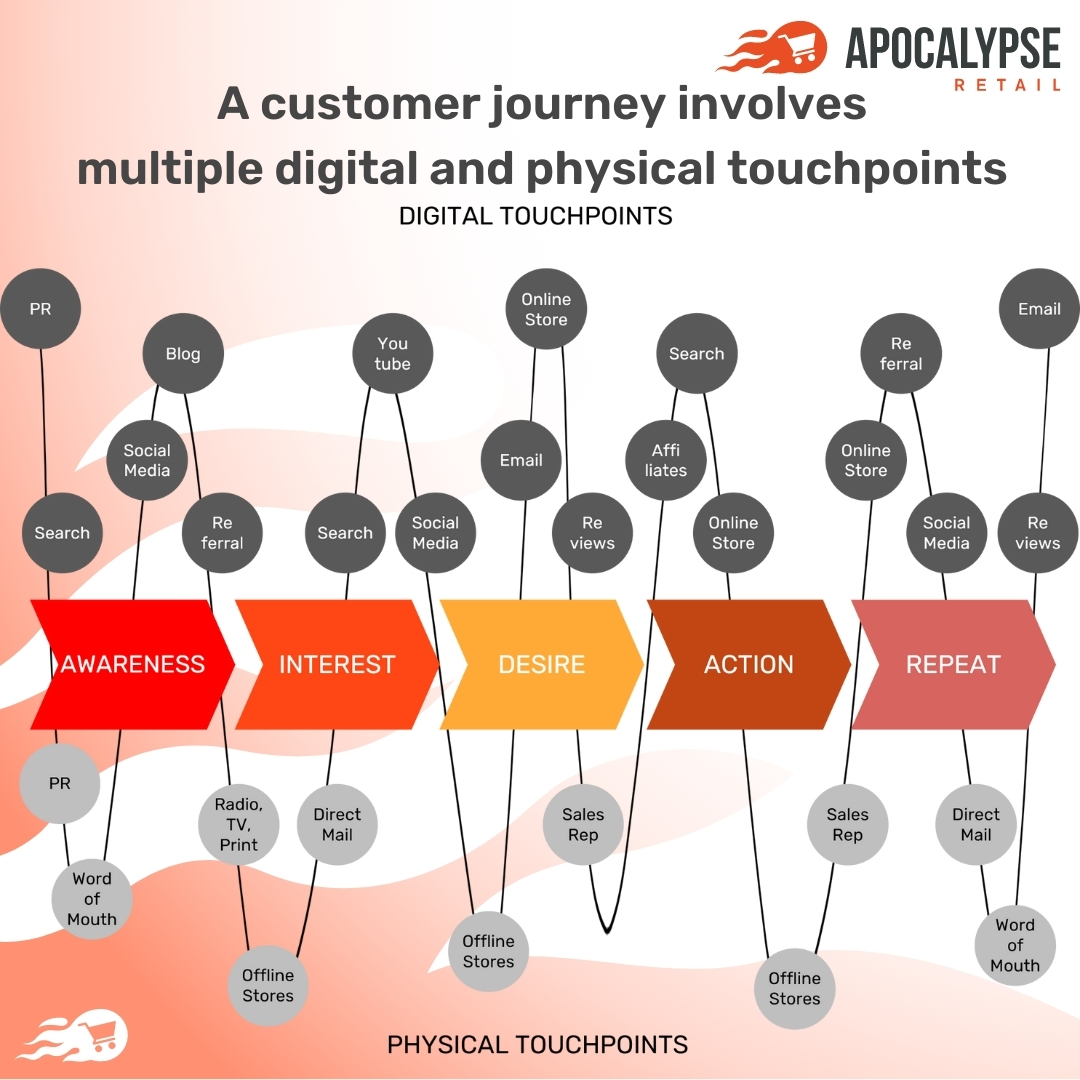
The problem is that very few companies have a clear strategy for all touchpoints. And even fewer companies have a strategy to provide a unified experience between touchpoints.
Below is a list of touchpoints that customers can have with a brand in their path to purchase.
The end goal for any brand should be to provide a unified and seamless experience across all touchpoints. This is what is known as Omnichannel Retail.
These are the primary customer touchpoints in modern Retail:
- Physical Stores
- Sales representatives or store associates
- Public Relations
- Direct mail
- Word of mouth
- Traditional marketing channels: TV, Radio, Print
- Company website and blog
- Social Media
- Search Engines
- Youtube
- Affiliates
- Customer reviews
Physical Primary Customer Touchpoints
1. Physical Stores

The physical store is the backbone of the Retail industry. It is the most traditional of primary customer touchpoints.
A store is a physical touchpoint where customers engage and interact with brands.
In a store, the customer interacts with the clearest value proposition from a product or service. But the physical store offers so much more than this.
Today, the store is a key touchpoint to offer everything that digital channels cannot provide.
Retailers who are thriving today have understood this. They are creating the store experience around essential, value-added services for their customers.
The store is not just a place where you can get the product immediately. Touching, feeling, smelling, trying a product are value-added experiences provided by physical stores.
These are real experiences that matter to consumers.
The sensory experience that a physical store provides to a customer is a massive part of the interaction. The smells, noises, colors, and displays within the store significantly impact how customers perceive the brand.
Within their merchandising strategy, brands must consider the sensory experience. In addition, they must consider how they want to set up the customer journey within the store to maximize product sales.
There is a lot of talk today about the sensory experience in the store, but there is nothing new about it.
Brands such as Disney or Starbucks have done a tremendous job working every detail of the physical store experience. And they have done it for more than 30 years.
2. Sales representatives or store associates:

There is a crucial touchpoint that can make or break a long-term relationship with a brand. This crucial touchpoint is the sales representative (sales rep) or store associate.
The sales rep is the human interaction that a customer can get with a brand. They are the human side of primary customer touchpoints.
How a store associate talks, dresses, behaves and helps is a representation of the brand.
Store associates are a key channel to drive a value proposition from the brand to the customer. The value of the store associate in the store is not by stocking shelves or working the checkout.
These are all tasks that have little value and will eventually be automated.
The real value of a store associate is to build trust and help the customer in their decision process once they enter the store.
It’s not just a matter of increasing the basket size. It is a matter of engagement with the customer to promote loyalty.
Many retailers pay bonuses to their sales reps only by the revenues they generate. Unfortunately, this leads to some sales reps sacrificing a long-term relationship for a short-term payout.
Companies must consider KPIs that promote customer loyalty and not just a one-off purchase to get the most out of a sales rep.
Focusing on KPIs that promote customer experience is better to motivate store associates.
These KPIs include:
- the store NPS,
- return rate within 90 days,
- or new members to the loyalty program.
Off-course, this measure must be implemented with the proper training for store associates.
Measuring and training store associates to follow these KPIs has an immediate payback. Not only by increasing revenues but also by reducing customer acquisition costs!
3. Public Relations

Public Relations is how a brand controls (or tries to) how other outlets will discuss them.
Companies very often neglect this role due to budget constraints.
Still, if done effectively, PR can significantly reduce branding expenses for a company. Thus, PR must be considered as one of the primary customer touchpoints.
An effective PR team can build momentum with the press and other outlets about a new product launch or opening a new store.
Good PR can drive tons of “free” traffic to your stores by relaying and distributing news about your brand.
Of course, news about your brand needs to be exciting or positive.
That is the role of a PR team: to get “control” of how a brand is perceived and talked about in mainstream channels.
4. Direct Mail

With email and digital channels, direct physical mail has lost a ton of budget, in the same vein as print media. But in 2021, many retailers are still doing Direct Mail and sending physical letters to their customers.
Just go and take a look at the trash near the post box in buildings. Restaurants and many retailers still rely on physical mail as a marketing channel.
Despite what you just read, we’re not against Direct Mail; we’re just against spamming in general, whether it’s online or offline.
There are few things as damaging to a brand than to be considered spammy. But if it’s done correctly, direct mail can still be a value-added channel to reach customers.
Direct mail can yield great returns when it’s done with good copywriting, great visuals, and proper customer segmentation.
5. Word-of-Mouth

The ultimate goal of all the touchpoints in this list is to increase word-of-mouth about your brand.
Getting people to talk positively about your brand is the holy grail for any Retailer. It is extremely hard and can only happen when companies provide a great experience in your primary customer touchpoints.
A great experience resets the expectation level from the customer. It becomes the point of comparison for all experiences to come and talk about with their friends.
People talk about products, brands, and experiences daily.
Companies that understand this aspect will create fans instead of just customers.
Suppose all your customers only had positive things to say about your brand. How many more customers could you get without investing a single euro in extra marketing?
6. Traditional marketing channels: TV, Radio, and Print

Traditional marketing channels are also known as offline marketing channels. For decades, the ad industry focused on creating brand awareness through the three big channels: TV, Radio, and Print.
Think about traditional marketing channels.
You can immediately think of Don Draper and the Mad Men crew in the golden years of ad agencies of Madison Avenue.
On top of the big three, traditional channels also include directories, magazines, newspapers, and flyers. You can also have movies or films in this category.
Traditional channels, particularly TV, are great channels to build brand awareness today. But the logistics and foggy attribution of these channels make them very inefficient.
Companies used to measure the efficiency of an ad campaign by total revenue growth. But the reality is that there are multiple factors influencing revenue growth. A good or bad day of weather, for example, can have a massive impact on the income of a physical store.
So brands started seeking channels that gave them more visibility in terms of revenue attribution. Digital channels have slowly but surely changed the face of the ad industry.
Most digital ads have been around since the late 1990s. But the fundamental shift in the ad industry accelerated in the last ten years.
According to eMarketer, ad spending on traditional channels went from almost 75% in 2014 to less than 40% of all spend by 2021.
Since 2019, digital ad spend has represented more than half of all spend.
Think about it. This is before the impact of the Covid19 pandemic!
In only five years, digital ads doubled their market share of the entire ad industry. And this market share is expected to reach two-thirds of all spend in the next couple of years.

Digital Primary Customer Touchpoints
The rise of Digital Marketing is due to its cost efficiency and ease of revenue attribution. Digital channels are incredibly efficient at connecting the right product to the right person at the right time.
This is the holy grail of omnichannel engagement.
Let’s take a look at the channels that are considered within the Digital channels.
7. Company website and blog

A Retailer’s website has become one of the primary customer touchpoints to look for the brand.
The website has different goals for Retailers and depending on how it’s structured. However, it can be a significant asset in helping customers move down the customer funnel.
As of today, any decent website of any Retailer must be completely mobile responsive. Some retailers have launched mobile apps, but this shouldn’t be an excuse to have a crappy mobile design on your main website.
Users must easily and quickly find all the information they need on a website whether they are looking for a specific product or want to find information on stores.
A homepage must be product-oriented, but it must also include all the necessary contact information. The information about customer service or physical stores must be clear, updated, and easily findable.
On top of this, Retailers can also provide additional content for their customers via their blogs. Therefore, if done correctly, a blog has some great benefits for ranking higher in Search Engines.
But before launching a blog, a company must consider that all the content they push becomes a new touchpoint for customers.
All content (posts, videos, or tutorials) must be curated to reinforce the customer experience.
8. Email

Email is one of the channels that has been present since the early days of e-commerce. But in the last ten years, it has evolved significantly with new email marketing tools.
Email marketing is a digital channel built around sending emails to prospects and customers. The key objective of email marketing is to keep a prospect engaged and potentially turn them into customers.
At the same time, it is also used to maintain existing customers engaged with the brand. The aim is to turn them into loyal, returning customers eventually.
Retailers must build and nurture their email lists to unlock the full value of email as a primary customer touchpoint.
In the age of social media and search engines, an email list is one of the most important assets of a brand. But most Retailers don’t take the most advantage of their email lists.
Email marketing is often used only as an outbound marketing channel. Sending weekly newsletters to customers is what most brands include in their email strategy. Still, with the right tools, brands can unlock the full potential of their email marketing strategy.
With the proper segmentation, brands can segment that email list by interest, behavior, or intent. This strategy highly increases the email conversion rate.
Also, the power of automation allows brands to “make money while they are sleeping.”
By setting up the proper triggers and email workflows, brands can automate specific touchpoints. All of this while providing a personalized experience.
The following workflows need to be automated to provide an incredible, cost-efficient experience:
- Welcome email > New account
- Welcome email > Newsletter signup
- Thank you email > Order confirmation
- Thank you email > Account birthday
- Thank you email > Customer’s birthday (if possible)
- Conversion email > Don’t forget the product in the basket
- Conversion email > Other people also viewed/bought
- Conversion email > Reorder the same product (after an estimated consumption time
- Feedback email > NPS
- Feedback email > Order, Product, or store review
- Referral email > Share our email and win X
Setting up these workflows can be time-consuming in the beginning. But once they are set up, they will generate revenues and customer loyalty with little additional marketing spend.
On top of a marketing channel, email is also a key point of contact for customer service.
Email is the most effective channel for customer service as (almost) everyone has an email, and 91% of consumers use email every day. It is challenging to find a channel with as much adoption by customers.
So companies need to consider email as an outbound, automated, and inbound touchpoint.
9. Social Media

The rise of Social Media has been staggering in the last 15 years. Today, social media platforms account for billions of users worldwide.
Social media allows users to talk about their lives, share photos, and find out what friends do. Most users under 60 years old spend time each day on at least one social media platform.
It is no surprise that Retail companies flock to Social Media to build brand awareness and spread marketing messages.
Social media has become one of the primary customer touchpoints as it involves direct communication with brands on an “equal” level.
For a marketing or commercial message to get viral across social media, users must be willing to distribute the content.
So companies have to create communities of fans and make sure they have content that is easy to consume and shareable.
But once you enter the social media game, it’s not just a marketing or branding channel. In social media, users can interact with the brand, ask questions or make complaints.
Brands and Retailers must consider Social Media as a two-way street.
Companies need to provide excellent customer support via social media on top of great content. This support will heavily impact how a brand is perceived through social media networks.
10. Search engines

As we saw before, search engines are THE most-used channel for brand discovery. According to the Global Digital Review, close to 34% of customers use search engines looking for brands.
Digging deeper into the French market, more than 62% of customers use Search Engines for brand research.

Search Engines essentially mean Google, as it accounts for close to 95% of the search engine market in Europe.
Google has become a virtual channel for Retailers to interact with their customers. In other words, Search Engines are the gateway to the internet.
When you make a query through a Search Engine, they have a catalog of billions of pieces of content available online. The algorithm will rank content to determine which has the most chances to answer your particular query.
As we saw before, a third of users will use Search Engines to discover brands. And almost two-thirds will use them to research a brand or product.
This gets complex as there are billions of pieces of content competing in a search engine’s ranking.
This staggering amount of content makes it a necessity to optimize content for better ranking. Therefore, every company needs to have a content optimization strategy regarding search engines.
Optimizing the position in Search Engines is what’s known as Search Engine Marketing (SEM).
SEM includes:
- Search Engine Optimization or SEO: a mix of semantic and technical strategies to optimize your content to rank higher in organic searches
- Search Engine Advertising or SEA: paid ads to optimize your positioning for specific keywords.
11. Youtube

There are debates on whether youtube is a Search Engine or a Social Media. The quick answer is that it’s a mix of both.
Youtube has become the second-largest search engine in the world, according to Alexa Rankings.
In the Global Digital Review of 2021 by WeAreSocial, Youtube came as the second-largest social media platform globally. Just after Facebook, Youtube has close to 2.3 Billion monthly average users.
In the French market, as of January 2021, Youtube became the first social media platform. More than 80% of french users between 16-64 years old declared to have used the platform in the past month.
Youtube has become the dominant platform to share content and interact with customers in video format.
Brands and Retailers need to use this touchpoint as a search engine and a social media platform.
To optimize content to rank higher, but also to interact and engage with its users.
12. Affiliates

Affiliates are some of the most underrated touchpoints a customer can have with your brand.
Of course, it’s a digital marketing channel, so it’s mainly driven to increase sales. Still, you can achieve excellent results in terms of branding by using affiliates properly.
Affiliates are websites or blogs that will direct traffic to your website for a commission (pay per click or sale).
Think of affiliates as influencers.
Instead of having a social media platform, they use their traffic from their website or blog.
The key to excellent affiliate marketing is to work with affiliates that curate their content. The best affiliates are those that create content that doesn’t feel like an ad.
Of course, you need to work with affiliates that have audiences like yours.
When the affiliate has the right incentives (pay per sale), they will create the best content to generate as much revenue as possible on your website.
It’s a win-win for all.
13. Customer Reviews

Customer reviews have become the ultimate digital social proof in today’s Retail. Authentic reviews can be a fundamental asset to generate trust with new customers.
Whether it’s product, store, or service reviews, companies have to nurture and collect as many reviews as possible.
Many platforms like Yelp, Square, or TripAdvisor built their reputation by giving “a voice” to customer reviews.
But in the past few years, Google My Business has become the most effective channel for customer reviews.
Google My Business is integrated with Google Maps and can have a massive impact on your local SEO ranking.
In other words, if you want customers to find your store, you need to have an updated, clear, complete Google My Business page.
As we said, customer reviews are fundamental to build trust for other customers. Companies need to make sure to address and nurture reviews.
Many retailers fail to promote and ask customers for reviews for fear of having a bad review. A bad review is still positive for your company:
- If the customer is right to leave a bad review, you have just identified a problem within the customer journey. You can then make the necessary corrections so it doesn’t affect other customers.
- If the customer is a pain in the ass, a negative review is an opportunity to make sure other customers see how you handle negative experiences. Let other customers know how you treat and reply to all customers, even the worst. Your replies to customer reviews have an audience. They should be treated as a marketing channel: you should never be condescending, aggressive, or petty.
This is a comprehensive list of the primary touchpoints of the customer journey that every company should know.
Do you want more insights into E-commerce, Omnichannel Retail, and Digital Transformation? Subscribe to ApocalypseRetail to get insights sent directly to your inbox. Our content is designed for top business schools, retail managers, and eCommerce entrepreneurs who want to survive in the ever-volatile retail industry. Subscribe to our newsletter to join the fight against the Retail Apocalypse!
The post The Complete List of Primary Customer Touchpoints Every Retailer Must Address appeared first on Apocalypse Retail.
]]>