The post Amazon Physical Stores: A Successful Game Changer in the Retail Sector? appeared first on Apocalypse Retail.
]]>We want to give our special thanks to Pablo Marcote & Ricard Codina, the two students who co-authored this post.
Sometimes, big isn’t big enough. For Amazon, the world’s most significant e-commerce player, the online world isn’t enough to contain its ambitions.
Amazon physical stores are part of the company’s well-planned entry into the retail landscape. And like everything it has touched, Amazon has all the expertise and financial punch to change the brick and mortar sector.
Shopping and Amazon are synonymous. But for a while now, it’s the company that’s been on a shopping spree.
This shopping spree is different from Jeff Bezos’s post-divorce purchases of a yacht that comes with another yacht or a mansion with a 9-hole golf course. No, this is about the company and not the new bachelor on the scene.
From Whole Foods to PillPack to Ring to Zoox, the online behemoth has acquired companies to build its portfolio, enhance its technological capabilities, and fuel its retail growth. As a result, its strategy is different from other online or big-box retailers.
What is Amazon’s physical store strategy?

The company has been rolling out Amazon physical stores to widen the horizon of its offerings in the retail sector.
Amazon Go, Amazon Go Grocery, Amazon 4-Star, and Amazon Lockers are only some moves to disrupt the market and enhance offline shopping experiences.
After redefining e-commerce, the company, it seems, is now about to redefine commerce as we know it.
Amazon Books, the company’s first venture into the traditional retail sector, was launched in 2015.
Starting in Seattle, it’s now present all across America. The Whole Foods acquisition followed suit. Then came Amazon Go, Amazon Go Grocery, and others. With Whole Foods, the company now has around 600 physical stores worldwide, divided as follows:

The strategy is to be an omnichannel marketplace instead of a single-channel seller.
After a testing phase opening Pop Up stores in 2018 following the acquisition of Whole Foods, Amazon has rolled out a complete physical strategy. However, the company is definitely not in the testing phase regarding its physical-store strategy.
For those interested in knowing, for example, where Amazon Go or Amazon Fresh is available, Amazon stores are mainly located in the US. They can be found in the following Amazon physical store locator. Nevertheless, Amazon plans to expand overseas, with the UK as a testing ground before a full-scale deployment in Europe.
But why the shift? Why is Amazon expanding to formats and delivery modules that are not in natural alignment with its traditional strengths? What’s prompting this retail expansion?
Seven reasons why Amazon is jumping to brick & mortar retail
1. The future of retail is omnichannel

Even though all the talk about the surge in online sales, especially the tremendous spike witnessed during the pandemic, offline commerce isn’t going anywhere.
That’s primarily because the offline shopper behavior of consumers is different from their online behavior. One is driven by experience while the other, by convenience.
This means that there aren’t exclusive groups of shoppers. Instead, most people prefer both kinds of commerce. What they want is a blend – and best – of both online and offline buying experiences.
E-commerce offers an exceptional choice of products, prices, and time-bound discounts that are difficult to find offline. In addition, Offline gives consumers a more immersive shopping experience that’s difficult to replicate online.
The tactile and sensory experience of being in a physical store adds a level of engagement that e-commerce can never compete with.
Amazon knows this and doesn’t want to be seen as just an e-commerce marketplace. They want to be where the customers are.
2. Gathering data on offline shopping behavior

Another reason for the launch and expansion of Amazon physical stores is the enormous data they give the online giant. But, unfortunately, while the company has the shopping data of millions of users, it doesn’t have much on offline shopping behavior.
The online shopping data, while significant, doesn’t tell much about the retail activities of consumers. This isn’t surprising as product search and discovery are different in both spaces.
By focusing only on one, Amazon would be missing out on a completely different set of customer insights.
The Whole Foods deal has to be seen in this context.
This deal gave Amazon detailed data on consumers’ consumption and behavior patterns of a well-established retail brand.
Importantly, it also allowed Amazon to club the benefits of in-store shopping with its Prime membership using refined consumer data.
In that sense, Amazon wasn’t acquiring Whole Foods. It was acquiring its customers.
3. Offline retail offsets shipping costs

Just because they’re a behemoth doesn’t mean rising costs don’t hurt them. Amazon, just like its customers, is always looking to save more. And when your shipping costs are around $61 billion a year, you want to bring it down.
With brick-and-mortar stores, customers would pick up their orders, significantly lowering the shipping costs.
They would also offer easy and inexpensive returns as customers themselves would be bringing back the products.
Also, whenever a customer arrives to either pick up or return a product, an Amazon physical store would be tempting not to check out.
They might find the product they were looking for or a similar one. This, without having to visit another store or open the app and search through several pages.
In other words, an Amazon physical store would double as a retail outlet and a pickup and return center.
4. Rising online acquisition costs

Customer acquisition is expensive whether you’re an independent online brand or the largest marketplace out there. For example, Amazon has to spend significantly on digital marketing to acquire and retain its customers.
And considering the competition and the choices a customer has, it’s a game they have to play repeatedly. As a result, the company has targeted millions of keywords and invested heavily in AdWords and SEO.
But with Amazon physical stores, there won’t be any need to spend to acquire customers repeatedly. Customers are loyal to their convenience or grocery stores and are unlikely to go out of their way to find a new one.
5. Physical store operations are ripe for disruption

If there’s one thing that Amazon’s famous for, it’s disrupting the models and markets it has entered.
And everyone knows that physical stores aren’t exactly known for their efficiency or ease of use. Legacy retailers have some legacy issues.
One could argue that nothing much has changed in the brick and mortar space over several decades.
It’s the same old process of customers locating the products on the shelves, picking them up, heading to a counter, waiting for the cashier to be free, and then checking out.
These are all friction points that Amazon hopes it will be able to solve with its technology.
Automated checkouts, cashier-less technology, and even staff-less stores are just some solutions already part of the Amazon physical store experience.
If those sound innovative, imagine the ability to pay with one’s palm! Now imagine that you can already do it at some Amazon physical stores.
6. A significant share of retail is still offline

Despite the growth of e-commerce, many consumers still prefer their offline shopping experiences.
Contrary to popular perception, online sales have been picking up. Still, they lag behind brick-and-mortar sales in most categories.
According to a PwC Total Retail Survey, 70% of consumers still prefer offline grocery shopping.
While this may not be surprising, what’s notable is that even for clothing and footwear and health and beauty, the majority still would instead buy them from a retail outlet.
So, since Amazon cannot comprehensively change customer behavior, it’s ready to expand its business model.
7. Growing the Amazon ecosystem

Amazon isn’t just the world’s biggest online marketplace.
It’s also an ecosystem of products and services that include everything. From Echo to Alexa to Kindle to payment services to probably self-driving cars in the future.
While the company encourages shoppers to seek its in-house solutions, a retail presence would speed up the process.
Consumers would be more encouraged to buy a Kindle or Echo when they see both in action. Once they roll out the grocery shopping through Alexa, it will elevate their retail game to a whole new level.
Importantly, all these are directed at growing Amazon’s Prime subscriber base. That membership would open up a world of omnichannel benefits to consumers. From shopping to entertainment, all enabled by voice commands.
8 Amazon physical store models you should know about
How has the omnichannel play from the largest e-commerce player worked out so far?
Here are the 9 Amazon physical stores through which the company hopes to revolutionize the retail landscape.
1. Amazon Go

Launched in 2018, Amazon Go relies on advanced machine learning to make shopping seamless for customers. For example, sensors on the shop shelves would inform the system what products a customer has picked up.
The best way to understand the convenience provided by the Amazon Go Concept is to watch this video:
The shopper doesn’t have to check out or approach any counter. Instead, they can head out of the store, and Amazon will automatically charge their accounts. This cashier-less technology is called Just Walk Out and will be explained further in the Amazon Fresh Store section.
This is an excellent example of breakthrough technology. And the company is using it to disrupt an industry notorious for its legacy inefficiencies.
2. Amazon 4-Star

Sometimes it helps to answer questions that no one has asked.
Customers never asked for the highest-rated Amazon products to be available offline.
But that’s precisely what the company did through Amazon 4-Star, which features four-star ratings or above products. These include books, devices, home products, and Echo, to name a few.
Consider it Amazon’s version of a Greatest Hits album.
3. Whole Foods

Whole Foods is perhaps the most high-profile acquisition (before the recent MGM purchase). It was Amazon’s most compelling move to enter the brick and mortar space.
With Whole Foods, Amazon wasn’t just getting close to 500 stores. It also got access to consumers who don’t mind spending extra on organic and sustainable food products.
4. Amazon Fresh Store

If Whole Foods is for more high-end and health-conscious customers, the Amazon Fresh store, previously known as Amazon Go Grocery, is targeted at those consumers who are used to shopping at Walmart or Target. The stores stock a wide variety of products beyond the healthy staples found at Whole Foods.
One of the main innovations implemented by Amazon in its physical stores focuses precisely on Amazon Fresh stores, with the new Just Walk Out shopping technology. Customers opting for the cashier-less technology can use Amazon One to scan their palms, use the QR code with their Amazon app, or insert a credit card linked to the Amazon account. The technology enables Amazon users to shop, pick up the desired items, skip the checkout process, and leave the store freely.
Does this mean that only Amazon users can shop at these new stores? Absolutely not. Anyone can shop at Amazon Fresh, whether using Just Walk Out or the traditional checkout lines paying by cash or a credit card.
5. Amazon Bookstores

No one forgets their first love. And for Jeff Bezos and Amazon, it’s always been books.
Launched in 2015, there are around 25 Amazon Bookstores in the US where customers can enjoy the tactile pleasures of touching and taking in that exquisite aroma that can only come from books.
6. Amazon Lockers

This is one of the finest ways in which Amazon is merging its online and offline brand experiences.
Amazon Lockers can be found in grocery stores, malls, and apartments. After ordering, customers will get a unique code to open the locker and get their product.
Whole Foods has Amazon Lockers which encourage customers to browse their products when they arrive to take their delivery. This is the kind of synergy that Amazon hopes to see across its Amazon physical stores and product portfolio.
7. Amazon Pop-Ups

These are Amazon’s take on casual pop-up stores.
The intent is to make it easy for customers to quickly browse trending products unavailable in stores through interactive displays. Unfortunately, in 2019, Amazon decided to close all its pop-up stores, terminating the experiment.
Nevertheless, later in 2020, Jeff Bezos communicated the strategic decision to reopen the pop-up tests to better understand the physical customer experience and leverage the new data gatherings.
8. Hair Salons

Yes, we, too, were surprised. But at its only location in London, customers can use augmented reality mirrors to know how a style or hair color would look on them.
They will also be given Amazon Fire tablets to entertain themselves. But, of course, they can also buy any cosmetic or beauty product by merely scanning a QR code.
We’re not saying it isn’t a riveting success, but the company doesn’t have plans to open more salons.
Amazon physical stores are the next stage in the evolution of a company with unprecedented domination in one space.
As they get popular, customers would also expect such tech-enabled services from legacy retailers.
It will also emphasize the divide between traditional big-box outlets and a technology-first company like Amazon, precisely what the company wants through its brick-and-mortar stores.
Do you want more insights into E-commerce, Omnichannel Retail, and Digital Transformation? Subscribe to ApocalypseRetail to get insights sent directly to your inbox. Our content is designed for top business schools, retail managers, and eCommerce entrepreneurs who want to survive in the ever-volatile retail industry. Subscribe to our newsletter to join the fight against the Retail Apocalypse!
The post Amazon Physical Stores: A Successful Game Changer in the Retail Sector? appeared first on Apocalypse Retail.
]]>The post The Real Value of the Physical Store in an Omnichannel Strategy appeared first on Apocalypse Retail.
]]>People often assume that an omnichannel strategy depends entirely on digital channels. But this completely misses the real value of the physical store in an omnichannel strategy.
As we said in one of our previous posts, Omnichannel is one of the most frequently used buzzwords in retail today.
But, the reality is that a true Omnichannel strategy for traditional retailers is not launching a website and selling online. Or, if you are a pure player, opening a physical store doesn’t make you an Omnichannel company.
Selling online or offline are just traits of a Multichannel strategy.
A Multichannel strategy is where a company meets the customers where they are, whether on their website, social media, email, or physical stores.
The key difference with an Omnichannel strategy is the consistency of the customer experience.
An Omnichannel strategy unifies a consistent customer journey across every single channel.
Let’s cover again why all retailers need to implement an omnichannel strategy.
An Omnichannel Strategy is Needed to fill the Existing Friction of the Mobile Experience

A lot of e-commerce pure players can see exponential growth during the years. This has led some to believe they can be pure online players indefinitely.
But if we look closer at those e-commerce players that are a bit more “senior,” most have started opening physical stores.
Amazon and Alibaba, the world’s e-commerce juggernauts, have aggressively expanded offline. Even some Digital Native Vertical Brands (DNVB) have jumped offline in recent years.
The reality is that even if online retail penetration is growing fast, the offline part of the market is still huge.
As Jeff Bezos put it in a letter to Amazon shareholders back in 2019:
“Amazon today remains a small player in global retail. We represent a low single-digit percentage of the retail market, and there are much larger retailers in every country where we operate. And that’s largely because nearly 90% of retail remains offline, in brick and mortar stores.”
Even if we consider that a quarter of global retail sales will be online by 2030, that still lets 75% of transactions offline.
So what is slowing online retail penetration?
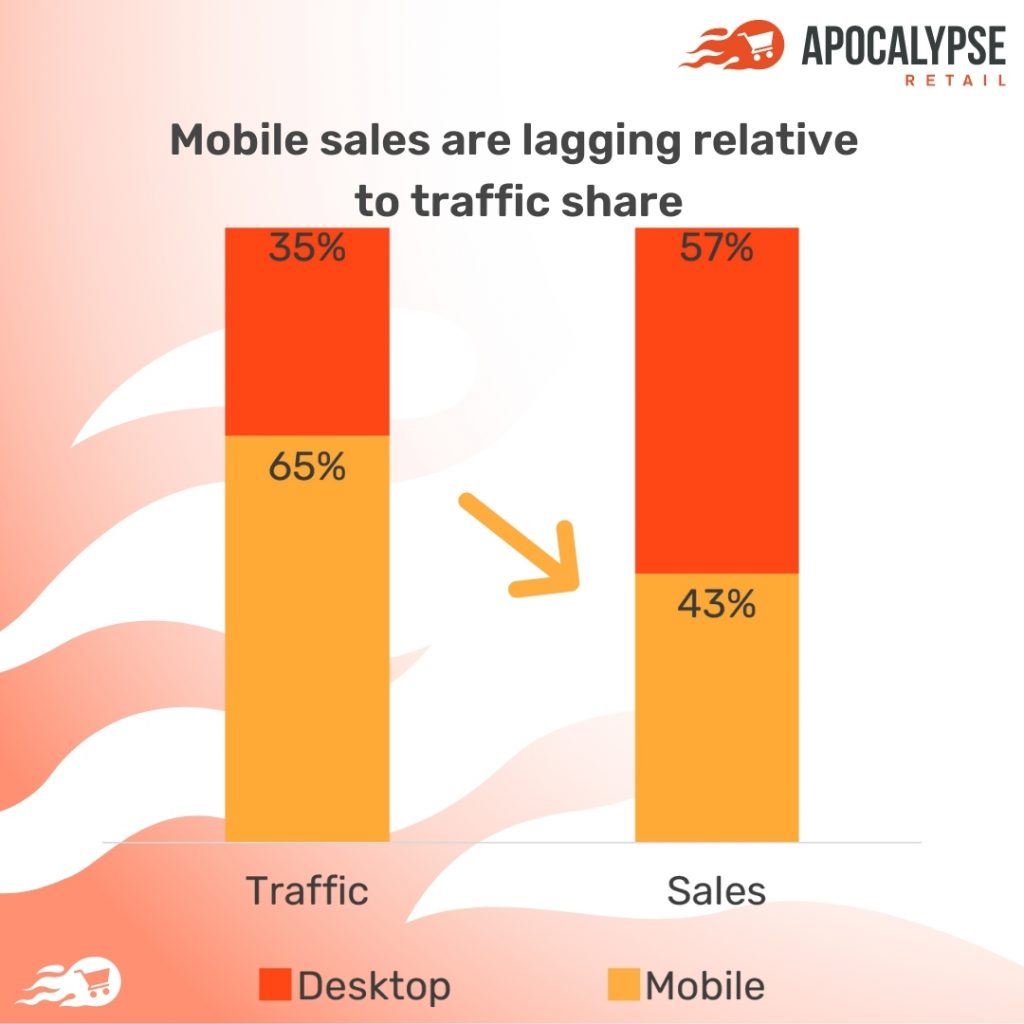
Mobile sales are lagging relative to traffic share.
Today, everyone and their mother has a smartphone. Both in developed countries and emerging markets, most adult consumers have a smartphone.
And they use those smartphones to go online to research and discover products or information. Or to chat or browse on social media.
As of 2020, mobile visitors represent almost two-thirds of global online traffic. But the problem is that it only represents 43% of global online transactions.
There is a clear drop in transactions relative to traffic.
Mobile conversion is also lagging relative to other devices.

Image Source: Apocalypse Retail 2021. Why do Retail companies need to implement an Omnichannel Strategy? Bernstein E-commerce Outlook September 2020
The drop in transactions relative to traffic is essentially due to much lower conversion rates than other devices.
If we deep dive by device, mobile conversion rates are meager compared to other devices. And this trend has been sustained for almost a decade.
Let’s compare conversion rates between devices from 2013 to 2019. In both years, conversion rates are almost 3x lower than desktop and 2x lower than tablet conversion rates.
Indeed, smartphone conversion rates improved more during that period than the other devices. But mobile conversion rates remain way too low.
The reality is that most websites are not designed for mobile-first.
Most websites are designed for a larger, easier-to-use desktop screen. And when users try to use it on mobile, it doesn’t respond in the same way.
The hard truth is that the mobile user experience is very hard to improve. At least to reach the same conversion rates as other devices.
So there will continue to be friction in the mobile customer journey which affects almost two-thirds of all online visitors and rising.
But how does mobile fare compared to the physical experience?
Customers still prefer in-store experience compared to mobile.

If the mobile experience is worse for purchase than other devices, the same can be said compared to physical stores.
Mobile traffic has increased exponentially, but the shopping behavior still favors offline stores.
Customers prefer to discover and shop for products in offline stores. Most product discovery is still offline, and customers will do most of the research on mobile devices.
In the end, even if mobile transactions are on the rise, most customers still prefer to shop offline.
The reality is that the physical experience offers something unique.
The value of the physical store and why all retailers must implement an omnichannel strategy
The Physical Store has a Unique Value Proposition

The most bullish e-commerce advocate will say that the physical store is dead. But when we started Apocalypse Retail, we were convinced this statement is wrong.
We don’t mean to give false hope to traditional retailers.
A lot, if not most, of legacy retailers, will perish in the Retail Apocalypse. But this doesn’t mean the end of brick-and-mortar Retail. Instead, it means the end of legacy brick-and-mortar Retail.
When analyzing online and offline retail customer journeys, it is clear that companies don’t have to choose between one or the other.
Both have entirely different value propositions.
The online experience offers convenience more than anything while the offline experience offers… the physical experience.
The offline experience offers human interaction, touching, trying on, seeing, smelling a product. These are all real, value-added experiences that profoundly impact customers.
The physical store has a unique value proposition that is not going to disappear.
The physical store must reinvent itself.

Most legacy retailers have been overconfident about the value of the physical store. And this has led them to keep using the same brick-and-mortar strategies that worked for the past 30 years.
But by doing so, they have been ignoring a massive shift in consumer behavior.
Consumers crave convenience more than anything. And the online experience is built to provide consumers with convenience.
The physical experience, by definition, requires a physical effort. So the physical store will never be able to compete in terms of convenience.
To survive the Retail Apocalypse, the store must reinvent itself. The physical store must be built and designed on everything that won’t be able to be provided online.
The unique value proposition from the store is its core strength.
As we said before, physical stores offer human interaction, touching, trying on, seeing, smelling a product. Retailers that understand this will change the way they approach physical stores.
But unfortunately, legacy retailers still approach the physical experience as they’ve always done. They continue looking at the store as a point of sale measured in terms of Sales/m2.
This completely fails to understand that customers are not exclusive to single-channel journeys. Retailers try to cram as much stock as possible in stores to maximize profitability per m2.
But a physical store is, above everything else, a customer touchpoint. And thus, it should be treated as a marketing channel. Marketing in the sense that it should be designed to attract visitors.
Whether the visitor completes the purchase online or offline is irrelevant. It should be a seamless customer journey.
The physical store provides a showroom where the customer can get everything they can’t get online. The whole package to try, test, and experience the product.
The rest of the journey will always be more convenient online. So, stores must be built and designed to maximize the customer’s physical experience.
Pure Players are Jumping Offline with a Different Approach to the Physical Store

As we said before, most e-commerce pure-players are jumping offline once they reach a certain point.
Amazon, for example, has invested massively in its offline expansion. Not only the Whole Foods acquisition but opening multiple Amazon Go stores with connected carts.
But the approach to physical retail is completely entirely different from the one used by traditional retailers.
Off-course, e-commerce players are looking to increase revenues when they jump offline. But this is only part of the offline strategy.
The offline strategy from e-commerce players is built on two things:
- The physical store is a data acquisition channel
- The physical store is a marketing channel
1. The Physical Store as a Data Acquisition Channel

Amazon is one of the best examples of this strategy.
Imagine you have one of the most powerful customer-data-gathering empires in the world. But this empire is built exclusively for online transactions.
As Jeff Bezos stated, Amazon only represents a fraction of the entire Retail market. And almost three-quarters of all retail transactions will still be done offline by 2030.
So even if they perfected an online data-gathering platform, Amazon “only” has access to a small part of the customer journey.
Now, imagine tracking a customer in your offline store with the same level of detail you can track them in an online store.
Knowing which products they viewed, which ones they added or removed to their cart, when they entered or left, etc. And connect this offline data with the online data you already have of the same customer.
The potential to have an accurate 360º view of the customer is limitless.
This is the way a company can offer relevant, consistent content across channels. And increase their customer retention rates, revenues, and profitability in the long run.
This explains why Amazon is aggressively expanding offline and, as of 2021, the company already operates more than 600 physical stores in the US.
2. The Physical Store as a Marketing Channel

E-commerce pure players much smaller than Amazon are also opening stores.
DNVBs such as Casper, Bonobos, or Le Slip Français in France have opened physical stores. But they have centered the entire offline experience on everything that their online stores could not offer.
The stores are designed as showrooms that offer a consistent value proposition to customers.
In the same way that these brands have disrupted their consumer categories, they are doing the same thing for offline retail.
For a DNVB, the physical store is, above all, a marketing channel. And they will treat it with the same data-driven approach that they use for every digital marketing channel.
The end goal of physical stores is to acquire more potential customers and raise brand awareness.
If the visitor converts offline, it’s a win-win, but if the visitor at least gives their contact info, it’s also a win.
They have just captured a lead. And they will use their deep understanding of the digital funnel to try and convert that lead into a customer.
In the end, it’s all about making sure that the Lifetime Value (LTV) of the Customer is higher than its customer acquisition cost (CAC).
If the CAC also includes the cost of a physical store, it’s because these brands are betting the LTV will also be higher.
DNVBs have understood the fundamental truth about Omnichannel Retail: The value provided by a unified customer experience across channels is greater than the sum of its parts.
Do you want more insights into E-commerce, Omnichannel Retail, and Digital Transformation? Subscribe to ApocalypseRetail to get insights sent directly to your inbox. Our content is designed for top business schools, retail managers, and eCommerce entrepreneurs who want to survive in the ever-volatile retail industry. Subscribe to our newsletter to join the fight against the Retail Apocalypse!
The post The Real Value of the Physical Store in an Omnichannel Strategy appeared first on Apocalypse Retail.
]]>The post What is the Retail Apocalypse? The End of Traditional Brick-and-Mortar Retail appeared first on Apocalypse Retail.
]]>In particular, the shifts in consumer behavior over the last two decades. In this period, there has been a massive shift in access-to-market for Brands.
Traditional brick-and-mortar Retailers have (mostly) failed to adapt to this shift. As a result, traditional retailers have legacy IT systems, outdated acquisition tactics, and rusty supply chains.
Very few companies made investments to update their infrastructures.
The majority just kept doing the same thing that had worked during the Golden age of traditional Retail.
Then the Covid19 pandemic struck in 2020 and a lot of traditional retailers were spectacularly underprepared to meet the demands of the new customer behavior.
What is the Retail Apocalypse? Understanding the golden age of brick-and-mortar Retail
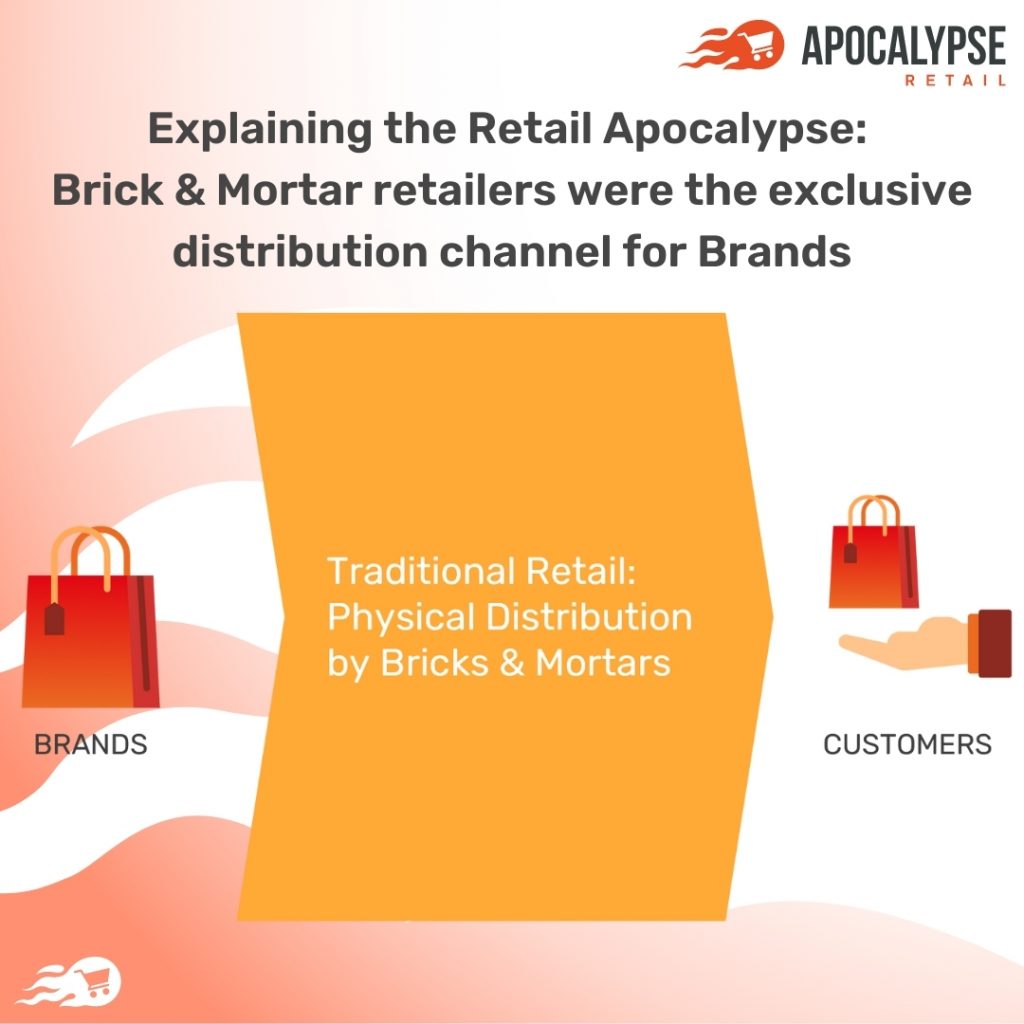
From the 80s to the early 2000s, wholesale brick-and-mortar Retailers dominated the market. They became what we know as Traditional Retailers or Legacy Retailers.
During three decades, these companies were THE channel for customers to access products and brands.
There was a clear separation of roles.
On one side, brands that designed and made products. On the other side, brick-and-mortar Retailers, which provided access-to-market to reach customers.
Traditional Retailers dominated every single Retail category. If you had a brand and wanted to have mass access-to-market, you needed a brick-and-mortar retailer. Most retailers specialized by category or by target audience.
Companies like Leroy Merlin, Home Depot, or Bauhaus specialized in the Home Improvement category. Companies like Galeries Lafayette or El Corte Inglés targeted more premium urban customers instead of a single product category.
Traditional retailers based their leverage on dense networks of physical stores. Networks were built across regional, national, and sometimes international levels.
Wholesale retailers became the gatekeepers for any brand that wished to sell a product for mass consumption. Retailers which thrived were disruptive and became dominant in their category or region.
They were disruptive in their approach to the customer experience. Generous loyalty programs and return policies helped them build trust with consumers. In turn, they built a strong and recurring customer base.
Their store network allowed them to have a local-based marketing approach. Traditional retailers built their strength on a close connection between store employees and their customers.
This connection gave them significant control over information on both brands and customers.
Information control turned to higher margins and higher profits.
But in the early 2000s, two significant changes put an end to Traditional Retailers’ dominance. The first one is the significant expansion of D2C commerce, and the second one is the rise of online shopping.
1. The rise of Direct-To-Consumer (D2C) Retail
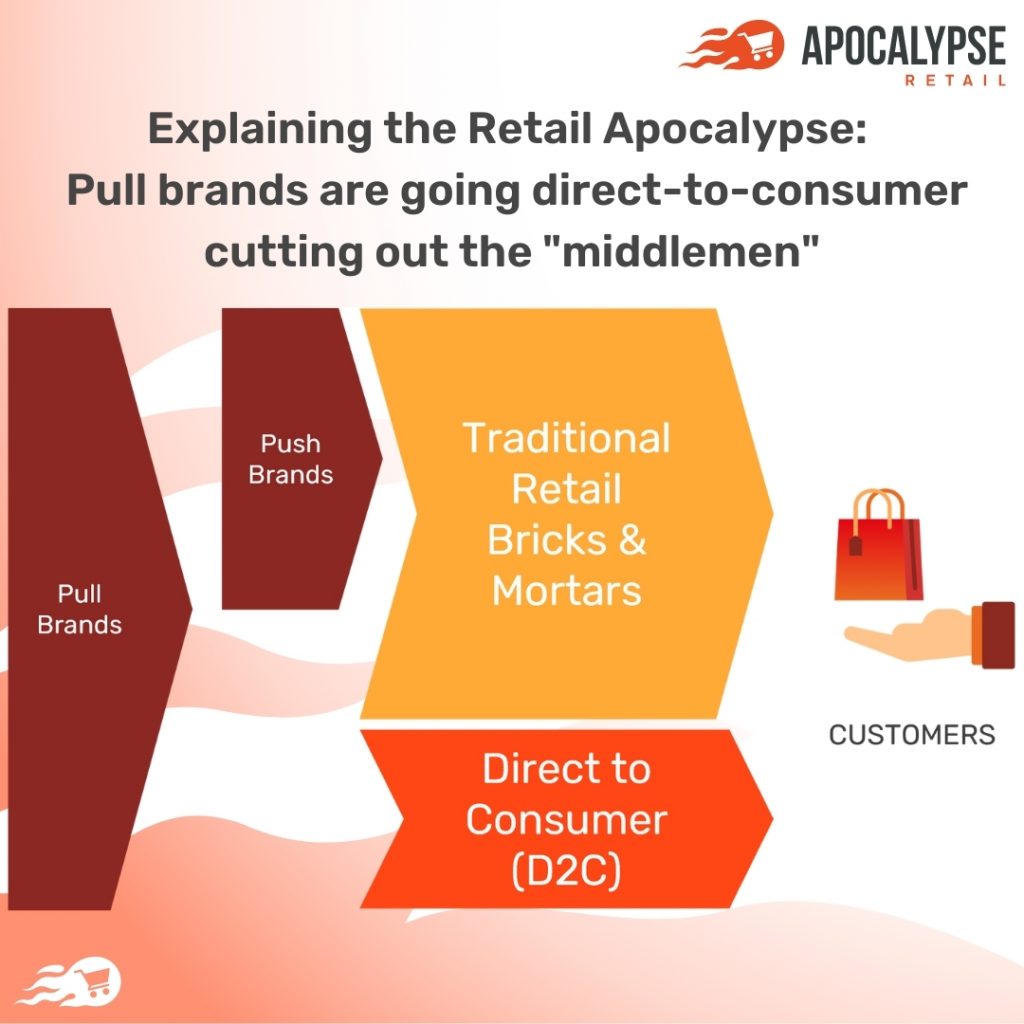
Brands that had enough pull to attract customers began establishing their own stores. These pull brands began cutting out the “middleman” and started reaching directly to customers.
Apple stores are the perfect example.
By 1999, Steve Jobs had returned for two years as Apple CEO. Unfortunately, he was less than happy with the customer experience provided by Retailers like Circuit City or Office Max.
He believed that the brand needed to have closer control over the presentation of its products. At this point, he built a team to venture into physical Retail.
By 2001, Apple opened its first two stores in the US, introducing clean, experience-based stores.
In all categories, brands began opening physical stores to reach customers directly. Categories like sports, fashion, luxury, or cosmetics have seen the most significant changes.
This trend has been accentuated in recent years.
Huge companies like Nike, Adidas, Nestlé, Unilever, or L’Oréal are taking the DTC route. These brands were dependent on wholesale retailers, but not anymore.
According to different reports in Modern Retail, Digiday, Retail Dive, these brands will generate over half of their revenues from DTC by 2025.
This is one of the root causes to understand the end of traditional Retail and what is the Retail Apocalypse. If you want to read more about established brands embracing DTC, read this post.
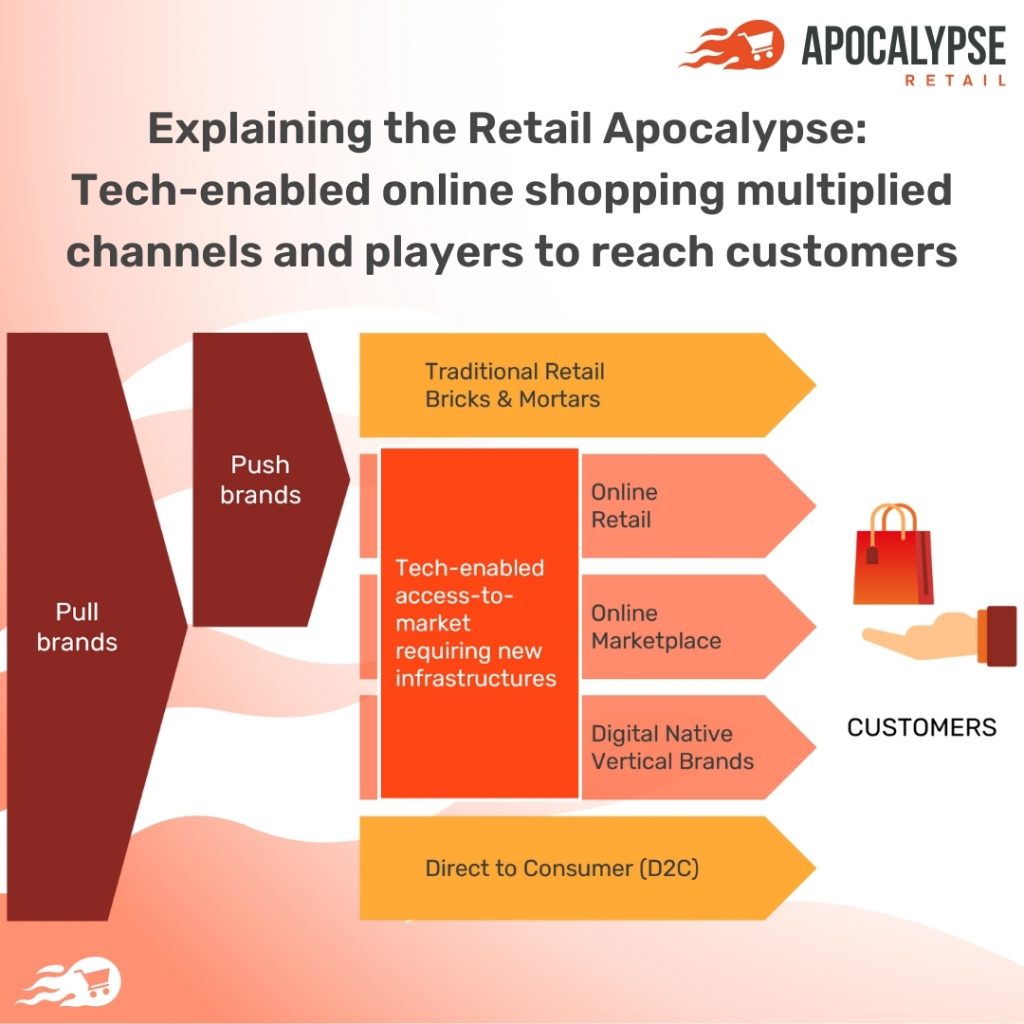
2. Technology multiplied channels for access-to-market

Way before the Covid19 pandemic, the internet and, in particular, mobile technology completely disrupted access-to-market for brands.
A new breed of Retailers used technology to implement new fulfillment methods and customer engagement strategies.
E-commerce appeared as a new distribution channel to increase competition for physical retailers. Before e-commerce, it was pretty straightforward for Retailers to identify their competitors.
At a local level, it’s easy to notice if a newcomer enters the market. It’s also easier to watch aggressive promotions or activities from competitors.
Online Retailing E-commerce changed these dynamics with new players.
New players such as online pure players, online marketplaces, or DNVBs multiplied competition for traditional retailers.
Let’s deep-dive into these different types of players to understand their impact on the Retail Apocalypse better.
What is an Online Marketplace?

Online Marketplaces appeared at the end of the 90s but got traction at the beginning of the 2000s. These players used technology to connect sellers to customers.
What is an online marketplace? An online marketplace is a platform that connects sellers of a specific product with customers for that product.
At its core, an online marketplace creates value by offering three services:
- A robust technological platform able to onboard thousands of sellers
- High traffic acquisition capabilities on the platform
- Healthy conversion rates for the products within the catalog
A marketplace operator is not the owner of the product. Also, the operator doesn’t necessarily have the physical stock of the product.
In exchange for its services, an online marketplace takes a commission per transaction. Sometimes, the marketplace also charges a fixed fee to use the platform.
An online marketplace can be compared to a shopping mall that runs only online. Still, there are significant differences in the customer journey and monetization business models.
Online marketplaces appeared in the middle of the 1990s. Amazon and eBay were created in the US in 1994 and 1995, respectively. By 1999, the model was exported internationally with the creation of Mercado Libre in Argentina and Alibaba in China.
The Amazon case is a bit different since it started as a Book Retailer Online.
In its early days, Amazon operated as an online retailer, being the owner of the books it sold. Later, Amazon shifted to a marketplace model connecting booksellers to customers.
During the 2000s, all these Marketplaces consolidated their positions as e-commerce leaders. As a result, most of the growth in their respective retail markets was captured by these players.
This growth was almost always at the expense of the traditional retailers competing in the same categories.
In the late 2000s, a new breed of online Retailer appeared: Digital Native Vertical Brands (DNVB).
What is a Digital Native Vertical Brands (DNVB)?

Digital Native Vertical Brands (DNVB) are a new category of Retail companies. Tech companies inspired these companies to disrupt industries through the use of technology.
The term was coined by the founder of one of the first DNVB to appear in the US. Andy Dunn, the founder of Bonobos, created the company in 2007 to disrupt the men’s fashion industry.
The trend continued with the appearance of Warby Parker, Everlane, and Casper in the early 2010s.
These brands had a single common principle: using technology to cut out the middlemen. In other words, they are using tech to become direct-to-supplier (DTS or D2S) and direct-to-consumer (DTC or D2C).
On top of this, these brands use technology as the primary source of customer acquisition. They build potent brands with social media and digital channels. The end goal is to create fans instead of customers.
The three main composites of a DNVB are:
- Vertically integrated business: Direct-to-Supplier and Direct-to-Consumer cutting out middlemen. An integrated value chain of Retail processes from design, to production, to distribution.
- Fully integrated customer journey through tech and data: All touchpoints of the customer journey are unified to create a bond that transcends the purchase. DNVBs not only use tech and data to develop and launch products. They also use it to address and retain customers.
- Implementation of Growth hacking: These brands went from zero to millions in a few years without traditional marketing channels or big budgets. However, they succeeded in using growth hacking tactics, emphasizing customer retention, notably digital channels for acquisition and brand awareness.
This business model is quite revolutionary.
The most prominent examples of DNVB are in the US. There is a fantastic, in-depth article about them by CB insights covering their strategies and DNVB success stories.
In France, these brands appeared more recently but have been equally successful and disruptive. Brands like Sézanne, Le Slip Français, and Tediber have grown in popularity.
These brands cut out the middlemen in their categories in the last five years and built strong communities.
The trend of DNVB disruption has been accelerated with the appearance of no-code e-commerce tools. In addition, software tools such as Shopify or Wix have made it easier than ever to launch an e-commerce company.
These tools provide excellent user experience and complete brand customization. In addition, they need little to no technical skills to start, making them ideal for creating an online brand. It’s no wonder these tools have had tremendous success these last few years.
In 2020, Shopify generated more than USD 100 Bn in Gross Merchandise Value. This figure is insane for a company that has less than five years.
And to think that DNVBs are the players who created most of this value.
The retail apocalypse is when competition multiplies and margins start falling
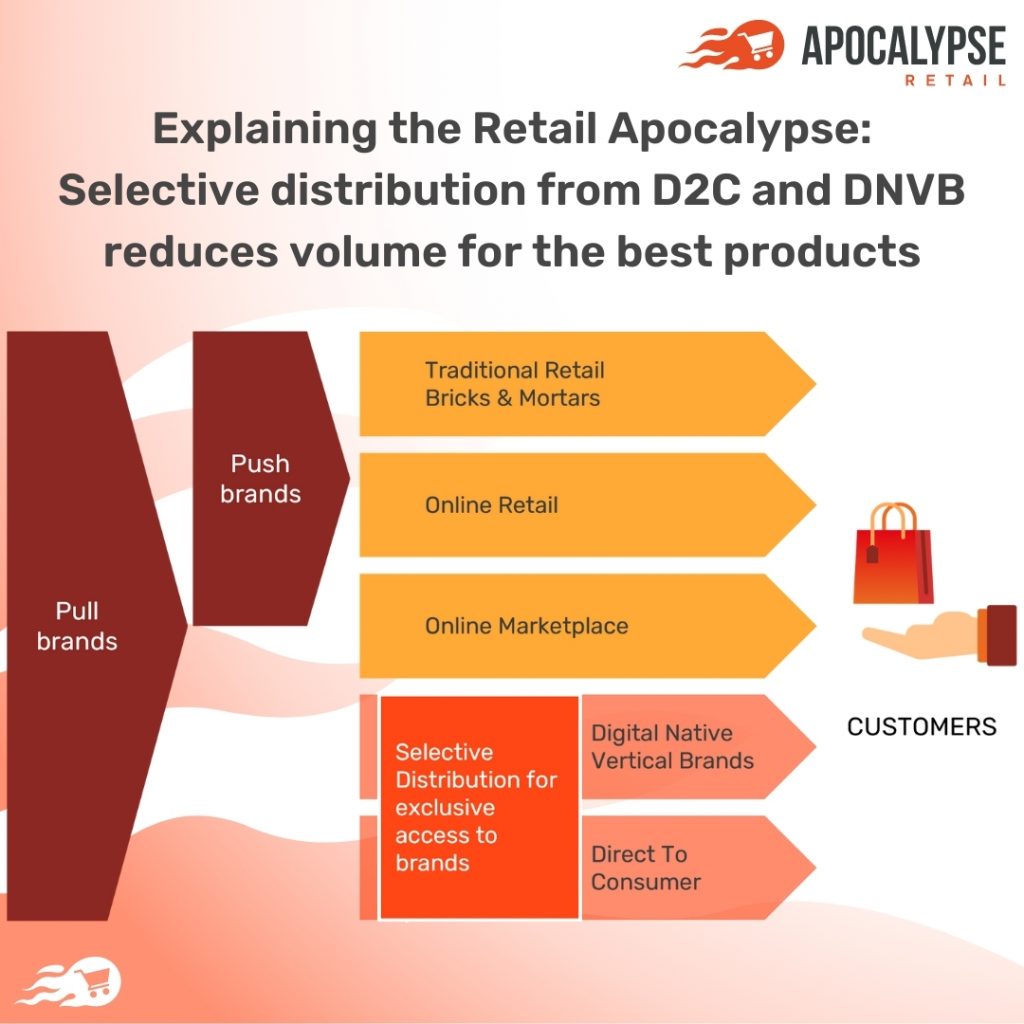
In summary, traditional retailers got challenged from multiple angles. As a result, they are no longer the dominant player to provide access-to-market for brands.
First, some of their biggest pull brands established direct physical footprints. This increased competition hurt margins for retailers. Second, their access to high-margin products got restricted by brands who prioritize DTC.
On top of this, most Retailers failed to adapt to the technological and operating complexity of e-commerce. As a result, the cost of revamping their Supply Chain and IT infrastructure is considerable.
Unfortunately, this cost deterred many retail executives from improving their online business.
For several years, retail executives managed to get decent results from their offline businesses. As a result, very few saw the need to push for digital transformation ten years ago.
The problem is that their survival now depends on them doing so. And they have to do it in a much shorter time, with a lot more competition from all sides.
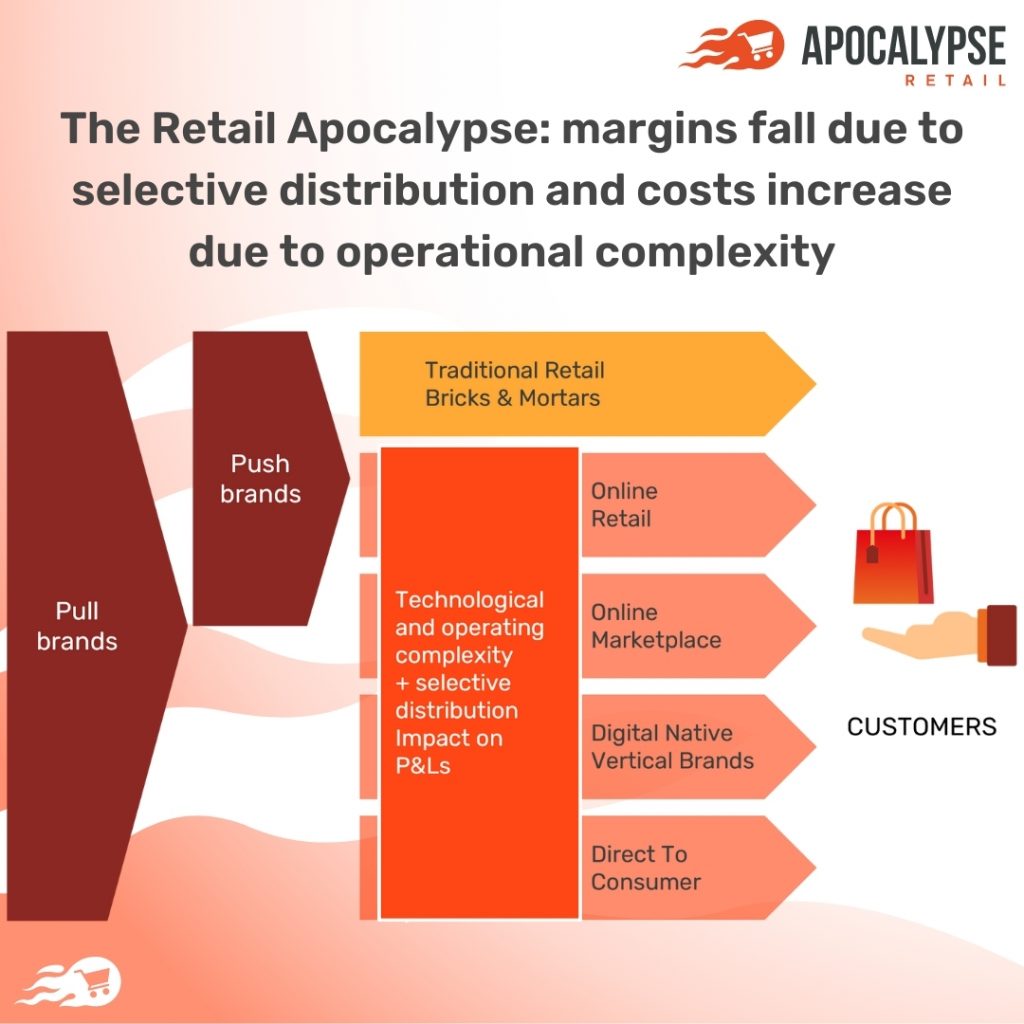
In this post, we have covered what is the retail apocalypse and how to explain the end of traditional brick-and-mortar retail. Over the next post, we’ll explain how small companies can compete with big retailers.
Do you want more insights into E-commerce, Omnichannel Retail, and Digital Transformation? Subscribe to ApocalypseRetail to get insights sent directly to your inbox. Our content is designed for top business schools, retail managers, and eCommerce entrepreneurs who want to survive in the ever-volatile retail industry. Subscribe to our newsletter to join the fight against the Retail Apocalypse!
The post What is the Retail Apocalypse? The End of Traditional Brick-and-Mortar Retail appeared first on Apocalypse Retail.
]]>The post The Impact of Covid19 on Retail: An Accelerator of the Retail Apocalypse appeared first on Apocalypse Retail.
]]>It is only an accelerator in a process that began almost a decade before.
The impact of Covid19 on Retail: chronicle of a death foretold

The year 2020 has been a terrible year for traditional retailers. It’s probably one of, if not the worst, years for physical retail.
Because of the Covid19 pandemic, lockdowns caused an unprecedented dip in physical stores’ traffic.
Only retailers considered as “essential” were allowed to remain open. The rest of retailers faced mass store closures or even total bankruptcies.
For some companies, Covid19 significantly undermined the chances of surviving the Retail Apocalypse.
Giant retailers like Inditex or H&M have reported hundreds of store closures. For small and mid Retailers, the story is even worse. Without support from states, many businesses have struggled to keep business afloat.
During lockdowns, retailers still had to pay their fixed expenses like rent or employees’ salaries. In Europe, state support allowed covering part of employees’ salaries. This was a huge help for companies and employees.
But retailers still had to pay monthly rent and utilities. Covering fixed expenses while the primary income source has been shut down is a challenge.
Without a doubt, Covid19 accelerated the Retail Apocalypse. Still, we shouldn’t talk about the Retail Apocalypse as if it was only related to the pandemic.
The truth is that Retailers’ underlying problems have been present for a while now. 2020 was the perfect storm to drive poorly prepared Retailers to bankruptcy.
What is the Retail Apocalypse?

If you google the term “Retail Apocalypse,” you’ll see results dating since 2010. There is a considerable amount of news and stories with this term.
The term “Retail Apocalypse” is used to describe the trend of store closures impacting Retailers. More specifically, brick-and-mortar Retailers.
The term is a fear-inducing term to drive clicks to headlines. In other words, clickbait (yes, we did it on purpose!).
The term “Retail Apocalypse” even has its own Wikipedia entry. According to Wikipedia, this phenomenon began around 2010. There have been regular updates for the last decade.
When we built the course for HEC Paris, list and timeline of Retail bankruptcies published by CB Insights.
This list covers dozens of cases for US retailers which have filed for bankruptcy since 2015. The article provides a sum of causes for each of these bankruptcies.
In summary, the Retail Apocalypse can’t be attributed to a single year or for a single cause. The US has been hit the hardest as they have the highest share of Retail space per inhabitant.
Yet, France is no exception to the complete transformation of brick-and-mortar models. French Retailers such as Naf Naf, Alinéa, Kidiliz, André, or La Halle have recently filed for bankruptcy.
Brick-and-mortar Retailers have been dying everywhere for the last decade.
The retail apocalypse has been happening for some time. The impact of Covid19 on Retail has been tremendous but it’s not the root cause of the Retail Apocalypse
But if it’s not due to Covid19, what is the root cause of the Retail Apocalypse?
E-commerce added significant pressure on Traditional Retail before Covid19.

Along with the impact of covid19 on retail, e-commerce has also had a considerable impact on retail. The rise of e-commerce is generally considered the main root cause of the retail apocalypse.
But this is only partly true.
What is E-commerce?

Everyone you know that has access to the internet has participated in e-commerce in some way.
When people think of e-commerce, they usually think of online retail. Purchasing a product via a website and having it delivered straight home is the most common view of E-commerce.
But E-commerce is much larger than just the sale of physical products done online. E-commerce involves any transaction that begins online.
E-commerce is buying a plane ticket or booking a hotel room (poor examples with Covid19). It also includes transactions for online services such as Netflix or Spotify.
Online penetration of the total retail market was already underway

Covid19 accelerated E-commerce penetration of total Retail. The share of e-commerce as a part of the total retail market has been rising for the last decade.
Covid19 fast-forwarded E-commerce penetration by two years.
But, as we said before, Covid19 is an accelerator but not the root cause. E-commerce penetration was already expected to reach more than 20% by 2030.
Global e-commerce will grow from 1 in 20 transactions in 2016 to 1 in 5 transactions by 2030.
If you focus on US and European markets, online retail penetration is even steeper. In these countries, online retail should reach 20% of the Retail market by 2024. 2024 is… tomorrow.

Over the next decade, most of the growth in the retail market will be online

Over the next decade, the Retail market is still expected to grow by 3-5% yearly. During the same period, online retail will grow at double-digit numbers every single year.
What this means is that most of the growth for the next decade will be online. Some would even argue that ALL growth will be online.
If you are a Retailer with a fragile online presence, it will be tough to grow over the next few years. The global pandemic has only accelerated this trend, but it has not been the root cause for these changes.
What is undoubtedly true is that the acceleration brought from the pandemic is here to stay. In other words, habits developed during the pandemic are not just going away.
According to a study from the University College of London, it takes roughly two months for a new behavior to become a permanent habit, with a maximum of 254 days.
So we are well over the limit for changes in consumer behavior to become permanent habits.

Every single category has been subject to E-commerce disruption
Back in 2010, some product categories were challenging to handle on e-commerce. Barriers to online commerce sheltered some categories from disruption for some time.
Logistics’ complexity or regulatory constraints were the most common barriers. Complex logistics sheltered categories like groceries and home improvement. Regulations sheltered categories like pharma or para pharmacy.
In other categories, disruption was slower as the user experience was not ready for detail-oriented products.
In the last decade, e-commerce players have torn these barriers down. These companies refused to accept that “it can’t be done online.”
Then came Covid19.
Since the beginning of the pandemic, every category has seen significant growth in online sales. Online acceleration was steeper in categories like groceries, pharma, or personal care products.

After the pandemic, no category is sheltered from the rise of E-commerce. But why is the rise of e-commerce accelerating the retail apocalypse?
The short answer is that most traditional retailers have failed to adapt to the changes in consumer behavior over the last two decades.
A long explanation will be developed in the next post. We will be covering the root causes of the retail apocalypse and the end of traditional retail.
Do you want more insights into E-commerce, Omnichannel Retail, and Digital Transformation? Subscribe to ApocalypseRetail to get insights sent directly to your inbox. Our content is designed for top business schools, retail managers, and eCommerce entrepreneurs who want to survive in the ever-volatile retail industry. Subscribe to our newsletter to join the fight against the Retail Apocalypse!
The post The Impact of Covid19 on Retail: An Accelerator of the Retail Apocalypse appeared first on Apocalypse Retail.
]]>