The post Instant gratification: Has Quick Commerce or Q-Commerce changed the way we shop? appeared first on Apocalypse Retail.
]]>We want to give our special thanks to Faraz Kavehei & Johannes Bareis, the two students who co-authored this post.
Quick commerce or q-commerce is completely disrupting e-commerce and Retail.
In this post, we’ll explain this model in a nutshell, introduce key players and analyze the advantages and challenges in the q-commerce industry.
What Is Quick Commerce or Q-Commerce?

Quick commerce, also known as Q-Commerce, is THE big new topic in the retail sector. Covid accelerated the rise of this new delivery model that addresses the consumer’s need for responsiveness and convenience.
Q-commerce changes the entire shopping experience, from the initial spark of interest in a product to the delivery rider knocking on your door.
Wait—you’re thinking—I thought online shopping was e-commerce, not q-commerce.
And you’re not wrong.
Q-commerce is a form of e-commerce, but the turnaround time between order and delivery is much shorter in quick commerce. For example, instead of waiting a couple of days for a product, customers receive their order within one hour, often in as little as 10 minutes.
This is why q-commerce is also called the third generation of e-commerce. On-demand deliveries that are executed almost instantly will be the new benchmark.
Q-Commerce was not born during the pandemic. But the increase in online ordering during the pandemic created the perfect tailwind for q-commerce.
Multiple industries took a severe hit due to the pandemic; q-commerce was one of the few sectors of Retail that flourished when folks had to stay at home. And that change of habit is here to stay.
How Does Quick Commerce Work?

You are expecting a few friends but did not find the time to prepare. You can simply go to the q-delivery app of your choice and order snacks and maybe one or two bottles of wine. About 10 minutes later, a delivery rider will ring the bell of your door.
But how does the magic happen?
Most q-commerce pure players warehouses, so-called “dark stores” or “micro-fulfilment centers.” These dark stores enable workers to quickly pick and deliver the products they have in stock.
Dark stores typically have over 1000 products ready for distribution. These “flash supermarkets” are often placed in strategic locations and act as urban fulfillment centers for a city district.
Until now, it mostly sounds like a regular logistics company that moved a bit closer to the consumer. But Q-commerce players use technology to make their processes more efficient and agile. For example, they use data to understand which locations are better suited to establish dark stores.
They develop specific Order Management Systems to route orders to the closest store to fulfill the order. Next, they match your order with the nearest rider to fulfill your order.
All within 30 minutes or less.
The Quick Commerce business models
There are different q-commerce players all over the world.
All have some specificity, but these are the few common factors:
- Delivery in less than an hour (10min delivery best-in-class)
- Locally focused delivery from dark stores
- A fleet of two-wheeled vehicles to move faster
Most q-commerce retailers are like supermarkets, so-called flash supermarkets.
They have everything from snacks to cosmetics to cleaning products.
Some q-commerce pure players are, in fact, “supermarkets” that hold their inventory. Other q-commerce players work with legacy brick and mortar supermarkets. They are third-party providers that perform the delivery.
What Are the Advantages of Quick Commerce?

1. Speed, Speed, Speed

Speed is the most significant advantage of q-commerce.
The genesis of q-commerce came from the need for ultra-fast delivery in the food industry.
Q-commerce sellers generally don’t have physical locations where customers can walk in and buy things. Still, q-commerce retailers have a unique selling proposition (USP) that sets them apart from competitors.
2. Brand loyalty

Q-commerce today is a commodity.
There are many players, and customers can easily choose from which one to be served.
But it is a winner-takes-all market. Not necessarily globally, but most likely in your district or city.
The one company that can meet customer demands quickly and efficiently will have the most repeat customers.
Customers are more likely to make a repeat purchase from a company that has consistently met their needs.
3. Ultra-fast delivery with 24/7 operations

Dark stores can operate 24/7, leaving no gaps between demand and delivery (given that the local laws permit 24/7 ops)
This makes q-commerce flourish in areas that have limited business hours for physical storefronts.
One of the main benefits of Q-commerce is to order anything you need at any time of the day (or night).
4. Tech-oriented inventory management

With AI and smart technology, q-commerce ensures that products are readily available for people in the area.
Q-commerce software analyses demand trends to help re-shelf stocks based on demand. And even if a product is unavailable for a short period. Then, the app will simply stop promoting that particular product and steer the demand towards other products in stock.
5. It is super easy

Once you’ve tried q-commerce, you understand its ease.
Q-commerce apps generally have straightforward UX/UI. They are built to have super simple sign-in processes and make repeat purchases very easy.
If you forget an item on your shopping trip and don’t want to return it, you can open an app and have someone bring it to you.
You don’t have to take your sweatpants off and put jeans on again.
What Are the Challenges of Quick Commerce?

1. Q-commerce is a commodity

The biggest challenge of quick commerce is staying on top.
All the q-commerce players have a similar model. It all comes down to the best inventory and the best execution.
The number of players existing today makes q-commerce a commodity. As a result, there are almost no switching barriers for customers.
This means that customers have plenty of choices to choose a provider. And it is just as easy to lose a customer as to gain one.
2. Q-commerce customers have Zero tolerance for failure

The primary drawback of ultra-fast delivery is living up to the ultra-fast standard.
It is a market where customers have zero tolerance for failure.
They will only stay loyal if their customer experience is always great.
A player that provides only “good” experiences loses its value and customers.
This is a market that is built on customers that NEED ultra-fast delivery for whatever reason. Unfortunately, these types of customers are the hardest to please.
3. Q-commerce is an extremely risky business model

With such customers, players have to constantly monitor efficiency across their supply chain.
The entire industry is hinged on speed and accuracy for profitability. And as we said before, this is a winner-takes-all market. This means that players need to raise massive amounts of cash to establish operations quickly and win the market.
And the entire business model is based on the availability of staff. Companies cannot scale and maintain their operations without enough riders and pickers available.
Players like Getir, Gorillas, or Flink have provided their staff with employment contracts. Others are still relying on gig workers. However, most countries and cities have started regulating the gig economy, which will impact the business model.
So, in the end, only one or two players will survive per area, and most players will burn through their cash.
4. Convenience often comes at the cost of work conditions

Delivery speed and convenience might come at the cost of agreeable work conditions.
Of course, it’s fantastic to shop for a beer and some snacks at 3 AM on a Tuesday. But there’s someone out there who has to bring you the bag of chips.
And as we said before, parts of the industry are based on the gig economy without full-time contracts or benefits. We’re not saying the gig economy is bad per se. But it has time and time again been proven to offer precarious work conditions.
But riders and pickers also have the freedom to decide where they want to work. Arguably, a job in a classical supermarket is also not more exciting.
In most countries, quick commerce companies would make a strategic mistake to offer lousy working conditions. There is a significant labor shortage in the low-wage sector, and companies have difficulties filling positions.
The food delivery company Wolt offers a sign-on bonus for new riders. An Indeed study suggests that the number of job postings is skyrocketing (e.g., 88% increase in the Loading & Stocking sector).
Companies should not focus on improving margins by reducing labor costs. Instead, they should consider the opportunity costs when they cannot fill positions or have enough riders available.
5. The model might not work everywhere

Q-commerce is mostly available to urban consumers.
The economics of the model is catered to densely populated areas in urban areas. As a rule of thumb, we could say that the sweet spot of the model is in areas with at least four-story buildings.
Some players serve more rural areas but with much longer delivery times. The economics of the model are different outside of the cities.
Additionally, it might not work in every country equally well. Convenience and delivery business models work very well in countries with high inequality (Singapore or Hong Kong). It needs a population segment with high disposable incomes that looks for convenience. And a lower-income population segment that is willing to perform the gig work.
It remains to be seen if the model also works in countries with small Gini-Coefficients, such as Nordic countries.
6. Q-commerce has a significant impact on local and small businesses

Additionally, one of the main casualties of q-commerce is local and small businesses.
It took a global pandemic to get stores to come around to in-store or curbside pickup for online orders.
Stores that are not adopting an omnichannel approach are being crushed.
This is a good thing because most local stores had utterly failed to adapt to changes in customer behavior.
But q-commerce mainly sells items from big supermarkets or big sellers. The type of players who can afford their commissions.
Most local small businesses don’t have the volume or margins to become q-commerce sellers. So a lot of them will inevitably be crushed by q-commerce players.
Is Quick Commerce Profitable?

Short answer: yes, at least in the long term.
There’s a lot of opportunity in quick commerce when executed correctly.
A study from Deloitte revealed that 50% of shoppers spent more money to get what they needed quickly in the heat of the pandemic. Q-commerce players can capture this willingness-to-pay.
In the US, GoPuff is the first-mover. They operate their better warehouses with 40% gross margins and a 10% contribution margin.
Of course, increased competition will put pressure on margins.
100% of GoPuff’s fulfillment centers became profitable after 18 months, and the best ones were even profitable after nine months.
At the same time, classical supermarkets are much more capital-intense and need many years to break even.
Is Quick Commerce Sustainable?

It is hard to prove that q-commerce is more sustainable than traditional shopping. But a few things about it are encouraging.
Deliveries are usually performed with electric scooters or e-bikes. It would be more sustainable if customers would no longer have to get into their cars to drive to the supermarkets or shopping centers.
The way supermarkets work produces significant food waste. Q-commerce has the potential to reduce food waste big time. It has short turnaround times of products. Food can be stored more functional (e.g., dark and cold). It does not have to be displayed in a way that is appealing to customers (e.g., on a shelf with bright light)
Customers do not touch food, and q-commerce companies can also sell the “curved cucumbers” that would be neglected in a supermarket.
Since q-commerce firms are more data-driven, they can better forecast demand. In turn, companies waste less food by ordering the right amount of non-durable products.
Food about to expire could be promoted or discounted on the app. If quick commerce players operate seven days a week, they would not have to deal with fresh food that could get rotten over the weekend.
What is next for Quick Commerce?

Expansion of the product offering
Most players have started with grocery delivery. But their product portfolio will expand to other areas such as OTC (over-the-counter) pharmaceuticals.
After all, we want to stay in bed when we are sick and don’t want to make our way to a pharmacy. Some do this already.
Beyond Groceries, Food, and convenience products
Quick commerce does not have to be limited to food delivery, groceries, OTC drugs, or other convenience articles. It could also solve that last-mile problem in the broader retail industry.
Q-commerce players could also help brands deliver other items like fashion of consumer electronics.
First, start-ups are already addressing this niche. For instance, Arive works with brands like Apple to deliver their products within 30min. The biggest challenge here is inventory. The products can be “flipped” with groceries within 2-3 days. With laptops or designer fashion brands, the warehouses would need to have a lot of expensive inventory. The products need to be readily available in many sizes, colors, or technical configurations.
Reshuffling of the marketing budgets of food companies
Food companies like Kraft Heinz spend a lot of money promoting their brand and products (let’s say a Bacon BBQ-Sauce) to a broad audience.
The demand for their product by customers and their brand image helps them to engage in favorable terms with supermarket chains and retailers.
But their marketing efforts (e.g., in the form of billboards or TV spots) have also targeted consumers that are highly unlikely to buy their Bacon BBQ-Sauce.
Maybe because they are vegetarian or simply do not like BBQs.
Quick commerce players can disrupt marketing in the food industry. Unlike brick-and-mortar supermarkets, they have very detailed information about the preferences and habits of individual customers.
They can monetize that knowledge and address consumers in a much more targeted and effective way.
Own Label products increase margins.
Quick commerce players will be offering their private-label products. They can do this because they have direct access to the customer.
Instead of negotiating with giants like Unilever, Kraft Heinz, and alike, they can offer customers own-label products. This would increase their profit margins.
Who’s Who in Global Quick Commerce
Let’s look at the major quick commerce players currently on the market.
The amount of money being poured into financing rounds for each player gives you a sense of how big the market could be.
GoPuff

The GoPuff business model is considered the q-commerce role model. Based in the U.S., GoPuff brings food, alcohol, over-the-counter drugs, and more to consumers in multiple states.
With micro-fulfillment centers, for a delivery fee of $1.95, shoppers have access to over 3,000 products within 30 minutes.
The company confirmed in July 2021 to have raised $1Bn to expand its global operations. GoPuff is consolidating the market and has acquired competitors such as Dija, Bandit, Liquor Barn, RideOS, Fancy, and BevMo.
Getir

Getir is a Turkish company that started with the speedy delivery of groceries and food from local restaurants.
The company can also provide apparel, pet food, and sex health products within minutes.
The Getir app has raised USD 550M in 2021 to expand to the US and other countries. The acquisitions of Moovand BLOK have accelerated Getir’s expansion.
Weezy

Weezy is a U.K-based grocery delivery service that offers instant delivery within 15 minutes.
It also highlights its stance as an anti-gig economy company, stating that its “riders are more than just riders.”
The company has “only” raised $25M in 2021
Cajoo

Cajoo is a prominent French q-commerce delivery service.
Servicing ten areas in France when we wrote the article, the company specializes in grocery delivery.
In late July 2021, Carrefour, France’s biggest retail company, acquired a minority stake in Cajoo. This investment is for an undisclosed amount.
This investment will allow the Cajoo App to speed up its development. And it will also give Carrefour direct insight to ramp up its delivery operations.
Gorillas

Gorillas is a leading q-commerce start-up and the fastest German company in history to reach the unicorn valuation.
They started their brand to limit food waste by providing fresh food on demand. Their main offer is to deliver in ten minutes or less.
The Gorillas app operates in the UK, Belgium, Denmark, France, Germany, the Netherlands, Spain, Italy, and New York City.
The company has closed a $1B Series C round in October 2021 with the strategic investor Delivery Hero as the lead investor.
Flink

Flink is the second major player from Germany and operates in even more German cities than Gorillas.
The company also expanded to France, Austria, the Netherlands, and Belgium.
Flink is backed by financial investors like Target Global and strategic investors with strong delivery experience such as DoorDash and Prosus.
The start-up has entered into exclusive cooperation with the retail giant REWE Group.
Jokr

Jokr has had extremely rapid growth.
It was founded by the Foodpanda founder Ralf Wenzel and other former Foodpanda and Rocket Internet employees who understand the food delivery market.
They have expanded to dozens of cities in the US, Latin America, and Europe in a few months.
The company has raised $170M in 2021 to expand its global operations.
Glovo

Founded in Barcelona in 2015, Glovo is one of the “old” players in the q-commerce business.
With Delivery Hero as their leading investor, Glovo has become a significant player for on-demand delivery in EMEA markets.
With the rise of q-commerce, Glovo has been investing in its ultrafast delivery capabilities to compete in this market.
They benefit from solid brand awareness and a robust presence in their current markets. So let’s see how they fare in the q-commerce business.
Rappi

Rappi is the Unicorn out of Colombia.
Same as Glovo, the company was a senior player in the delivery business founded in 2015.
The company’s main activities come from on-demand delivery.
They have risen to the top, establishing themselves as the dominant player in Latin America. They have become the most significant player in countries like Colombia, Brazil, or Mexico.
In 2021, they launched a new Rappi Turbo feature, allowing for deliveries in ten minutes or less. This is the start of their q-commerce business.
Again, same as Glovo, they benefit from brand awareness and customer loyalty in their current markets. It will be exciting to see how they compete in the quick-commerce business.
What will Amazon do in quick commerce?

The retail giant Amazon is currently standing on the sideline regarding quick commerce. For example, its fastest service Amazon Fresh needs about 2-3 hours of delivery time in major cities.
Going forward, there are two possibilities for how Amazon will (re-)act.
- They will wait and acquire the leading quick commerce player
- They will choose a different strategy (just-in-time instead of instant on-demand delivery)
Amazon could also decide not to become part of the quick commerce race.
They are still way ahead regarding access to the customer and their household (think Smart fridges and Alexa). Amazon could bet on the convenience of automatic restocking. Your milk or guacamole could be delivered and restocked just in time before your current container is fully consumed.
Conclusion:
There may be a lot of challenges ahead for Q-commerce.
The market will consolidate, but several players might dominate in a specific city or area.
So we do believe q-commerce is here to stay and will only grow in popularity. It educates consumers and changes consumer demands in the long run.
But we are thrilled to see who comes out on top in the long run.
If you know other players to include in this list, drop us an email, and we’ll add them.
Do you want more insights into E-commerce, Omnichannel Retail, and Digital Transformation? Subscribe to ApocalypseRetail to get insights sent directly to your inbox. Our content is designed for top business schools, retail managers, and eCommerce entrepreneurs who want to survive in the ever-volatile retail industry. Subscribe to our newsletter to join the fight against the Retail Apocalypse!
The post Instant gratification: Has Quick Commerce or Q-Commerce changed the way we shop? appeared first on Apocalypse Retail.
]]>The post Will Ecommerce in China Dictate the Model For 21st Century Retail? appeared first on Apocalypse Retail.
]]>We want to give special thanks to Varvara Dyudina & Raphaël Delannes, the two students who co-authored this post.
By the end of 2021, more than half of all retail transactions will come from eCommerce platforms.
According to EMarketer, eCommerce in China will account for 52.1% of the country’s retail sales. It is a massive boost from just 44.8% last year.
China will become the first country where most retail purchases come from online platforms. Researchers also forecast 58.1% of Chinese transactions coming from the eCommerce market by 2024.
Huge online shopping and online payment platforms have emerged with the growth of Chinese eCommerce. Companies like Alipay and WeChat Pay are now a payment standard in the Chinese market.
So what does this mean for eCommerce entrepreneurs and retail managers, exactly?
They should look closely at the Chinese market as it could impact global retail.
This guide will cover the state of Chinese eCommerce and the main actors involved. Then we will go over the key dates and trends for eCommerce in China. And later, we will discuss how it could become the blueprint for 21st century retail.
China’s success in developing its eCommerce market is unparalleled.
In the United States, eCommerce purchases in the retail industry only amount to about 15%. European countries are even less involved in eCommerce at 12.8% percent.
Who Are the Main Actors of Ecommerce in China?
![[Image Title alt text: Who Are the Main Actors of Ecommerce in China?]](https://lh4.googleusercontent.com/HJ-kH89mJAq-Am1WPuni2vlrBqzj1im0l4yijE8LskApPThJPB-nUqLo7xJfReBxWzz_NeDihWJkrDq_xv_Sx5uf7EzmyLTHlejCPYUfNVqHoFRrFF4vV76Rx28-GHJNRuTyzBOA)
In the past decade, many platforms have emerged to handle the demand of Chinese consumers who shop via online marketplaces.
There are several actors, but one thing to keep in mind about the Chinese e-commerce market is that it’s highly concentrated.
As of 2020, the top three e-commerce players (Alibaba, JD.com, and Pinduoduo) concentrated 90% of all e-commerce in China. Compared to the US, this is a very high concentration, where the top three players (Amazon, Shopify, eBay) concentrate “only” 50% of the market.

Taobao (Alibaba)

Owned by the e-commerce giant Alibaba, Taobao offers both C2C and B2C sales opportunities for users. That is what sets it apart from many other Chinese eCommerce platforms,
Taobao is a genuine and well-established eCommerce marketplace founded by Alibaba. It allows users to build their online shops and sell through Taobao.
Small and medium businesses can also sell on Taobao. Though large companies are more appropriate for Tmall, a marketplace is covered below.
Tmall (Alibaba)

Also belonging to Alibaba, Tmall is the biggest B2C online retail platform in Asia.
Part of Tmall’s popularity comes down to the fact that you can buy anything on its website. From not-so-great low-quality wholesale items to sophisticated, luxury, high-quality products.
At the same time, the requirements for the merchants to enter the platform are stricter. For example, only “validated” is allowed to guarantee the quality of the service.
Think of Tmall as China’s Amazon.
Pinduoduo

Pinduoduo or PDD is another eCommerce platform rising to fame in China.
This platform is successful because it provides customized recommendations for consumers. Search-based eCommerce platforms do not usually offer personalization features.
Pinduoduo has excelled in providing personalized customer journeys. Users can even use their friends’ lists and favorites to access tailored recommendations.
Another value proposition unique for Pinduoduo is the group buying option. We will cover it in more detail later on.
JD.com

JD.com is one of the largest retailers in China and a Fortune Global 500 company. In addition, it is well known for platforming cross-border sales.
Like Amazon, JD.com is responsible for much of the platform’s inventory. They also fulfill orders in-house through a massive first-party logistics network.
The JD.com business model has lower margins than huge enterprises like Alibaba. However, it also ensures better quality control over products and delivery speed.
Kaola

Kaola is the go-to platform for Chinese consumers purchasing products from Western countries.
This cross-border eCommerce website sells products from foreign brands. In addition, it allows sellers to market their goods through various Kaola-based marketing channels.
These channels include online forums, various portals, and several advertising options.
Little Red Book (Xiaohongshu)

Little Red Book is a Chinese social shopping network based in Shanghai.
This unique and disruptive platform has over 100 million users. It caters to individuals who want to find the hottest beauty and skincare products. It focuses on products from international brands that are not available in China.
Tons of brands around the globe sell on Little Red Book, but it isn’t that much of a shopping platform. Instead, it’s a place where users can post reviews and tips on products they’ve used.
VIP.com

VIP is an eCommerce website based in Guangdong. With an impressive 52 million users, VIP is the third biggest eCommerce platform in China.
There are a few different reasons why VIP is so successful. In particular, its focus on international sales and discount sales models.
VIP Shop, the owner of VIP, is currently also building a financial service platform. The latter’s purpose will be to handle.” online payments and insurance.
Suning

Another example of a large retailer in China is Suning. It is a B2C retailer with a massive online eCommerce platform and 9,000 stores around the country.
Suning sells all sorts of physical products and services and content merchandise.
Douyin (Tik Tok)

A relatively new competitor in the Chinese eCommerce market, Douyin is the sister app to TikTok for the Chinese market.
It’s an eCommerce platform that focuses on live streaming to sell products.
It became famous after staging an offline event, “ecosystem conference.” The event challenged many Chinese Commerce giants, including Pinduoduo and Alibaba’s platforms.
Key Dates for Ecommerce in China
China has its specific holidays and festivals that set the pace for brands to launch their promotional campaigns. Therefore, it is an excellent chance to attract as many customers as possible.
Chinese consumers are particularly attracted to discounts. That fact makes these campaigns truly important for the merchants.
There are a few key dates in the Chinese calendar to consider if you want to succeed in eCommerce in China.
Single’s Day is The Biggest Megasale Event in the World

Single’s day is a 24-hour super discount period on November 11th in China. It was initially launched by Alibaba and followed by all the significant players of e-commerce in China. It’s similar to “Black Friday” in the United States.
“Single’s day” has become a very appreciated and anticipated event in China. It is also a crucial period for local companies.
On 11.11, consumers tend to purchase products they would not in standard time. The practice of buying a year’s worth of ordinary daily life items is also mainstream.
12.12 or Double 12 Festival

The 12.12 festival is a sequel to Single’s Day (11.11 day). It was launched to benefit smaller Alibaba vendors that couldn’t compete against more prominent brands during Single’s Day.
The festival has rapidly become another famous shopping festival in the country.
Chinese New Year

New Year in China is one of the most, if not the most, events of the year. It also has the particularity of being one of the biggest shopping festivals.
It is common to return to your hometown during this festivity to celebrate it with your family. So, weeks before the Chinese New Year, there’s a rise in consumption as people buy presents to bring home to their relatives.
Golden Week

In China, the national holiday is also known as the Golden Week. It is one of the most extended holidays in the country after the Spring Festival and takes place from October 1st until October 7th.
People usually travel during this week, while consumption skyrockets in the country.
This also illustrates itself within eCommerce in China. For example, Tmall Global saw a 79% spike in sales during the golden week of 2020 (compared to the same period in 2019).
How Did Ecommerce in China Grow So Much?

Many factors are involved in the most recent boost in digital transactions. But most evidently, it can be attributed to the COVID-19 pandemic.
Writer Owen Matthews in his article broke down the pandemic’s influence on China’s online market as a whole.
“COVID-19 stay-at-home orders were a huge boost for eCommerce in China as elsewhere,“ the article reads, “Although the country’s overall retail sales are down, Chinese consumers will spend 144.44 trillion yuan ($20.8 trillion) on retail eCommerce in 2020, up 16% from 2019, according to Emarketer.com. Chinese e-commerce companies have also adapted rapidly to the COVID-19 reality, both by supporting government initiatives — for example, JD.com deployed autonomous vehicles to deliver essential medical supplies in Wuhan — and by launching new services such as contactless delivery to make it easier for consumers to continue shopping during lockdowns.“
The growth of Chinese eCommerce companies is simply astounding, seen by the sheer size of numbers during Singles Day.
In 2020, Alibaba and JD.com racked $74B and $41B, respectively. So to give you some perspective taking the combined global revenues from Amazon and during Black Friday 2020, it is 7x and 4x, respectively.
Chinese eCommerce companies have been going above and beyond regarding tech innovations. The aim is to create a more dynamic experience for consumers.
Today Chinese eCommerce companies are as competitive as the whole Chinese market. Alibaba ruled it with an iron fist with a market share of 81% no more than a few years ago.
Now, other online platforms offer innovative technologies and better customer service. As a result, Alibaba’s market share dropped to about 55%, where it currently stands.
Competition has allowed eCommerce companies to take advantage of new technologies.
Chinese companies pushed innovations like live shopping, digital payments, group coupons, and deals. Later, they started merging social media and eCommerce and instant messaging integrations.
While other countries are still sticking to point-and-click eCommerce, China has a thriving and competitive market exploring the boundaries between shopping and real life.
Mcommerce is the Cornerstone of Ecommerce in China

According to the Bernstein Ecommerce Outlook, the Chinese market had around 900M internet users in 2020.
Let that number sink in.
There is no single country in the world with as many internet users. It has almost three times as many users as the US and nearly twice as many as the EU.
But you have to consider that the high growth of internet penetration in China came at the same time with the invention of the smartphone.
China is the world’s leading smartphone market, so smartphone penetration is very high. According to Bernstein, 90% of Chinese users access the internet through their phones.

This, in turn, encourages them to conduct their purchases through their phones. As a result, since 2015, more Chinese consumers have made purchases via phones than via computers.
Several factors make mCommerce particularly popular in China:
- Mobile payment apps such as WeChat Pay and Alibaba’s Alipay. They make it very quick, easy, and convenient for buyers to pay for items using their smartphones;
- Multi-functionality. Social media apps are utilized for many everyday functions. You can book appointments, order food, plan overseas trips and pay bills. WeChat allows to do all these within a single app;
- Cost-efficiency. Investment in mobile has become more attractive in recent years. The reason lies in the lower costs of mobile networks and falling cost of mobile devices;
- Better access. Mobile allows people living outside of the main cities and towns to have brands they would not otherwise have.
Another major factor is that western buyers embraced e-commerce long before smartphones emerged. With the internet being late to come to China, many Chinese netizens have bypassed desktop use.
As a result, mobile internet access has a more prominent position in China than in Australia.
5 Trends Driving Ecommerce Growth in China

We have established that the growth of e-commerce in China is unparalleled anywhere else in the world.
There are specific structural differences with other markets like the US, like the share of mobile e-commerce and market concentration. These differences encourage players in these countries to argue that China shouldn’t be the blueprint for 21st century Retail.
But despite these differences, there is no doubt that underlying innovations are pushing the growth of e-commerce in China.
Let’s look at five of these trends fueling the growth of Chinese e-commerce.
1. Live Shopping

One of the biggest trends shaping eCommerce in China has to be live shopping.
In an interview with Financial Times, technology entrepreneur Dan Dan Li noted the similarities between the old-school American shopping channel and the newly emerged trend of selling products via mobile video demonstrations.
Live video is a massive part of China’s eCommerce apps like Douyin, Taobao, JD.com, and Pinduoduo. But Lin noticed that in the West, the nature of eCommerce is still very static and unchanged.
“Almost everything else is mobile-first,” said Li in the FT interview, “Entertainment is mobile-first, social is mobile-first, but eCommerce [in the US] is in the Stone Age.”
These dynamics can cause a significant change in other countries. For example, China’s growth in eCommerce has been casting a shadow on American and European markets for some time now.
2. Omnichannel engagement

Another quite popular trend in Chinese eCommerce is the use of omnichannel marketing.
Omnichannel marketing is something that marketers are starting to pick up on in the US or Europe.
In China, it’s already been an established must-do for eCommerce entrepreneurs. A cross-channel strategy isn’t just effective, but it could also be inexpensive.
A unified approach to content creation across different marketing channels can result in significant synergies. Thus, reducing the cost of organic social media marketing and search engine marketing.
3. Social commerce

Social media shopping is another hot topic for Chinese eCommerce. Experts forecast such sales to reach $363 billion in 2021, tripling the results of 2018. They are also expected to account for 13 % of total eCommerce sales this year.
Online social networking became an essential part of our lives, and advertisers took over social media platforms. So the latter’s transformation in an ecosystem for eCommerce was a question of time.
The multi-functionality of Chinese social media encouraged the development of social eCommerce.
Mini Programs introduced by WeChat boosted the trend. These subcategories ease the experience for both merchants and customers.
The Programs also became popular with residents of smaller cities who tend to use cheaper mobile data providers. It is preferable to have a single app for them instead of downloading several new ones.
Digital payment options like WeChat pay also contributed to the social eCommerce trend. As a result, customers can have a smooth, unified experience without exiting the platform.
4. Group buying

The growing popularity of group-buying also answers the Chinese eCommerce peculiarities.
Pinduoduo is a significant contributor to the trend. Its unique value proposition made it the fourth largest eCommerce platform in China. One of the key features was the engagement of customers from rural areas.
Group-buying implies bulk purchases by a community. But, first, a community leader creates a WeChat group to disseminate product offerings.
Then, he organizes bulk orders of different products directly from brands and distributors. First, the order arrives on the name of the leader. And later, he distributes individual orders among the community.
Such a method engages around 100-150 customers at once. It allows community members to benefit from low-cost delivery. It also helps to order items not available in the local stores.
5. Low-tier markets

One more trend occurring with Chinese eCommerce entrepreneurs is targeting low-tier markets in China.
It makes sense to market and sell to consumers in big cities like Beijing.
But consumers in smaller towns deal with lower living costs. Thus, they have more disposable income. Therefore, marketing to this demographic is clever as the Chinese market is big enough.
Is Ecommerce in China the Blueprint for Ecommerce in Other Countries?

Here is the million-dollar question: Could China’s eCommerce model become a global trend?
Prominent American and European corporations have often underestimated Chinese companies. So the possibility of them adopting Chinese eCommerce trends seems a bit iffy.
It doesn’t help that the Chinese market has few connections to other markets. But, again, it can be partly explained by the distance and protectiveness from the government.
While this seems grim, a lot is still up in the air. It looks like China could be the blueprint for eCommerce in other countries.
A whopping majority of retail sales are occurring through online platforms. It isn’t only inspiring for eCommerce entrepreneurs. It could very well become a reality in other countries.
As we’ve established, there are structural reasons why the Chinese e-commerce market might be unique. There is an unparalleled penetration of commerce, and the market is highly concentrated.
But players worldwide take a page out of the Chinese e-commerce playbook. Instead, players like Amazon or L’Oreal are dabbing into live shopping or social commerce outside the Chinese market.
So despite the structural differences, it is worth looking towards China for inspiration in the coming years. Or at least the most prominent global players are doing it.
Do you want more insights into E-commerce, Omnichannel Retail, and Digital Transformation? Subscribe to ApocalypseRetail to get insights sent directly to your inbox. Our content is designed for top business schools, retail managers, and eCommerce entrepreneurs who want to survive in the ever-volatile retail industry. Subscribe to our newsletter to join the fight against the Retail Apocalypse!
The post Will Ecommerce in China Dictate the Model For 21st Century Retail? appeared first on Apocalypse Retail.
]]>The post Conversational Commerce: Everything You Need to Know to Implement it in 2022 appeared first on Apocalypse Retail.
]]>We want to give our special thanks to Soyeong Lee & Nicolas Oulianov, the two students who co-authored this post.
Conversational commerce is an e-commerce trend that has gained lots of traction lately. Since 2015, when Chris Messina from Uber coined the term, it has become omnipresent. However, conversational commerce is no longer a trend but an industry standard.
As a retail professional, you may not know what conversational commerce is. But as a customer, you sure do. Today, this form of commerce is everywhere. And customers expect companies to use it both in standard and creative ways.
This article tells you what you need to know about the new standard of commerce. We also show you inspiring examples of companies using conversational commerce. Finally, learn how to get started with this new form of commerce right now.
What is Conversational Commerce?
Conversational commerce is when customers can chat directly with your brand from anywhere. For example, from a messaging app, like Whatsapp, Facebook Messenger, Wechat, KakaoTalk… Or through a voice assistant: Ok Google, Amazon Alexa, Siri.
Customers can initiate a conversation with a company via a real human or a robot to engage or complete a transaction:
- Ask questions about the product
- Get a custom pricing
- Order products and pay securely
- Follow their delivery
- Ask for help or customer support
And much more.

The exact format of conversational commerce varies from company to company. For example, a live chat on your website lets the customer talk to a salesperson.
But this form of commerce can also get very technical. For example, it can be a chatbot on Facebook Messenger, from which the customer can order and pay right away.
Chatbots understand users’ intentions with artificial intelligence, machine learning, and natural language processing. Then, with automated responses, chatbots offer quick responses to most queries.
For example, Pizza Hut developed a Facebook Messenger chatbot from which you can order food.

Facebook or Twitter users chat and order custom pizzas right from the Pizza Hut chatbot. The bot can remember their previous orders or customization for future purchases.
The Pizza Hut chatbot also keeps customers aware of their latest promotions and provides easy access to the FAQ.
Is Conversational Commerce a Fad?
The short answer is no, all the contrary.
Customers’ expectations of conversational commerce solutions are growing. This is because messaging apps are getting huge.

In China, people are already chatting with 1.5 billion businesses on the messaging app WeChat. Today, Whatsapp has 2 billion users, and Facebook Messenger has 1.2 billion.
The demand for conversational commerce is real. Customers expect to reach out to your brand like they do with anyone on the messaging apps they use daily. Not through contact forms or phone calls.
Messaging apps are more casual and convenient. 71% of consumers say they are willing to spend more time with a brand on messaging apps than on the phone.
Is Conversational Commerce a Threat to Retail?
This form of commerce increases personalization in the shopper’s experience. And Brick and mortar lose some of its key advantages. A customer noFor example, a longer has to go to the store to get the customized recommendations of a connoisseur.
Conversational commerce’s ubiquity sets new standards for the whole retail and e-commerce industry.
Customers are likely to complain if no instant messaging is available. They will publicly unleash their outcry on social media and destroy a brand’s reputation in a flash.

But conversational commerce is also an incredible opportunity for traditional retailers. For example, the popular clothing retailer H&M created a chatbot to promote its e-commerce and physical stores.
H&M sells many different clothes, and customers can quickly get lost on the website. So H&M developed the Kik chatbot, which recommends different clothes based on the user’s taste and preference.

The chatbot asks customers to choose photos of clothing they like and to describe their aesthetic with keywords, like Boho or Grunge. Then, the chatbot suggests articles to buy according to their style profile.
Notice H&M’s use of conversational commerce is much more visual. This sort of commerce doesn’t mean you’re limited to text. You can use visual cues like emojis, gifs, and pictures to engage with customers.
How Conversational Commerce Can Make E-commerce Websites Stand Out?
With conversational commerce, you can increase conversion rate, customer retention, and brand advocacy. Indeed, this sort of commerce provides highly desired customization of the whole shopping experience.
But you have to do it right.
Conversational commerce can improve and ease out any step of the customer’s journey. The most standard ones help customers get information about the product and handle customer support after the sale.
For example, L’Oréal, helped by Haravan, added an automated virtual assistant called Mr. Bones. The bot embodies its brand Kiehl’s Vietnam. On Facebook Messenger, the bot took care of customers’ inquiries, and shoppers could buy right from the chat.

L’Oréal Kiehl’s Vietnam solution to generate conversations increased revenue by 22%. As a result, it became the first conversational commerce retail channel in South East Asia.
Is Voice Commerce the Future of Conversational Commerce?
In the future, a transaction initiated via a conversation will be using voice commerce.
With voice commerce, everything is done with voice by talking to a voice assistant like Ok Google, Siri, or Alexa.
But this is not something for the future. It is a very real solution we have at our disposal, which is only waiting to become a mass adoption solution.
For example, with Amazon Echo, shoppers can track their delivery. Then, with a voice command, the voice assistant Alexa will reply by listing their ordered items. They can also order a Domino’s pizza without having to take out their credit card.

Voice commerce is relatively new. But it’s expected to grow as people use voice assistants more and more, especially since they are already available on any smartphone.
In 2020, 38,5% of the US population used a voice assistant at least monthly. It’s 12% more than the year before. This is the highest growth in the use rate ever, caused mainly by the lockdowns in the US.
The customer behavior is shifting. As a result, voice commerce will likely become very, very big.
How to Get Started?
You don’t have to be a big company to start doing commerce via automated conversations. Small e-commerce businesses can begin with conversational commerce right now. All they need is to create an account on social media and chat with customers.

But as you get more customers, tracking every conversation becomes near impossible. So instead, you can use more advanced solutions to reduce your workload and improve customer satisfaction.
These advanced solutions also let you be present on many channels. Like Facebook Messenger, Whatsapp, or voice assistants. Then, a bot or your salesperson replies to them from a single interface.
Here are six solutions to get started with conversational commerce as an e-commerce store:
- Zendesk: customer support and B2B sales
- Intercom: Facebook Messenger and bots for marketing & support
- Birdeye: customer feedbacks and reviews
- Tidio: enhanced and personalized live chat
- Botnation AI: DIY Facebook Messenger chatbot

Conversational Commerce is Not a Silver Bullet
To deploy a successful conversational strategy for commerce, you should first think of its purpose. For example, when and why would a customer want to talk to your brand? What is the level of service the customer would expect?
Once the purpose is clear, map out the existing communication channels you have. See how you can already improve existing touchpoints with your users or even remove them. But to be sure to succeed, you need solid fundamentals and an omnichannel strategy.
Likewise, don’t put poor conversational experience for the sake of it.
Everyone hates bad chatbots and no customer will buy more just for having a chatbot.

To prevent this outrage against your chatbot, be open about what the bot can and cannot do. If there is an issue, allow the customers to reach out to a human.
Conversational commerce solutions can make a good customer service experience even better. But it will not fix your internal operational issues.
Using chatbots and creating conversations with customers, you can create new opportunities for your business. But to be sure to succeed, you need strong fundamentals and an omnichannel strategy.
Do you want more insights into E-commerce, Omnichannel Retail, and Digital Transformation? Subscribe to ApocalypseRetail to get insights sent directly to your inbox. Our content is designed for top business schools, retail managers, and eCommerce entrepreneurs who want to survive in the ever-volatile retail industry. Subscribe to our newsletter to join the fight against the Retail Apocalypse!
The post Conversational Commerce: Everything You Need to Know to Implement it in 2022 appeared first on Apocalypse Retail.
]]>The post The Ultimate Guide to Ecommerce Merchandising: Adapting your Website for an Omnichannel Customer appeared first on Apocalypse Retail.
]]>We are all impacted by merchandising and marketing techniques every day.
When you go to the grocery store, you’ll probably have noticed the offers they have on products. These offers are strategically placed to encourage you to buy something.
Online stores need to apply similar tactics on their websites. The goal is to boost their sales through eCommerce merchandising.
Today’s consumer uses multiple devices and multiple channels on their customer journey. They jump from online to offline seamlessly for discovery, research, or to purchase a product.
But there are crucial differences in the way people shop online and in-store. And it is critical to understand these differences to offer the best possible omnichannel experience.
What Is Ecommerce Merchandising?

Any time we make a purchase online, we are buying from an eCommerce business. An eCommerce business is simply a business where the transaction is made online.
E-commerce marketing is the process of attracting visitors to your website. But once visitors enter your website, you need to drive them down a purchase funnel.
This second process is called eCommerce merchandising or E-merch.
E-merch is the sum of processes to keep a customer interested in your website and push them to make a purchase. eCommerce merchandising aims to organize and structure your products or services offered.
The goal is to make it as simple as possible for visitors to find what they want and become paying customers.
Why Is Ecommerce Merchandising Important?

Online shopping is expected to reach 1 in 4 retail transactions by 2030. The growth of e-commerce is tremendous and will continue to grow by double-digit numbers over the next decade.
But the reality is that online shopping still has a fair amount of friction in the customer journey. In particular in the mobile experience.
Most customers still love to get a sense of a product by touching it, feeling it, and trying it. They need this before deciding whether or not to make a purchase.
Other aspects like the shipping fee or delivery times can discourage potential visitors.
Ecommerce merchandising exists to fill the gaps from the lack of a physical experience. It can be a make or break for online businesses. And can have a significant impact on your omnichannel experience.
It is what sets a company apart from others, especially when competition is higher than ever.
Here are some examples of e-merchandising strategies that can help your business:
- Displaying products in a way that draws in the attention of the customer
- Having a search bar to allow customers to find products quickly
- Display filters for customers to find their best-suited products
- Promote particular products
These are some of the strategies that we’ll explain further down in the article.
But first, let’s deep dive into the most important differences between online and offline shopping behavior.
What are 9 Differences in Online vs. Offline Consumer Behavior?
Customers are omnichannel in their approach to the purchase journey, meaning they jump from one channel to another seamlessly.
But this doesn’t mean they behave exactly the same on every channel. So companies must understand the differences in consumer behavior between online and offline channels.
Here are the 9 key differences in consumer behavior between online and offline channels:
- Effort
- Entry and Exit Points
- Audience
- Duration Of The Visit
- Content Renewal
- Product Availability
- Visit Frequency
- Conversion rates
- Interaction
1. Effort: Traveling To The Store vs. One Click Away

When it comes to everything in life, we tend to prioritize convenience. We want to access the products we need quickly and from the comfort of our own homes.
Convenience is where online shopping is preferable to visiting a physical store.
The things we need are simply a click away without us having to leave our homes and travel anywhere. There are times when traveling to the store implies too much effort, or you just don’t feel like doing it.
Online shopping, on the other hand, is usually straightforward. If done correctly, it can be effortless.
2. Entry and Exit Points: One or Two vs. Multiple

There will typically be only one way in and one way out when shopping at a physical store.
With an online store, however, this is entirely different.
Customers can enter or leave your online store from any page they want. In other words, you have as many entries and exits as you have pages on your website.
There are offline merchandising techniques with much better results for this reason. Techniques like placing products at entryways have much better conversion offline.
If 100% of offline visitors enter through a single entry point, the chances of converting on that product are very high.
Suppose that you use the same technique online by displaying the products on your homepage. But only about 30% of your visitors enter via your e-commerce homepage.
In this case, the chances of converting on that product are much lower. This is what happens with e-commerce conversion rates.
3. Audience: Local vs. National or International

Most of us won’t travel too far to visit a store.
Physical stores will only attract customers located within a relatively small radius. People will move within 20-25 km from their home unless they look for something specific or niche.
On the other hand, online stores can attract a national or even international customer base.
So long as customers can have a product delivered to them without too much cost or wait, it doesn’t matter where the business is.
Thus, e-commerce businesses have a much broader reach than physical store retail.
4. Duration Of The Visit: 1 hour vs. 4 minutes

Browsing in a physical store is one of the perks of the physical experience.
Some consumers love to see the products and touch them even if they are not making a purchase.
Customers like to visit a store because of the experience they get. The average consumer can spend around an hour or so in a physical store.
But, online behavior is much shorter. As we said before, in the online experience, everything is one click away.
The average visit time in an online shop is between 3 and 4 minutes so online stores need to grab the customers’ attention as fast as they can.
5. Content Renewal: Once a month vs. Once a Day

Merchandising helps businesses deploy their marketing strategy and messages in each channel.
In an offline store, changing the store layout to adapt to marketing messages requires significant effort. Most retailers will only change the layout every 4 to 8 weeks because of this. Since visits are less frequent, it is not crucial to change the layout faster.
Regarding online, customers have a shorter attention span and more frequent visits. For this reason, it is recommended for e-commerce websites to change messages and content every day. If not possible, at least every week.
To change the content, an online store only needs to upload pictures or content. The most intense part is content creation, but the technical process is very easy.
Visit frequency has an impact on the need for updated content.
Customers will be less inclined to visit physical stores regularly whereas e-commerce businesses can entice them with constantly updated content and layout.
In every online visit, the customer should always see something new.
6. Product Availability: Getting the product immediately vs. Waiting

One of the benefits of shopping in a physical store is that you can get your hands on the product you want immediately.
No matter how fast shipping is online, it’s simply impossible to offer the same service. Even with q-commerce (quick commerce), you still have to wait around 10 minutes.
Some consumers no longer have the patience to wait for things they want.
Whenever you buy something online, there’s always a risk it won’t come on time or that delivery will take a long time which makes immediacy a considerable benefit from offline stores.
7. Visit Frequency: 3-4 times per year vs. 3-4 times per month

As we discussed before, visit frequency is very different online than offline.
Customers will visit physical stores less often than they will online stores.
This difference is due to two main reasons:
- Time and effort to visit the store
- Content and merchandising are not renewed fast enough for customers to make a trip worthwhile
The difference can be significant.
Customers might visit an online store the same number of times a month as they would visit a physical store in a year. Around 3 or 4 times. If your marketing plan is strong, the online visit frequency can even be higher than this.
Today it is effortless to check a store from your mobile whether it’s from an organic search, email, ad, or simply a direct visit.
The effort difference just makes visit frequency much higher online.
8. Conversion rates: 50% vs 2-3%

Every single difference in behavior that we highlighted until now has a massive impact on conversion rates.
The effort, entry/exit points, visit duration, and immediacy increases offline conversion rates.
A customer that makes the effort of going to a store is much more likely to make a purchase.
On the other hand, an online store addresses a much larger audience, with multiple entry/exit points and shorter visit duration.
In these conditions, it is much more challenging to convert a visitor into a paying customer.
Offline stores conversion rates are around 50%, compared to 2-3% for online stores.
An offline store has 15x to 25x higher chances to convert a visitor into a customer. But its reach is much lower than an online store.
9. Interaction: Human vs. User Interface / Chatbot

In physical stores, there will almost always be store assistants on hand to help. Store associates or sales reps are there to help you find things you need or give you advice about products.
At the very least, there will be someone waiting to welcome you into the store. When you need assistance, you will usually be able to find someone to help you relatively quickly.
The help is then immediately and is there within the store operating hours.
Human interaction is something much more challenging to get online.
The closest thing is talking to customer service, but it doesn’t have the same “human” feeling. And it is rarely available during the 24/7 online store operating hours.
On top of a phone number, online stores can also provide live chat features on their website. But for phone or live chat to be successful, it needs to be immediate communication.
The problem is that this can be very costly, and not many retailers can afford to do it properly.
What is Omnichannel Merchandising?

Omnichannel merchandising is a way of bridging the gap between online and offline customer journeys.
Most of us like to spend some of our time online and enjoy going to the store.
Omnichannel merch creates a unified experience across all touchpoints in a customer journey. Customers can jump seamlessly from a channel to another. In other words, customers are omnichannel in their behavior.
With an omnichannel merchandising strategy, a company helps customers move from one channel to another without friction. The main goal of omnichannel merch is to remove any frictions from the customer journey.
Some essential features of omnichannel merchandising are:
- A great mobile responsive website
- High quality and detailed product content
- Consistent product offers and discount across channels
- Delivery or pickup options according to the customer needs
- Unified loyalty rewards across channels
11 Ways Retailers Can Adapt To E-Commerce Merchandising

Most companies already have a multichannel strategy with functioning online and offline stores. Here’s a complete rundown of e-commerce merchandising best practices.
1. Change Content And Deals Daily

Customers are looking for deals and products to be changing all the time.
As part of your e-commerce marketing strategy, it is essential to keep images fresh and update your deals regularly. Daily if possible.
This ensures customers always have something new to see. In addition, it encourages more frequent visits, which increases the chances of a purchase.
2. Ecommerce Merhandising Requires a Powerful Internal Search Engine

Most people think of Google when you use the words “Search Engine.”
Improving your website to rank higher on Google is very important and is taken care of by SEO, which means search engine optimization.
But in e-merch, the internal Search Engine is equally or more important as an e-commerce store can have hundreds or thousands of items available in its catalog.
Because online customers are lazy and impatient, they must be able to easily search for products and quickly find them.
A customer that is looking for a specific product is much more likely to complete the purchase so every retailer should make it a priority to have a robust and reliable internal search engine.
3. Ecommerce Merhandising requires Mobile-First Design

Mobile traffic now exceeds desktop traffic as everybody and their mother has a smartphone.
And m-commerce or mobile commerce is rising quickly which is unsurprising as people like to shop while they are on the go, from the couch, or even from bed.
Online stores must ensure their websites are mobile-friendly, in particular, the product page and checkout funnel.
The best way to do this is to design your user experience and campaigns first for mobile. In terms of UX and design, it is much easier to go from mobile to desktop than vice-versa.
4. Ecommerce Merhandising implies to Make Contact Easy

Customers trust companies that make it easy to contact them.
It is very frustrating to have to do a deep search around a website looking for contact information.
Make customer contact as easy as possible. This will generate more contacts but will also help you solve more customer doubts or issues.
5. Promote Product Discovery with cross-sell and up-selling

A homepage is a great place to highlight the products you want your customers to engage with and see first.
These products must be relevant to the customer to provide a maximum chance of conversion. But when an online store has hundreds or thousands of products in its catalog, it is difficult to show them all.
An online store can promote product discovery with collections. Collections are great to cross-sell or up-sell products.
Cross-selling is offering similar products to customers. For example, showing the same product from another brand.
Up-selling is offering complementary products to a product. For example, showing a belt to a person that added a pair of pants to its cart.
The idea is to show the customer similar and relevant products that they can discover.
Well-placed products will grab the customer’s attention which can be on the homepage or a product page.
You can make the process scalable with automation, whether similar to previous purchases or previously seen products.
The most crucial part is that product collections must be relevant to the customer.
6. Personalization At Scale is a powerful tool of ecommerce merhandising

Personalization and customization are essential to e-commerce merchandising.
Customers want to feel valued, and few things make a customer feel more valued than having a personal experience.
An online store can do this by gathering and analyzing data on its customers.
For example, you can make relevant recommendations with data on what products a customer saw or purchased. Or, with data about the date of birth, you can send a relevant message to a customer on their birthday.
Online stores must use data to understand what their customers like or dislike. By doing so, they gather insights on their shopping habits to create a more personalized shopping experience.
7. Use Social Proofing And User-Generated Content

User-generated content or UGC is all content that comes from users. For example, it can be a consumer review of products or stores, but it can also be photos or videos with products.
The main objective of UGC is to provide social proof to other customers to build trust with a company.
According to research, 79% of customers will trust an online review as much as they would a friend’s feedback so social proof must be nurtured and displayed as often as possible.
If the reviews are negative, at the very least, you have valuable insights to improve your processes.
8. Be Clear About Delivery Lead Times and Cost to improve your Ecommerce Merhandising

The most frustrating thing about online shopping can be waiting times for delivery.
Research shows that 19% of people said that they abandon their cart at checkout because delivery is too slow.
The best thing you can do is be open and honest about how long the products will deliver rather than overpromising on delivery. And when it comes to delivery it is also essential to be honest about delivery costs.
According to research, 53% of online shoppers will abandon their carts because of unexpected extra costs.
9. Use Product Bundling to reinforce your Ecommerce Merhandising

Product bundling is suggesting complementary products as a pack of items sold together.
Product bundles are great to increase the average basket size. More often than not, they also help increase profitability as they reduce fixed costs per unit economics.
There must be a perceivable value for the customer. For this reason, bundles should be cheaper together than the sum of products if bought separately.
10. Marketing Automation To Increase Repurchase

Automating your marketing can help to increase the number of customers who will become returning customers.
Marketing automation is easier than ever today. There are plenty of solutions to help automate your marketing strategy.
Automation will help you increase your customer retention rate. With the proper automation workflows, you can send relevant messages to existing customers.
Building a customer database can take a while, but it is one of the best investments a retailer can make. It allows unleashing the full power of marketing automation.
11. Detailed and Quality Product Pages is the Holy Grail of Ecommerce Merhandising

It cannot be overstated how important it is for a website to have a nice look and feel. In particular regarding Product Pages.
Quality and detailed content on product pages are crucial to increase conversion. They help customers reduce the need to touch and feel a product.
Retailers must invest in high-quality images of products. And they must work on detailed product descriptions with relevant use cases. If the budget allows, some products should also have video content.
The product page content is your online sales pitch so you need to ensure it contains all the valuable information that a customer needs to know about a product.
How to Improve Your E-Commerce Merchandising Strategy?

E-commerce merchandising involves learning how to adapt to an ever-changing environment.
Online stores must do everything they can to compensate for the lack of physical experience. This is the true objective of E-merchandising.
But E-merch must be a continuously evolving process. It needs to be up to date with changes in technology and omnichannel customer behavior.
Some essential features of omnichannel merchandising are:
- Daily change in content
- A powerful internal search engine
- A great mobile responsive website
- Easy contact for customers
- Product discover with cross-sell or up-sell
- Personalize the experience
- Use Social Proofing
- Clear delivery time and costs
- Product bundling
- Marketing automation
- High quality and detailed product content
Overall, retailers need to work harder when going online than in their offline stores to keep online customers engaged.
But those that achieve it will set their business apart from the crowd!
Do you want more insights into E-commerce, Omnichannel Retail, and Digital Transformation? Subscribe to ApocalypseRetail to get insights sent directly to your inbox. Our content is designed for top business schools, retail managers, and eCommerce entrepreneurs who want to survive in the ever-volatile retail industry. Subscribe to our newsletter to join the fight against the Retail Apocalypse!
The post The Ultimate Guide to Ecommerce Merchandising: Adapting your Website for an Omnichannel Customer appeared first on Apocalypse Retail.
]]>The post How to compete with a big Retailer? Short answer: provide a better experience! appeared first on Apocalypse Retail.
]]>An improved purchasing experience resets the expectation level on all purchasing experiences. This is the hard truth of 21st century retail, and especially after the impact of the Covid19 pandemic on retail.
It is true whether you buy from an e-commerce pure-player, from your local store, or a big Retailer. So whether you are a small retail store or a growing e-commerce player, all companies are playing by the same rules.
But not all companies have the same budgets, so it can appear daunting to enter the Retail market when there are many established players.
Traditional retailers only provide an average or good customer experience.

The reality is that today, most Retail customer experiences are only rated “OK.” Only a few are rated as “Good,” and none are “Excellent.”
This is one of the reasons to explain the Retail Apocalypse with traditional brick-and-mortar retailers closing stores and filing for bankruptcy.
When you, as a customer, experience something new and refreshing, what do you do? You will automatically compare all your following experiences to that particular refreshing experience.
This customer behavior is nothing new in retail. Customers have always been attracted to over-the-top experiences. This is what made brands like Disney or Starbucks so famous during the 80s and 90s.
Still, for digital customers, expectations are higher and higher every day. And these expectations are higher on every single channel that customers use.
This is where many Retailers struggle to provide great experiences for their customers.
We’re not saying good or OK experiences in every channel. We are referring to GREAT experiences in every channel.
You know which experiences we are talking about, no?
We are talking about those experiences that generate a “wow-effect” on customers, and they want to share with their friends.
How to compete with a big retailer: Anyone can enter the Retail Market, but not everyone can provide a great experience.

In today’s Retail, almost anyone can launch an online Retail (e-commerce) business. There are no coding skills required anymore.
You don’t even really need loads of cash to start. You just need to have time and curiosity.
But it might seem daunting to enter a market to compete with huge companies with big budgets. So how to compete with a big Retailer, whether online or offline?
The answer is simple: provide a better experience than them.
This is something that students and startup founders often think it’s very difficult. They get understandably worried by the cash aspect of competition.
The reality is the bigger the company, the slower they are. This lack of speed comes from inefficient structures and organizations. These inefficiencies make it incredibly difficult for a big company to provide great experiences.
Or at least not on a consistent level across all their channels.
For big retailers with stores, most of the great experiences for customers come from the physical touch-point. In particular, from that store employee who went the extra mile.
This is often the result of a specific human interaction rather than a consistent process across a store network.
Retailers invest massively in training their store employees to provide outstanding customer experiences. This investment can provide excellent results if done correctly. Still, it’s costly to do at scale, and it is a long-term game.
This is the reason that makes “wow experiences” scarce among big Retailers. The capacity to provide extraordinary experiences is where a smaller player has an edge.
Digital native companies are often born with an exceptionally accurate view of their customers. From the start, these companies implement tools to track and analyze customer behavior.
With these tools, small companies create more meaningful connections with customers.
Which leads to a higher rate of “wow experiences.”
Providing great experiences implies a deep understanding of your customer base.

We’ve seen success stories of companies that go from zero to millions in a few years. Companies that start from scratch and have hyper-growth through different growth hacking techniques.
Growth hacking became a buzzword for entrepreneurs looking to grow quickly. But at the heart of growth hacking, there is an unavoidable step if you want to succeed.
You need to have a deep understanding of your customer or a 360 view of the customer.
It’s not just their demographics like age and location. You have to understand their journey, interests, pain points, intentions, context, etc.
Small, focused companies tend to provide consistent customer engagement across channels. They actively aim to provide that “wow effect” during different journey steps.
DNVBs don’t focus on having customers; they focus on having fans. So they make an effort to provide a great experience.
This effort implies a deep understanding of their customer base across all channels. This is where most big companies fail to bridge the gap across channels.
Most of the time, retail managers want to provide consistent engagement. Still, they rarely do it because of outdated systems or complicated internal processes.
This is why big companies offer a better experience in a single channel. In their organizations, big retailers often separate the online from the offline revenue.
This leads to a different experience by channel, almost always benefiting the offline experience. This happens because resources are allocated to the channel that brings the most revenue.
By doing this, Retailers focus on having generous loyalty programs or training store employees, often forgetting to make all these investments in every channel. The problem is that today the lines get blurred between online and offline Retail.
The customer behavior today is omnichannel. The customer jumps seamlessly from one channel to the other depending on their context and needs.
And the purchasing experience is constantly improved by smaller, more agile companies.
This means big retailers have to do much more work than they used to provide a great experience. But big retailers are not used to this much effort to make a sale.
For almost three decades, asymmetric information benefited Retailers against customers. But today, customers have a smartphone in their pocket. So they turned the tables on who controls the information.
This means that today, customers have complete control of when, where, how, and whom they want to buy from.
So whether you are a small or big player in Retail, you have to put in the work to offer a great experience. This is the real answer on how to compete with a big retailer.
This means generating long-standing impressions on your customers and providing a consistent experience across channels.
Do you want more insights into E-commerce, Omnichannel Retail, and Digital Transformation? Subscribe to ApocalypseRetail to get insights sent directly to your inbox. Our content is designed for top business schools, retail managers, and eCommerce entrepreneurs who want to survive in the ever-volatile retail industry. Subscribe to our newsletter to join the fight against the Retail Apocalypse!
The post How to compete with a big Retailer? Short answer: provide a better experience! appeared first on Apocalypse Retail.
]]>The post What is the Retail Apocalypse? The End of Traditional Brick-and-Mortar Retail appeared first on Apocalypse Retail.
]]>In particular, the shifts in consumer behavior over the last two decades. In this period, there has been a massive shift in access-to-market for Brands.
Traditional brick-and-mortar Retailers have (mostly) failed to adapt to this shift. As a result, traditional retailers have legacy IT systems, outdated acquisition tactics, and rusty supply chains.
Very few companies made investments to update their infrastructures.
The majority just kept doing the same thing that had worked during the Golden age of traditional Retail.
Then the Covid19 pandemic struck in 2020 and a lot of traditional retailers were spectacularly underprepared to meet the demands of the new customer behavior.
What is the Retail Apocalypse? Understanding the golden age of brick-and-mortar Retail
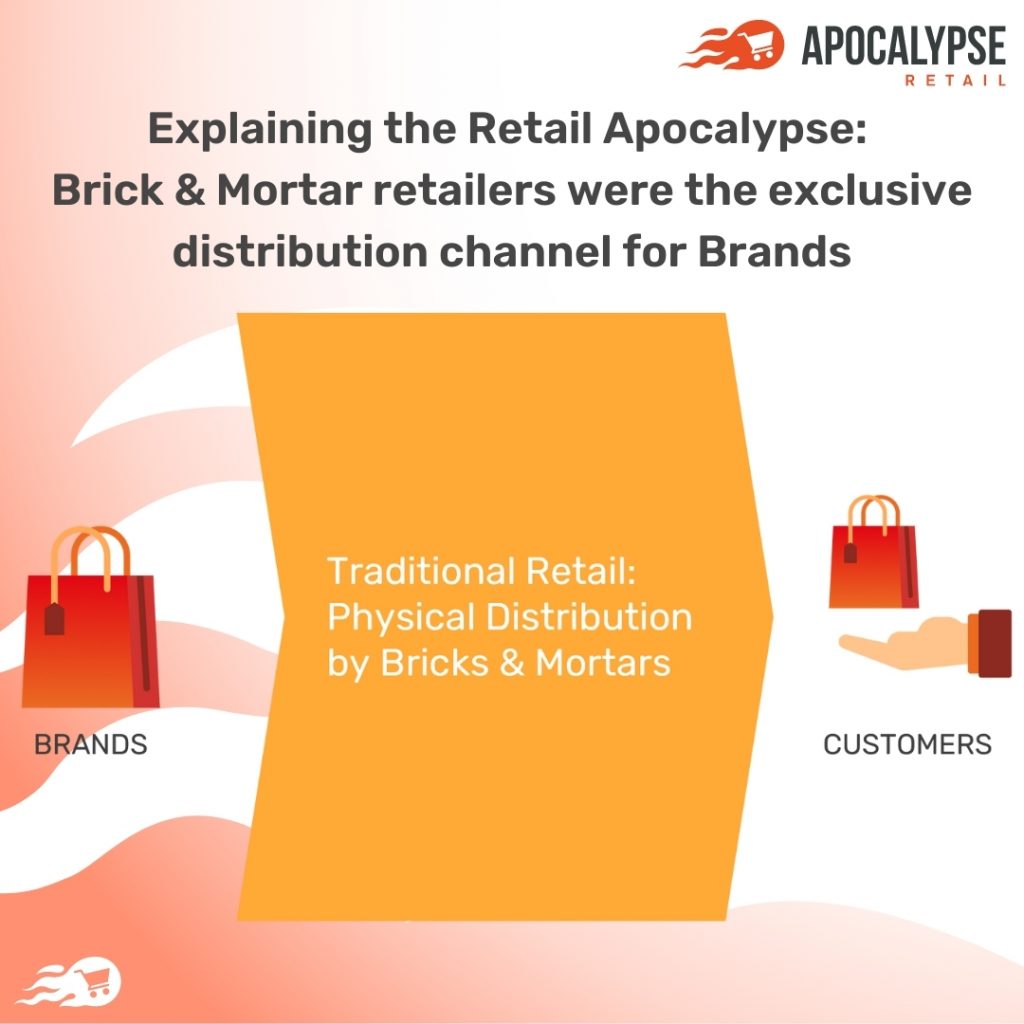
From the 80s to the early 2000s, wholesale brick-and-mortar Retailers dominated the market. They became what we know as Traditional Retailers or Legacy Retailers.
During three decades, these companies were THE channel for customers to access products and brands.
There was a clear separation of roles.
On one side, brands that designed and made products. On the other side, brick-and-mortar Retailers, which provided access-to-market to reach customers.
Traditional Retailers dominated every single Retail category. If you had a brand and wanted to have mass access-to-market, you needed a brick-and-mortar retailer. Most retailers specialized by category or by target audience.
Companies like Leroy Merlin, Home Depot, or Bauhaus specialized in the Home Improvement category. Companies like Galeries Lafayette or El Corte Inglés targeted more premium urban customers instead of a single product category.
Traditional retailers based their leverage on dense networks of physical stores. Networks were built across regional, national, and sometimes international levels.
Wholesale retailers became the gatekeepers for any brand that wished to sell a product for mass consumption. Retailers which thrived were disruptive and became dominant in their category or region.
They were disruptive in their approach to the customer experience. Generous loyalty programs and return policies helped them build trust with consumers. In turn, they built a strong and recurring customer base.
Their store network allowed them to have a local-based marketing approach. Traditional retailers built their strength on a close connection between store employees and their customers.
This connection gave them significant control over information on both brands and customers.
Information control turned to higher margins and higher profits.
But in the early 2000s, two significant changes put an end to Traditional Retailers’ dominance. The first one is the significant expansion of D2C commerce, and the second one is the rise of online shopping.
1. The rise of Direct-To-Consumer (D2C) Retail
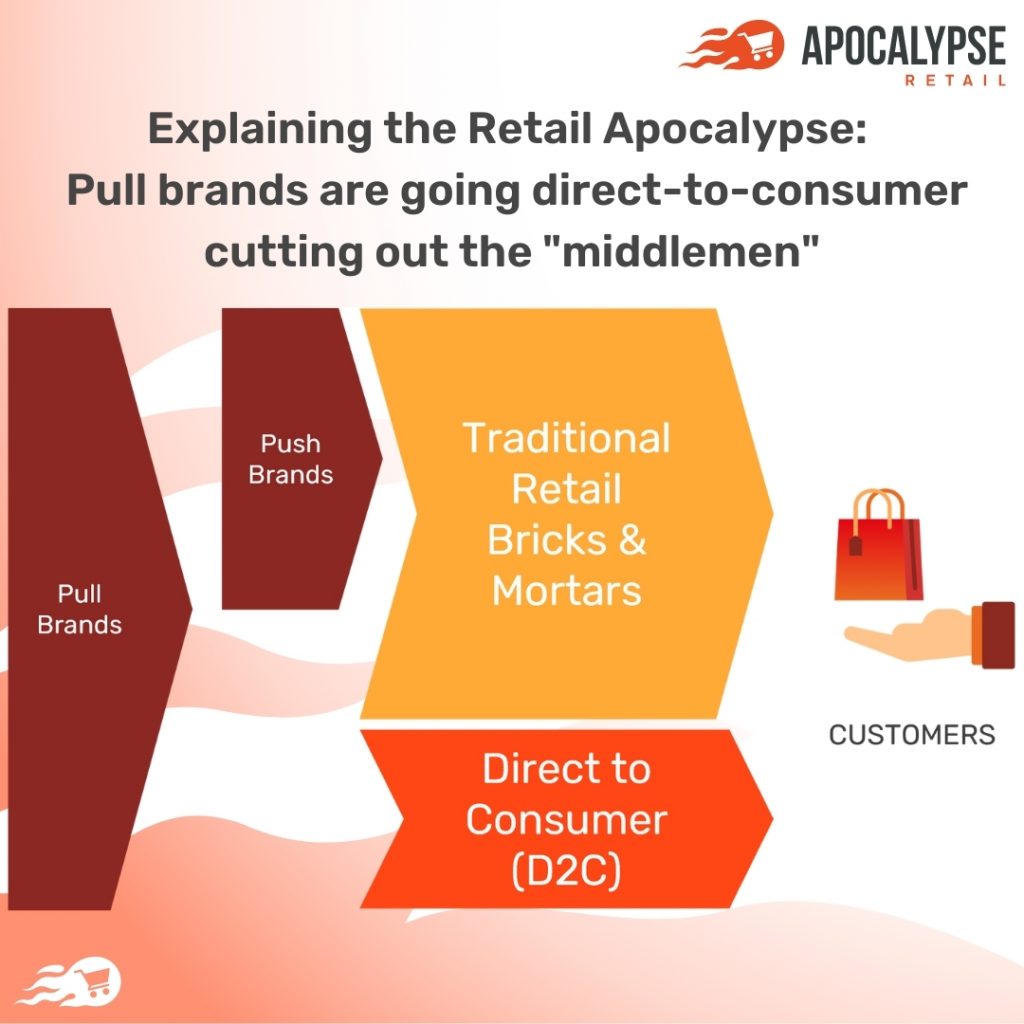
Brands that had enough pull to attract customers began establishing their own stores. These pull brands began cutting out the “middleman” and started reaching directly to customers.
Apple stores are the perfect example.
By 1999, Steve Jobs had returned for two years as Apple CEO. Unfortunately, he was less than happy with the customer experience provided by Retailers like Circuit City or Office Max.
He believed that the brand needed to have closer control over the presentation of its products. At this point, he built a team to venture into physical Retail.
By 2001, Apple opened its first two stores in the US, introducing clean, experience-based stores.
In all categories, brands began opening physical stores to reach customers directly. Categories like sports, fashion, luxury, or cosmetics have seen the most significant changes.
This trend has been accentuated in recent years.
Huge companies like Nike, Adidas, Nestlé, Unilever, or L’Oréal are taking the DTC route. These brands were dependent on wholesale retailers, but not anymore.
According to different reports in Modern Retail, Digiday, Retail Dive, these brands will generate over half of their revenues from DTC by 2025.
This is one of the root causes to understand the end of traditional Retail and what is the Retail Apocalypse. If you want to read more about established brands embracing DTC, read this post.
2. Technology multiplied channels for access-to-market

Way before the Covid19 pandemic, the internet and, in particular, mobile technology completely disrupted access-to-market for brands.
A new breed of Retailers used technology to implement new fulfillment methods and customer engagement strategies.
E-commerce appeared as a new distribution channel to increase competition for physical retailers. Before e-commerce, it was pretty straightforward for Retailers to identify their competitors.
At a local level, it’s easy to notice if a newcomer enters the market. It’s also easier to watch aggressive promotions or activities from competitors.
Online Retailing E-commerce changed these dynamics with new players.
New players such as online pure players, online marketplaces, or DNVBs multiplied competition for traditional retailers.
Let’s deep-dive into these different types of players to understand their impact on the Retail Apocalypse better.
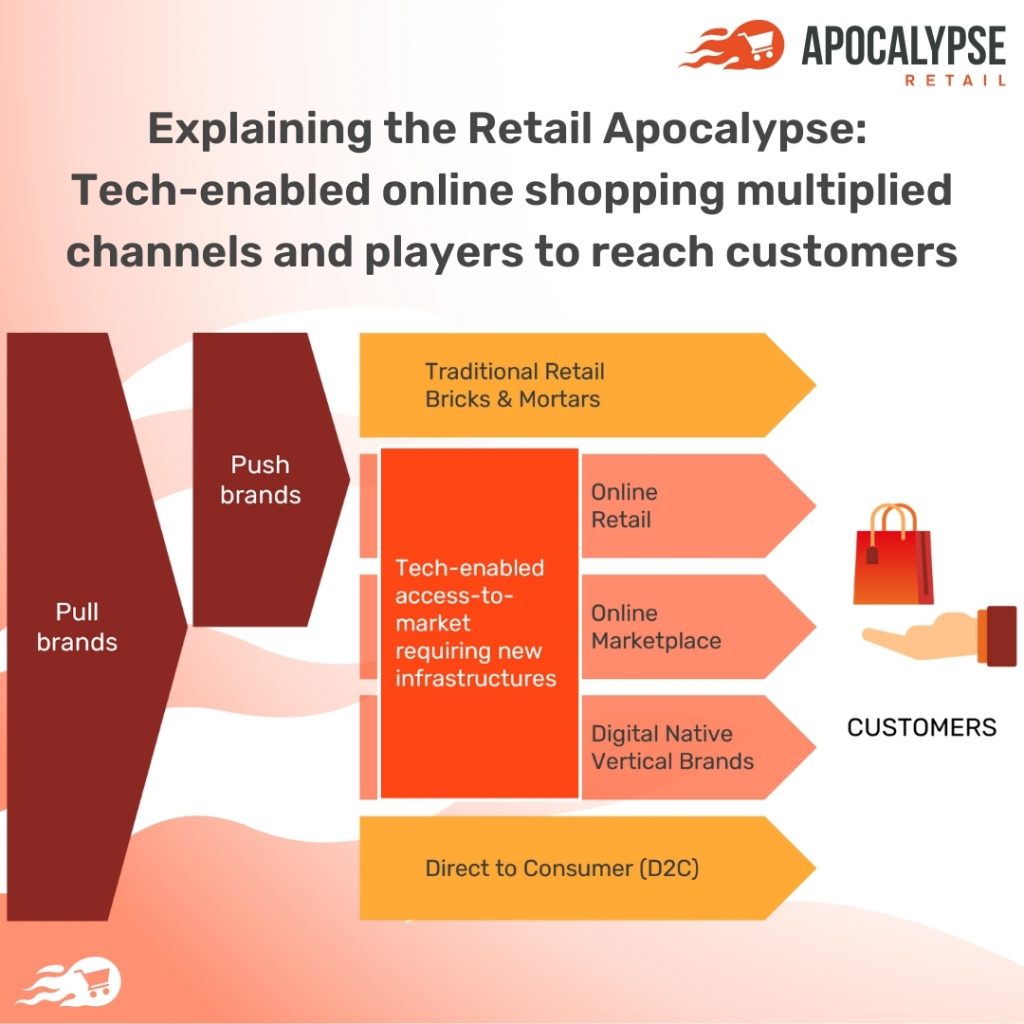
What is an Online Marketplace?

Online Marketplaces appeared at the end of the 90s but got traction at the beginning of the 2000s. These players used technology to connect sellers to customers.
What is an online marketplace? An online marketplace is a platform that connects sellers of a specific product with customers for that product.
At its core, an online marketplace creates value by offering three services:
- A robust technological platform able to onboard thousands of sellers
- High traffic acquisition capabilities on the platform
- Healthy conversion rates for the products within the catalog
A marketplace operator is not the owner of the product. Also, the operator doesn’t necessarily have the physical stock of the product.
In exchange for its services, an online marketplace takes a commission per transaction. Sometimes, the marketplace also charges a fixed fee to use the platform.
An online marketplace can be compared to a shopping mall that runs only online. Still, there are significant differences in the customer journey and monetization business models.
Online marketplaces appeared in the middle of the 1990s. Amazon and eBay were created in the US in 1994 and 1995, respectively. By 1999, the model was exported internationally with the creation of Mercado Libre in Argentina and Alibaba in China.
The Amazon case is a bit different since it started as a Book Retailer Online.
In its early days, Amazon operated as an online retailer, being the owner of the books it sold. Later, Amazon shifted to a marketplace model connecting booksellers to customers.
During the 2000s, all these Marketplaces consolidated their positions as e-commerce leaders. As a result, most of the growth in their respective retail markets was captured by these players.
This growth was almost always at the expense of the traditional retailers competing in the same categories.
In the late 2000s, a new breed of online Retailer appeared: Digital Native Vertical Brands (DNVB).
What is a Digital Native Vertical Brands (DNVB)?

Digital Native Vertical Brands (DNVB) are a new category of Retail companies. Tech companies inspired these companies to disrupt industries through the use of technology.
The term was coined by the founder of one of the first DNVB to appear in the US. Andy Dunn, the founder of Bonobos, created the company in 2007 to disrupt the men’s fashion industry.
The trend continued with the appearance of Warby Parker, Everlane, and Casper in the early 2010s.
These brands had a single common principle: using technology to cut out the middlemen. In other words, they are using tech to become direct-to-supplier (DTS or D2S) and direct-to-consumer (DTC or D2C).
On top of this, these brands use technology as the primary source of customer acquisition. They build potent brands with social media and digital channels. The end goal is to create fans instead of customers.
The three main composites of a DNVB are:
- Vertically integrated business: Direct-to-Supplier and Direct-to-Consumer cutting out middlemen. An integrated value chain of Retail processes from design, to production, to distribution.
- Fully integrated customer journey through tech and data: All touchpoints of the customer journey are unified to create a bond that transcends the purchase. DNVBs not only use tech and data to develop and launch products. They also use it to address and retain customers.
- Implementation of Growth hacking: These brands went from zero to millions in a few years without traditional marketing channels or big budgets. However, they succeeded in using growth hacking tactics, emphasizing customer retention, notably digital channels for acquisition and brand awareness.
This business model is quite revolutionary.
The most prominent examples of DNVB are in the US. There is a fantastic, in-depth article about them by CB insights covering their strategies and DNVB success stories.
In France, these brands appeared more recently but have been equally successful and disruptive. Brands like Sézanne, Le Slip Français, and Tediber have grown in popularity.
These brands cut out the middlemen in their categories in the last five years and built strong communities.
The trend of DNVB disruption has been accelerated with the appearance of no-code e-commerce tools. In addition, software tools such as Shopify or Wix have made it easier than ever to launch an e-commerce company.
These tools provide excellent user experience and complete brand customization. In addition, they need little to no technical skills to start, making them ideal for creating an online brand. It’s no wonder these tools have had tremendous success these last few years.
In 2020, Shopify generated more than USD 100 Bn in Gross Merchandise Value. This figure is insane for a company that has less than five years.
And to think that DNVBs are the players who created most of this value.
The retail apocalypse is when competition multiplies and margins start falling
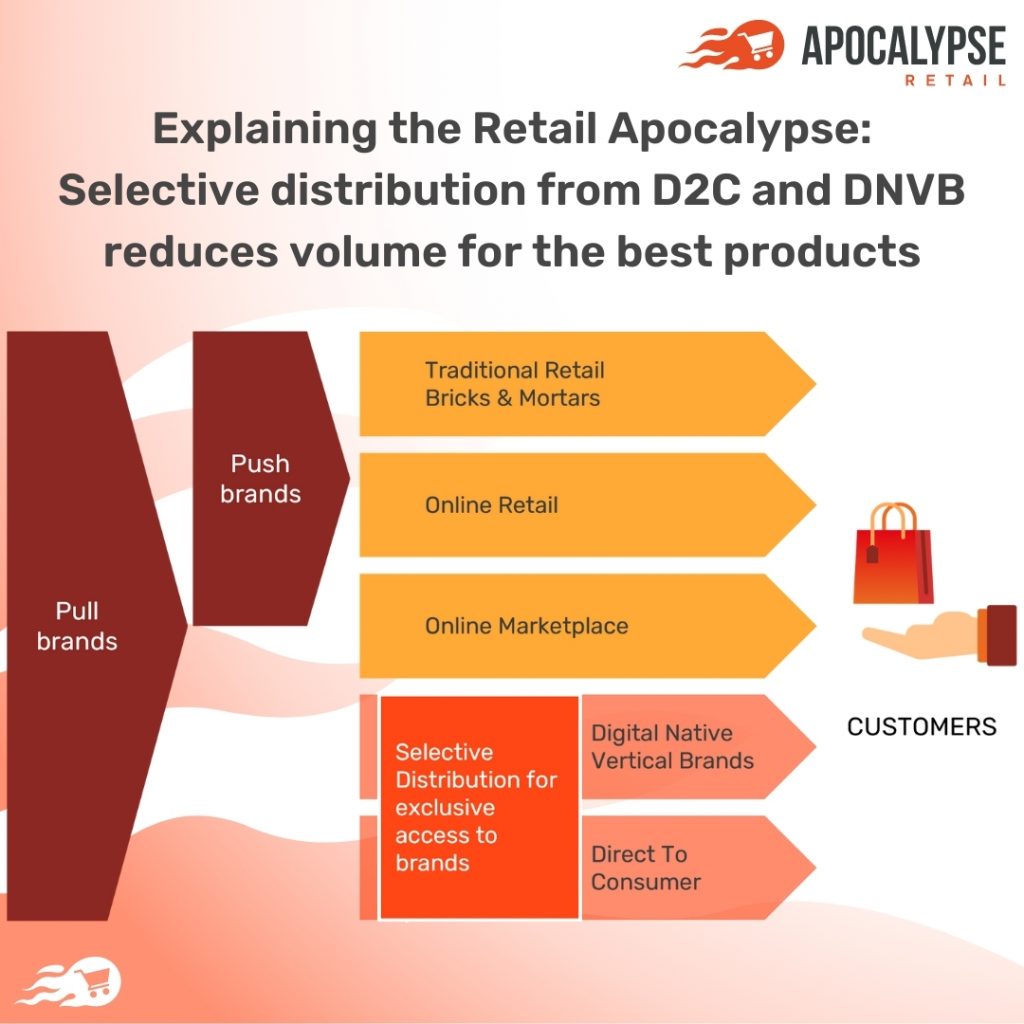
In summary, traditional retailers got challenged from multiple angles. As a result, they are no longer the dominant player to provide access-to-market for brands.
First, some of their biggest pull brands established direct physical footprints. This increased competition hurt margins for retailers. Second, their access to high-margin products got restricted by brands who prioritize DTC.
On top of this, most Retailers failed to adapt to the technological and operating complexity of e-commerce. As a result, the cost of revamping their Supply Chain and IT infrastructure is considerable.
Unfortunately, this cost deterred many retail executives from improving their online business.
For several years, retail executives managed to get decent results from their offline businesses. As a result, very few saw the need to push for digital transformation ten years ago.
The problem is that their survival now depends on them doing so. And they have to do it in a much shorter time, with a lot more competition from all sides.
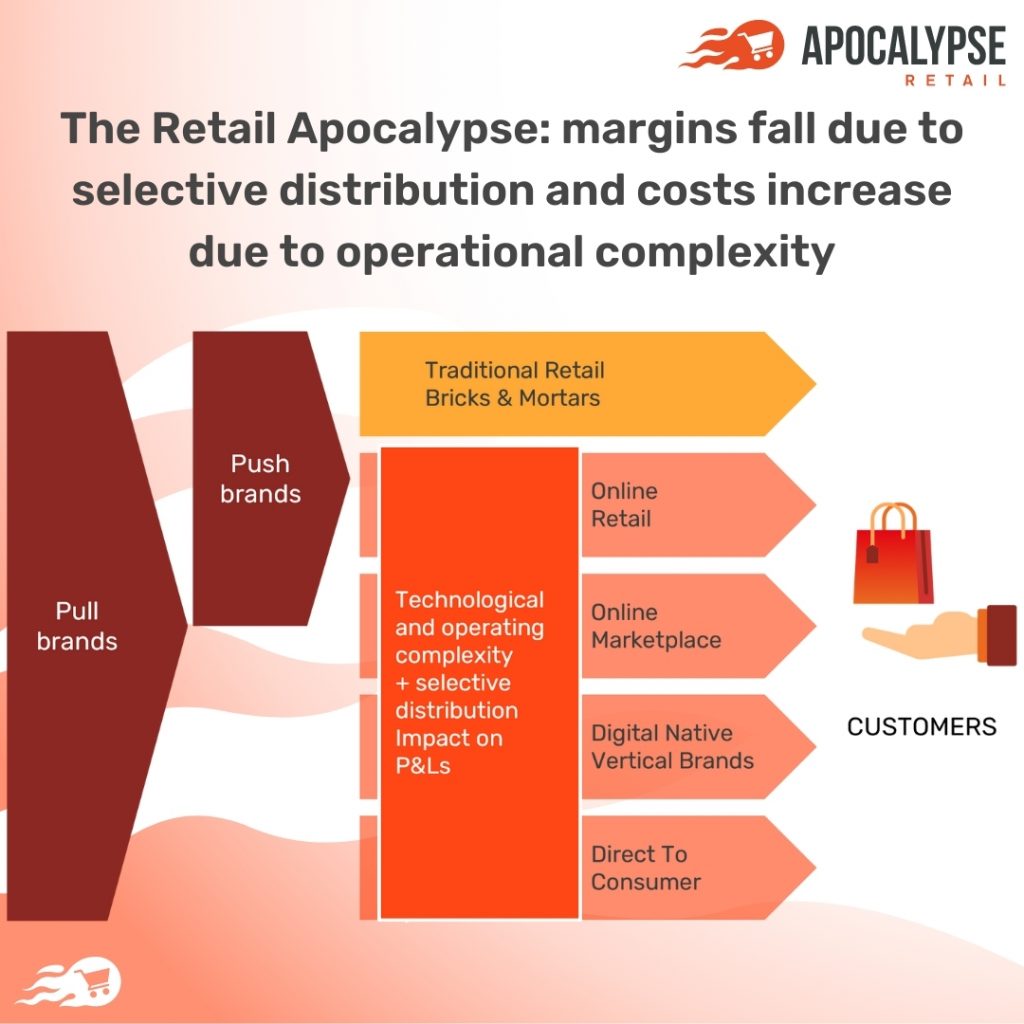
In this post, we have covered what is the retail apocalypse and how to explain the end of traditional brick-and-mortar retail. Over the next post, we’ll explain how small companies can compete with big retailers.
Do you want more insights into E-commerce, Omnichannel Retail, and Digital Transformation? Subscribe to ApocalypseRetail to get insights sent directly to your inbox. Our content is designed for top business schools, retail managers, and eCommerce entrepreneurs who want to survive in the ever-volatile retail industry. Subscribe to our newsletter to join the fight against the Retail Apocalypse!
The post What is the Retail Apocalypse? The End of Traditional Brick-and-Mortar Retail appeared first on Apocalypse Retail.
]]>The post The Impact of Covid19 on Retail: An Accelerator of the Retail Apocalypse appeared first on Apocalypse Retail.
]]>It is only an accelerator in a process that began almost a decade before.
The impact of Covid19 on Retail: chronicle of a death foretold

The year 2020 has been a terrible year for traditional retailers. It’s probably one of, if not the worst, years for physical retail.
Because of the Covid19 pandemic, lockdowns caused an unprecedented dip in physical stores’ traffic.
Only retailers considered as “essential” were allowed to remain open. The rest of retailers faced mass store closures or even total bankruptcies.
For some companies, Covid19 significantly undermined the chances of surviving the Retail Apocalypse.
Giant retailers like Inditex or H&M have reported hundreds of store closures. For small and mid Retailers, the story is even worse. Without support from states, many businesses have struggled to keep business afloat.
During lockdowns, retailers still had to pay their fixed expenses like rent or employees’ salaries. In Europe, state support allowed covering part of employees’ salaries. This was a huge help for companies and employees.
But retailers still had to pay monthly rent and utilities. Covering fixed expenses while the primary income source has been shut down is a challenge.
Without a doubt, Covid19 accelerated the Retail Apocalypse. Still, we shouldn’t talk about the Retail Apocalypse as if it was only related to the pandemic.
The truth is that Retailers’ underlying problems have been present for a while now. 2020 was the perfect storm to drive poorly prepared Retailers to bankruptcy.
What is the Retail Apocalypse?

If you google the term “Retail Apocalypse,” you’ll see results dating since 2010. There is a considerable amount of news and stories with this term.
The term “Retail Apocalypse” is used to describe the trend of store closures impacting Retailers. More specifically, brick-and-mortar Retailers.
The term is a fear-inducing term to drive clicks to headlines. In other words, clickbait (yes, we did it on purpose!).
The term “Retail Apocalypse” even has its own Wikipedia entry. According to Wikipedia, this phenomenon began around 2010. There have been regular updates for the last decade.
When we built the course for HEC Paris, list and timeline of Retail bankruptcies published by CB Insights.
This list covers dozens of cases for US retailers which have filed for bankruptcy since 2015. The article provides a sum of causes for each of these bankruptcies.
In summary, the Retail Apocalypse can’t be attributed to a single year or for a single cause. The US has been hit the hardest as they have the highest share of Retail space per inhabitant.
Yet, France is no exception to the complete transformation of brick-and-mortar models. French Retailers such as Naf Naf, Alinéa, Kidiliz, André, or La Halle have recently filed for bankruptcy.
Brick-and-mortar Retailers have been dying everywhere for the last decade.
The retail apocalypse has been happening for some time. The impact of Covid19 on Retail has been tremendous but it’s not the root cause of the Retail Apocalypse
But if it’s not due to Covid19, what is the root cause of the Retail Apocalypse?
E-commerce added significant pressure on Traditional Retail before Covid19.

Along with the impact of covid19 on retail, e-commerce has also had a considerable impact on retail. The rise of e-commerce is generally considered the main root cause of the retail apocalypse.
But this is only partly true.
What is E-commerce?

Everyone you know that has access to the internet has participated in e-commerce in some way.
When people think of e-commerce, they usually think of online retail. Purchasing a product via a website and having it delivered straight home is the most common view of E-commerce.
But E-commerce is much larger than just the sale of physical products done online. E-commerce involves any transaction that begins online.
E-commerce is buying a plane ticket or booking a hotel room (poor examples with Covid19). It also includes transactions for online services such as Netflix or Spotify.
Online penetration of the total retail market was already underway

Covid19 accelerated E-commerce penetration of total Retail. The share of e-commerce as a part of the total retail market has been rising for the last decade.
Covid19 fast-forwarded E-commerce penetration by two years.
But, as we said before, Covid19 is an accelerator but not the root cause. E-commerce penetration was already expected to reach more than 20% by 2030.
Global e-commerce will grow from 1 in 20 transactions in 2016 to 1 in 5 transactions by 2030.
If you focus on US and European markets, online retail penetration is even steeper. In these countries, online retail should reach 20% of the Retail market by 2024. 2024 is… tomorrow.

Over the next decade, most of the growth in the retail market will be online

Over the next decade, the Retail market is still expected to grow by 3-5% yearly. During the same period, online retail will grow at double-digit numbers every single year.
What this means is that most of the growth for the next decade will be online. Some would even argue that ALL growth will be online.
If you are a Retailer with a fragile online presence, it will be tough to grow over the next few years. The global pandemic has only accelerated this trend, but it has not been the root cause for these changes.
What is undoubtedly true is that the acceleration brought from the pandemic is here to stay. In other words, habits developed during the pandemic are not just going away.
According to a study from the University College of London, it takes roughly two months for a new behavior to become a permanent habit, with a maximum of 254 days.
So we are well over the limit for changes in consumer behavior to become permanent habits.

Every single category has been subject to E-commerce disruption
Back in 2010, some product categories were challenging to handle on e-commerce. Barriers to online commerce sheltered some categories from disruption for some time.
Logistics’ complexity or regulatory constraints were the most common barriers. Complex logistics sheltered categories like groceries and home improvement. Regulations sheltered categories like pharma or para pharmacy.
In other categories, disruption was slower as the user experience was not ready for detail-oriented products.
In the last decade, e-commerce players have torn these barriers down. These companies refused to accept that “it can’t be done online.”
Then came Covid19.
Since the beginning of the pandemic, every category has seen significant growth in online sales. Online acceleration was steeper in categories like groceries, pharma, or personal care products.

After the pandemic, no category is sheltered from the rise of E-commerce. But why is the rise of e-commerce accelerating the retail apocalypse?
The short answer is that most traditional retailers have failed to adapt to the changes in consumer behavior over the last two decades.
A long explanation will be developed in the next post. We will be covering the root causes of the retail apocalypse and the end of traditional retail.
Do you want more insights into E-commerce, Omnichannel Retail, and Digital Transformation? Subscribe to ApocalypseRetail to get insights sent directly to your inbox. Our content is designed for top business schools, retail managers, and eCommerce entrepreneurs who want to survive in the ever-volatile retail industry. Subscribe to our newsletter to join the fight against the Retail Apocalypse!
The post The Impact of Covid19 on Retail: An Accelerator of the Retail Apocalypse appeared first on Apocalypse Retail.
]]>