The post DNVB: 11 Digital Native Vertical Brands That Are Disrupting French Retail appeared first on Apocalypse Retail.
]]>We want to give our special thanks to Benjamin Lechtman & Gaspard Alcalde, the two students who co-authored this post with us.
Digitally native vertical brands or DNVBs are exploding in popularity. This new generation of highly disruptive brands is changing the world of Retail.
These brands are direct-to-supplier and direct-to-consumer companies that design, build, sell, and ship their products in-house.
While they only became popular over the last decade, we can expect DNVBs and other forms of Direct-To-Consumer commerce to be the new norm in Retail over the coming decade.
Brands that manufactured FMCG (Fast Moving Consumer Goods) and CPG (Consumer Packaged Goods) depended entirely on retail distributors to access their market.
But the rise of online shopping and smartphones opened multiple new channels for brands to access their customers.
This is why DNVBs are becoming such a big deal.
They are at the crossroads of two of the root causes of the Retail Apocalypse: the rise of direct-to-consumer and the rise of e-commerce.
In this article, we’ll guide you to understand how digitally native vertical brands work, where they come from, and give you some examples specific to the French Market.
What is a Digital Native Vertical Brand (DNVB)?

A Digital Native Vertical Brand in Marketing is a brand created online with a honed-in focus on customer experience across the entire customer journey.
DNVBs always start online, and many will evolve into opening physical stores. However, unlike your average e-commerce company, a digitally native vertical brand controls its entire manufacturing and distribution process.
The three critical aspects of a Digital Native Vertical Brand are:
- Vertically integrated business
- Deep focus on understanding the customer
- Growth hacking at the core of their marketing strategy
1. A DNVB is a Vertically Integrated Business

These brands have total control over the business model, using technology to cut out the middlemen in their manufacturing, supply chain, or sales processes.
DNVBs often boast a significant price advantage over their competitors in the same industry since they have successfully cut out the middlemen to reduce in-between commissions.
By taking this D2S (direct-to-supplier) and D2C (direct-to-consumer) approach, they significantly increase their margins while providing better prices than their competitors.
An e-commerce company tends to have a deeper understanding of its customer journey than an offline company. What separates DNVBs from general e-commerce is that they use this deep understanding of the customer to adopt changes in their manufacturing, supply chain, and sales processes.
DNVBs can implement product design changes according to their wants and needs vertically integrated. And they can do it much faster than their competition, which gives them a competitive advantage.
2. A DNVB Focuses On a Deep Understanding of The Customer
Another element of DNVB is the approach they have to understand their customers to increase retention.
As we’ve said before, e-commerce companies tend to have a much deeper understanding of the customer journey than offline companies.
What is different about DNVB’s is they use this understanding at all moments of the customer journey to create a bond with the customer that transcends a single purchase.
The focus is felt across the customer journey, especially in customer service, significantly better than the average brick and mortar Retailer.
The fundamental aim is not to acquire customers but to create fans of the brand. This fan-like status ensures retention and referral, thus reducing future customer acquisition costs.
A DNVB will use its websites or blogs and social media platforms to create a community of fans. As they control every aspect of the product, they can provide a unified experience across the customer journey.
They successfully offer scalable personalization for the customer, which allows them to create intimacy with their customers and increase retention and referral chances.
3. Growth Hacking is The Core of the DNVB Marketing Strategy

A DNVB will generally handle all of its marketing internally, often relying on growth hacking techniques to increase its audience through cost-efficient campaigns.
Digitally native vertical brands in France and worldwide are often created with limited marketing budgets, which forces them to get creative with their marketing budgets.
As a result, they generally use targeted ads on Social Media or Search platforms, like any other Retailer.
What makes DNVBs unique is that they consider every single touchpoint across the customer journey, online or offline, as a marketing channel.
By doing so, they approach every touchpoint with a test-and-learn approach to measure its effectiveness for customer acquisition and retention.
As they have a deep understanding of their customers, DNVBs efficiently use their budget to launch campaigns across the customer journey to maximize customer retention and referral.
This approach allows them to build significant fan bases at a fraction of the cost of a traditional Retailer to reach the same results.
The Origins of the Name DNVB or “Digital Native Vertical Brands”

The term “Digital Native Vertical Brand” was coined by Andy Dunn, the founder of US clothing company Bonobos.
In a blog post in 2016, Dunn described the growing emergence of companies created online and sell and ship their products.
He specifically focused on why these companies can’t be considered typical e-commerce companies. Instead, he argued that these brands have a unique approach by managing their end-to-end distribution processes, giving them a specific edge over general e-commerce.
A DNVB Is Not Ecommerce, It’s Vertical Commerce

Dunn noted in the Medium post the competitive advantages of having a vertical integration: “The product gross margins are at least double that of e-commerce (e.g., 65% versus 30%). The contribution margins can be 4–5x higher (e.g., 40–50% versus 10%).”
For Dunn, we are not simply talking about e-commerce; we are talking about vertical commerce.
This competitive advantage in unit economics represents a radical difference from e-commerce: “Vertical commerce can make money. E-commerce, not so much.”
A DNVB Is Maniacally Focused On The Customer Experience
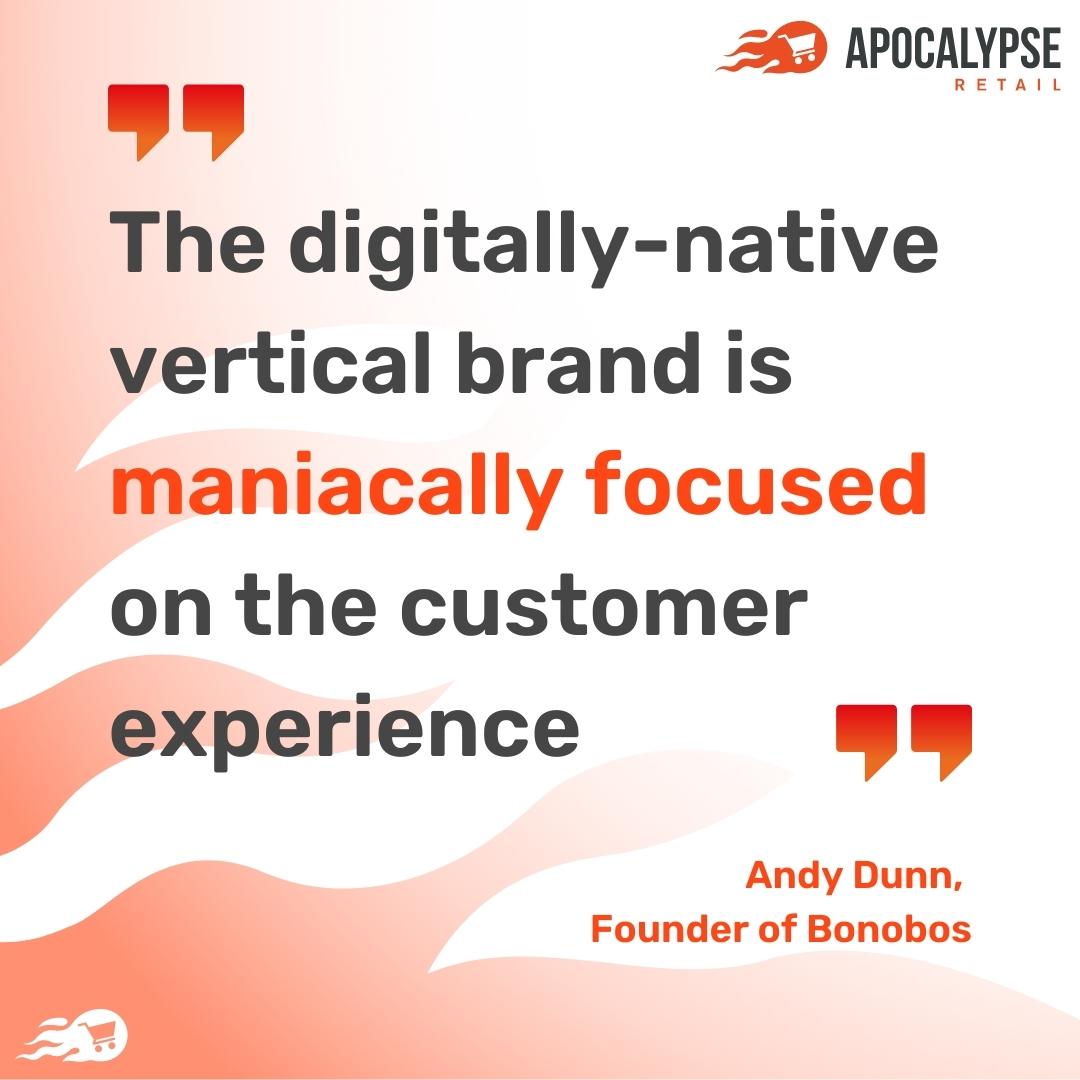
Another key trait of these companies, according to Dunn, is the focus on the customer. In the post, Dunn explained that a “maniacal focus” on customer experience is another common trait of DNVBs.
These companies have an unprecedented focus on the customer as they are obsessed with customer experience. It begins with the quality and design of the products they sell and is constant across the customer journey providing a solid service experience before and after the purchase.
For Dunn, it is also vital to consider that DNVBs should not be viewed as tech companies.
They are indeed brands born online, and they mostly use digital channels. But what they are fundamentally disrupting is the Retail sector as they are Retail companies with a different approach to technology.
What Is The Difference Between DNVB and D2C?

“Digital Native Vertical Brands” companies and “Direct-to-Consumer” companies are phrases that are often used interchangeably. Still, there are some significant differences between the two.
A DNVB is essentially a D2S (direct-to-supplier) and D2C (direct-to-consumer) mixed: a D2S2D2C, if you will.
Direct-to-consumer refers to companies that sell their products directly to consumers without relying on wholesale Retailers (online or offline).
For example, a DNVB is a direct-to-consumer brand, but they also have integrated their supply-side to cut out middlemen such as importers or distributors.
In this sense, a DNVB is a D2C, but not every D2C is a DNVB.
Success Stories: 11 DNVB or Digital Native Vertical Brands in France

Focusing on the French Market, DNVBs work similarly to other countries.
As of 2021, french DNVBs had an estimated annual turnover of €640M and were growing at 3x the average growth of e-commerce players.
With these numbers, it’s undeniable that DNVBs are becoming highly popular in France.
According to the digital native study, as of 2021, there were almost 450 brands identified within the DNVB collective in France, adding more than 100 brands only in 2021.
The one thing where French DNVBs are highly different is that most of them have a solid corporate social responsibility message.
Impact and sustainable Retail is part of the DNA of most of these brands. As we’ll look through examples, most success stories among french DNVBs players are highly focused on making retail more sustainable.
Le Slip Français: Local Manufacturing For Chic French Underwear

Le Slip Français made its mark by creating gender-neutral underwear using 100% french textile manufacturers. This 100% Made-in-France approach has been a critical differentiator for the brand to sustain local manufacturing.
Their motto, “Change fashion, change the world,” really exemplifies the products they make and how they are socially charged.
They’re currently disrupting the fashion industry with a complete catalog of products from underwear to socks and pajamas.
The brand was created in 2011 by Guillaume Gibault, a former HEC Paris student, and, as of 2019, generated more than 24M€ in sales.
They started with a pure online focus selling from their website and currently operate 16 stores in France and sell through Retail wholesalers to generate additional volume.
As of November 2021, the brand had 138k followers on Instagram.
Jimmy Fairly: The French Warby Parker

Jimmy Fairly is a famous French eyewear brand similar to Warby Parker in the US, but with a special french touch. The brand was created in 2011 by Antonin Chartier and Sacha Bostoni, a former HEC Paris student.
They even contacted Warby Parker founders to look for synergies initially but got no reply. So they focused on growing in the french market and concentrated on high-quality eyewear and social consciousness.
For every pair purchased, the company will donate another to someone in need.
Using this social-impact practice, the brand gained significant traction online and built up a reputable brand presence among its followers with the Buy-One-Give-One program.
Back in 2012, Sacha Bostoni said in an interview, “People say we’re a hipster brand, but when we look at our customers, they really love that we’re a brand with convictions.”
As of 2019, the brand had sold more than 280k pairs of glasses and donated the same amount.
This Digital Native Vertical Brand is also an example of a brand that started online but rapidly found the benefits of having physical stores.
The “cosy store” concept is considered one of the fundamental parts of their growth. Currently, Jimmy Fairly has 52 different storefronts around France and 3 in London.
As of November 2021, the brand had 165k followers on Instagram.
Tediber: The French Casper

Tediber is another French brand heavily inspired by another American DNVB, Casper, and a special French touch.
The brand quickly built a reputation with its mission statement: make buying an “Incredible Mattress” affordable and accessible for everyone.
The notion of an “incredible” product has been a trademark of the company as they expanded their catalog with the “incredible bedspring,” the “incredible pillow,” or the “incredible bed sheets.”
The company was launched in 2015 by Julien Sylvain, Juan Pablo Naranjo, Jean-Christophe Orthlieb, and Aude du Colombier.
They’ve found a ton of success by focusing heavily on the purchasing experience. In addition, their 100-day return policy is very generous and helped them build trust with their customers (as a disclaimer, this was the same strategy Casper used in the US).
But the execution in the European markets is what has set Tediber apart, as they’ve harnessed strong support from existing customers. As a result, they boast more than 35k positive reviews on their website.
In the Covid era, the mattress industry was significantly impacted, as mattresses are typically sold in showrooms where consumers can physically try out beds for their comfort level. Tediber offers a more digital experience at an affordable price by cutting out the middleman.
Tediber has jumped to the physical world by opening three different storefronts in Paris, Toulouse, and Lille in the last few years. These stores are showrooms for the brand’s products where customers can effectively test the quality of their “incredible mattress.”
As of November 2021, the brand had 100k followers on Instagram.
Gemmyo: The Jewelry Brand of the Rose Kitten

Gemmyo was created in 2011 to disrupt the jewelry industry.
The company was founded by Pauline Laigneau, former HEC Paris Student, Charif Debs, Malek Debs, Alexis Joseph, and Fanny Boucher.
In the beginning, the brand was exclusively using digital channels to grow.
They smartly used funds raised in 2013 to launch a marketing campaign that significantly increased their brand awareness. They put billboards in the Paris Metro displaying a rose kitten wearing a ring in its right ear.
Gemmyo has implemented technology across its customer journey to provide scalable personalization. Which has become one of their critical differentiators as it is not a common trait in the jewelry industry.
Traditional Retailers in the jewelry industry fail to provide accessible personalization in their products. Using instant messaging like WhatsApp, 3D technology, and Lean Manufacturing, Gemmyo offers unique pieces for their customers according to their needs.
Currently, the company operates four stores in France, which they use as showrooms for their products. They have also launched an online video platform where consumers can speak with a jewelry adviser to ask questions and get answers—a perfect solution in Covid times.
As of November 2021, the brand had 126k followers on Instagram.
Veja: French Sustainable Sneakers with a Brazilian Touch

Veja is one of the “senior” brands on this list.
The brand dates back to 2005 when founded by François-Ghislain Morillion, a former HEC Paris student, and Sébastien Kopp.
Veja is a footwear brand with substantial success in Europe, mixing a clear commitment for ethical Retail and fair trade.
The company has been involved with several Brazilian associations to finance fair trade extraction, ethically sourced cotton, rubber, and leather to make the sneakers.
The brand is exceptionally transparent about the project. It openly discusses the limits of pushing ethical Retail within a digitally native brand that strives to be profitable.
On their website, they openly challenge themselves: “While we’re proud of our sneakers and the way we make them, other questions beg to be answered. Do we really need to buy so many pairs of shoes?”.
Perhaps it’s this honesty and level of transparency that their customers love, as the brand made over 65M€ in sales in 2019, almost doubling the revenues from 2018.
The brand operates three stores in Paris, New York, and Bordeaux and has started selling through multiple online and offline wholesalers.
As of November 2021, the brand had 714k followers on Instagram.
Bobbies: Footwear With a Parisian Chic

Bobbies is another successful French DNVB that sells footwear with a Parisian chic.
The brand was established by Alexis Maugey and Antoine Bolze back in 2010. Since its inception, the brand has focused on designing and producing high-quality leather shoes with a particular “parisian touch” and made-in-Europe.
In addition, the brand’s vertical positioning allows them to offer these products at a much lower price than the competition of luxury leather shoes.
The “parisian chic” has been at the heart of the branding strategy, which has worked very well. The company reported more than 8M€in revenues by 2017 and exceeded the 20M€ bar in 2020.
Many DNVBs use social media to spread brand awareness, as it is relatively inexpensive and does not require the use of a third-party marketing firm.
Bobbies, for example, consolidated a strong community of fans on social media, particularly on Facebook and Instagram. As a result, they have almost half a million combined fans on both platforms.
The brand has jumped to physical Retail by opening three directly owned stores in Paris and Lyon.
The brand controls the entire experience in these stores and provides a unified approach to the “Parisian chic” journey.
They also had a rapid international expansion via wholesale Retailers and other websites. As a result, their shoes are now sold in more than 50 countries.
As of November 2021, the brand had 321k followers on Instagram.
Joone: Baby Care Products That Are Good For The Planet

Joone is a brand that has focused on disrupting the baby care market with a strong sustainability message.
Launched by Carole Juge Llewellyn in 2017, the brand has concentrated on providing the highest quality baby care and skin care products while promoting “radical transparency” in environmental impact.
The brand has taken a radical approach to sustainable Retail, making local production and close-manufacturing circuits a key selling point for their diapers.
The brand boasts that every product in the catalog is manufactured in France, keeping their carbon footprint as low as possible.
In the same vein as German DNVB Lillydoo, founded in 2015, Joone started with a subscription model for diapers that worked.
Amazon had already disrupted the diaper industry with subscriptions, but what set Joone apart is the transparency regarding the sustainability of its products.
This transparency has appealed to many French parents looking for less polluting diapers for their kids.
This brand also focuses on a transparent DNVB that utilizes a subscription model rather than your typical browse-and-buy D2C approach.
Joone is very transparent about its pricing and requires no commitment to use its service. Parents can enjoy a whole month’s diapers supply regularly. The service is set up to be customizable according to use and the number of children consumers have. If you purchase a product that isn’t a good fit, you can easily send it back.
Even if baby care products have been at the core of their catalog, Joone has expanded to women’s skincare products. Following the brand’s mission about transparency, they are aggressively expanding to disrupt the sustainable skincare market.
As of November 2021, the brand had 79k followers on Instagram.
Respire: Bringing Sustainability to the Skincare Industry

Respire is another brand disrupting the skincare industry with an ethical approach.
This success story is a favorite of ours as it combines excellent story-telling with the right mix of personal and company branding—all of this, of course, with fantastic execution to sustain scalable growth.
The brand was founded in 2018 by Justine Hutteau and Thomas Méheut, a former HEC Paris student. The company launched via crowdfunding focused on creating a natural made-in-France deodorant.
The crowdfunding quickly gained traction using a compelling story of how Justine Hutteau was diagnosed with a benign tumor.
After being diagnosed, she started paying attention to the ingredients and components of her skincare products. She quickly realized that there was no product made from natural products, so she decided to create it.
Justine already had a strong community of Instagram followers, which she used to provide traction for crowdfunding. As a result, the crowdfunding had raised more than 200k€, selling 21k products in just a month.
After the initial success with the crowdfunding, Respire has built a fantastic community in just under two years. They started selling through big Retail wholesalers like Monoprix and Sephora, building solid brand awareness.
The brand sold 800k products in its first year and added products to the catalog, from shampoo to sunscreen.
It has efficiently used a subscription-based model as consumers can automatically deliver their products at a specified frequency. In addition, by subscribing instead of directly buying, customers can enjoy percentage-based discounts.
Their ambition is to become the leading skincare company in Europe by 2030, which may seem far-fetched. But given the initial success, it shouldn’t be impossible.
As of November 2021, the brand had 157k followers on Instagram.
Bergamotte: Digitalizing The Flower Revolution To Make it Sustainable

Bergamotte is a digitally native vertical brand created and launched in Paris in 2016 by Romain Raffard and Loïc Reperant.
In the same vein as Colvin, which launched in Spain in 2015, Bergamotte intends to disrupt the flower industry. This industry historically struggled to grow in e-commerce due to the complexity of distribution and shipping for its products.
What has set Bergamotte apart in brand positioning is its push to make the flower industry more sustainable. The brand’s mission is to build a “greener future,” which they follow with impressive transparency about their carbon footprint.
The company has a clear commitment to reducing its products’ carbon footprint, and since 2020 commits to selling European-only plants and flowers.
This approach is radically different from the rest of the french flower industry, as 85% of flowers sold come from abroad.
This approach to making the industry more sustainable has found an audience within french customers. The brand has built a community of close to 200k followers on social media.
As of November 2021, the brand had 190k followers on Instagram.
Tiptoe: Sustainable Furniture With Modular Table Legs

Tiptoe is a sustainable furniture manufacturer and distributor founded in Paris in 2015 by Matthieu Bourgeaux and Vincent Quesada.
The two founders launched the brand via crowdfunding to create a well-designed, sustainable, modular table leg that made furniture affordable.
Then, building on their impeccable table leg design, they added new products to the catalog, including dining tables, bedside tables, desks, and chairs.
They found significant success in the furniture sector by providing an excellent online shopping experience that does not require a physical showroom.
In addition, the brand focused on having fantastic product photography and showcasing its sustainability practices in all its communications.
In an industry that focuses on delivering fast furniture or “disposable” furniture cheaply made, Tiptoe takes an approach to create timeless furniture pieces affordable and high-quality.
The brand has found a large audience in Europe by educating consumers about the environmental impact of mass-scale furniture disposal.
As of November 2021, the brand had 207k followers on Instagram.
Tikamoon: Made To Order French Decoration

Tikamoon is another furniture and home goods brand that successfully became a digitally native vertical brand in France.
Like Tiptoe, this brand focuses on designing furniture that lasts, rather than disposable, cheap items.
The brand was founded in Lille in 2007, and after several years it was acquired by the Adeo Group, one of the largest home improvement companies globally. In 2021, the founders regained complete control of the company separating from the Adeo Group.
Despite being part of a large group for some time, Tikamoon kept significant autonomy and boasted its Digitally Native Vertical Brand status since inception.
The brand is exclusively sold online, and most of the brand’s products are made-to-order. This feature could be limited in lead times, but the brand has done a great job explaining longer lead times to their customers.
As of November 2021, the brand had 104k followers on Instagram.
If you know other players to include in this list, drop us an email, and we’ll add them.
Do you want more insights into E-commerce, Omnichannel Retail, and Digital Transformation? Subscribe to ApocalypseRetail to get insights sent directly to your inbox. Our content is designed for top business schools, retail managers, and eCommerce entrepreneurs who want to survive in the ever-volatile retail industry. Subscribe to our newsletter to join the fight against the Retail Apocalypse!
The post DNVB: 11 Digital Native Vertical Brands That Are Disrupting French Retail appeared first on Apocalypse Retail.
]]>The post The Growth of Direct To Consumer is One of the Root Causes of the Retail Apocalypse appeared first on Apocalypse Retail.
]]>Today, more and more established product brands bypass traditional distribution and take a shorter route to put their products directly in consumers’ hands.
In particular, Consumer Product Goods (CPG) brands and Fast-Moving Consumer Goods brands are growing their share of direct-to-consumer sales.
To explain this, one could argue it’s only about profitability, but as we’ll explain in this article, there’s much more to it.
Starting with detailed definitions of DTC, CPG, and FMCG, we’ll then dive in and explore why DTC is an excellent strategy for brands dealing with CPG or FMCG.
By explaining this strategy, we’ll cover how the growth of direct to consumer is one of the root causes of the Retail Apocalypse.
What is Direct-to-Consumer, DTC or D2C?

Direct-to-consumer is a retail strategy that brands can use to access consumers directly, without going through distributors.
These distributors can be online or offline, but they will generally take a margin to sell the products in exchange for their services and access to consumers.
In a direct-to-consumer business model, a brand will control the entire purchasing experience with the customer without any middlemen or distributors.
Direct-to-consumer can also be referred to as DtC, DTC, or D2C.
What is the difference between DNVB and DTC?

You’re likely familiar with Peloton, Bonobos, Dollar Shave Club, or Casper.
Who hasn’t thought about sampling the five pairs of glasses Warby Parker allows consumers to try before buying?
Whether you need designer glasses or a fresh razor to show up in your mailbox, these digital native vertical brands (DNVBs) offer textbook examples of how DTCs should operate.
DNVBs are products of the digital age and, by definition, are DTCs. In other words, DNVBs are just direct-to-consumer companies born in the digital age.
Here’s how a DNVB model starts:
- Born on the internet
- No initial brick-and-mortar storefront
- Source products directly
- Sell products directly to consumers
- Uses technology to scale
Unlike traditional retail businesses, DNVBs control everything about product distribution in a vertically integrated company. So, to sum it up, it’s Direct-to-Supplier and Direct-to-Consumer or D2SD2C if you like to shorten words.
Today, instead of solely describing a method, the term DTC defines a specific distribution channel. In this case, DNVBs are part of the DTC business, but they do not stand alone in the DTC space.
More and more established brands are joining the DTC party!
What are Fast-Moving Consumer Goods (FMCG) or Consumer Packaged Goods (CPG)?

Let’s start with the basics: do you eat Oreos or Pringles? or have you purchased toothpaste, deodorant, or dog food?
All of these are classic examples of consumer packaged goods (CPG), but only some are examples of fast-moving consumer goods (FMCG)
Overall, you could use the same term in retail, but if you want to get technical, the main difference is the purchase frequency.
FMCGs are technically a subset of the CPG category. However, FMCGs are, by definition, consumer products that are purchased with a relatively high frequency as consumers use them every day.
Great examples of FMCG are toothpaste, potato chips, or shampoo, which are products that consumers tend to repurchase frequently for daily consumption.
On the other hand, CPG includes a broader scope of products with a short shelf life but is not as fast as FMCGs.
For most people, these two categories include the same types of products, and the only nuance is in how short is the shelf life.
CPGs and FMCGs include products consumers use every day and need to restock regularly, including the following categories:
- Food items
- Beverages
- Cleaning products
- Personal care items
- Over-the-counter drugs
From a retail standpoint, CPG and FMCG products have a few characteristics:
- High volume
- Short shelf life
- Low price per unit with low contribution margins per unit
- Low engagement and effort to choose the product
- High repurchase frequency
The Growth of Direct-to-Consumer Removes the Toll of Middlemen in Traditional Retail Distribution

In a nutshell, every CPG or FMCG goes through a similar process.
These products go through multiple channels before consumers ever see them on a store shelf.
Here’s what the CPG supply chain looks like:
- Manufacturer
- Importer
- Distributor / Wholesaler
- Retailer
- Consumer
The path from the brand to the consumer reads like a long and winding road.
Eventually, products will get to the consumer, but many middlemen are involved in the journey.
Of course, you have to consider that every middleman in the process takes a cut of profits, reducing margins for brands.
This is where direct-to-consumer increases margin by streamlining the entire process.
When a brand moves away from the traditional third-party method of getting products to the marketplace, they eliminate all middlemen involved.
- Manufacturer
- Own Store (online or offline)
- Consumer
As you can see, you’ll find no middlemen as products get to consumers directly from the manufacturer via the brand’s own store network.
Today’s Consumer is Ready for a Direct Relationship with Brands

DNVBs do many things right, but their obsession with the consumer’s experience is an area that established brands are looking at closely.
Modern consumers have much broader access to brands thanks to online shopping and technology.
The modern consumer is omnichannel in their behavior, meaning that they jump seamlessly from one channel to the other.
In this sense, the traditional retail experience is not enough to attract consumers and generate long-term retention.
Consumer values continue to evolve, along with their expectations. And today’s consumers value convenience and unique experiences more than anything.
So, to make them happy, brands should strive to reach consumers in every channel and offer them a unique experience to ensure repurchase.
Customer studies, focus groups, and other types of market research cannot substitute for regular real-world consumer interactions.
In a more traditional retail distribution approach, CPG and FMCG brands have limited interactions with customers. Instead, it’s the retailer that develops a direct relationship with consumers through its distribution network.
In other words, brands are removing the middlemen, the big box stores, the discount department stores, or the hypermarkets.
By creating a direct relationship with consumers, brands get first-party high-value data to deliver value to each unique consumer. This is the foundation of a 360 view of the customer.
E-commerce is Paving the Way for the Growth of Direct to Consumer

We’re no longer living in the dawn of the digital age.
Companies that haven’t embraced the power of digital channels are missing out on a new kind of relationship with consumers.
It’s no longer about having an online presence.
Having a website is not just about brand awareness and storytelling. Most brands realize that their websites are a powerful tool to build a direct relationship with their customers.
In this sense, brand websites are becoming their online store-fronts to interact and engage directly with their customers. In other words, brands are building an omnichannel engagement strategy.
Not only because brands have built their e-commerce stores, but also they have started selling through online marketplaces.
Marketplace commissions are a fraction of the margins that traditional retailers take when selling to consumers.
So brands can sell through online marketplaces and increase their profits, even if they don’t own the relationship with the customer.
In the old model, a brand company needed brick-and-mortar stores to reach consumers. The retailer, who played the gatekeeper, controlled what brands and products they allowed shoppers to buy.
The physical store became the focal point, which meant the retailer, not the brand, owned everything about the consumer’s shopping experience.
Through the help of e-commerce, brands are embracing the growth of Direct-to-consumer to control the entire narrative.
Direct to Consumer is a Smart Move for CPG and FMCG Brands

There is an undeniable advantage for any brand of cultivating a relationship with end-consumers. By focusing on gathering data from customer touchpoints, a brand can better understand its customers.
According to a study from Brandshop, 88% of consumers prefer buying directly from a brand if they are given the option.
Consumers expect an engaging shopping experience when they buy from the brand’s online store and physical stores.
But for CPG and FMCG, there is a strategic advantage to growing their D2C business.
When they cut out the middlemen, they take away their tolls and increase their margins.
Sourcing products directly from the manufacturer and selling them directly to consumers can significantly increase their margins.
Those additional margins mean a CPG or FMCG brand can invest more in marketing than they could if they remained tied to regular retail distribution.
These brands can increase their customer acquisition costs, as they have all the data they need to understand their customers and increase their lifetime value.
In turn, a higher lifetime value pays for the increase in customer acquisition costs.
It is no coincidence that CPG and FMCG brands are embracing the growth of direct to consumer.
As we’ll see below, some of the most established global brands like L’Oréal, Adidas, Nike, Unilever, and Nestlé are investing massively to scale their D2C business.
These brands alone expect to generate more than 50% of their revenues from DTC by 2025, if not sooner!
In summary, a DTC business model improves the following aspects for brands:
- Increase revenue
- Increase gross margins
- Minimizes the brands’ dependence on third parties
- Allows deeper relationships with consumers with higher lifetime value
That last point is what drives the success of digitally native vertical brands.
The Growth of Direct to Consumer is Impacting Traditional Retail

When a CPG brand moves to market directly to end consumers, there are many clear advantages.
However, there are multiple casualties in the process. As you guessed, those casualties are the middlemen or traditional retail distributors.
Traditional retailers are watching their entire business model crumble.
More than 135 big retailers have filed for bankruptcy since 2015 in the great Retail Apocalypse. Of course, the impact of the Covid19 pandemic accelerated the end of traditional retail, but it’s not the root cause of the Retail Apocalypse.
These companies built their entire business model upon being the point of distribution between brands and consumers.
If consumers go right to the source and purchase directly from brands, it means they’re not buying from retailers anymore.
Here’s something else suggested by a 2018 study of DTC models—manufacturers no longer send their hottest new products through retail channels. Instead, they reserve those hot commodities for their direct-to-consumer channels.
This is a process called selective distribution, in which brands keep the best products within their D2C channels.
So, if traditional retailers want to survive the Retail Apocalypse, they must lose their dependency on branded products.
They can either start their private labels and implement a direct-to-consumer approach. Or they can build stronger relationships with customers by offering better retail experiences so that customers continue to purchase from a distributor.
We’ve discussed DNVBs as an example of D2C, but the growth of Direct to Consumer is everywhere in retail.
Many established retail brands are investing massively to develop their DTC business.
Five Examples of Established Brands Embracing the Growth of Direct to Consumer

Established brands moving to DTC channels include both big and small players. As we’ve said before, embracing DTC channels is a brilliant move for brands.
Here are five established brands that are taking full advantage of the growth of direct to consumer business:
L’Oréal

L’Oréal is a global hair and skincare company with many top-of-mind brands.
The company owns brands like its namesake brand L’Oréal Paris and some global brands like La Roche-Posay, The Body shop, Biotherm, Lancôme, or Garnier.
L’Oréal is also dedicated to continued expansion in the DTC market. Currently, the brand offers consumers tools designed to help them customize makeup colors online. L’Oreal is also committing to market on Amazon due to the platform’s status as the beginning point for consumers to shop for cosmetics.
L’Oréal is massively investing in its e-commerce infrastructure. In a 2020 interview, former CDO Lubomira Rochet said the company went from zero to 25% of sales from e-commerce since 2010.
The company has also set a very ambitious target to reach 50% of e-commerce sales by 2023.
This is a really impressive share of sales to reach in such a short time.
Nike

Everyone knows Nike. It’s the world’s largest sports brand and is not precisely a CPG brand, but it perfectly fits this list.
By the end of 2020, after a year in a global pandemic accelerating the retail apocalypse, Nike is thriving, and its share price hit an all-time high.
Over the last years, Nike has implemented a “Consumer Direct Offense” strategy, moving from third-party retailers to having a direct-to-consumer approach.
Nike’s strategy is summed up in the following lines:
- Cut back on wholesale distribution and raise the bar for brand experience with wholesalers, which remained in the network.
- Invest massively in content on digital channels
- Focus on community building with native Apps
- Deploy customization, data analytics, and logistics
In 2020, Nike generated 35%, more than a third of its revenue, from DTC. This share is up from 15% back in 2010. Now that is a steep acceleration!
Adidas

The second-largest sports brand in the world refuses to be left behind by competitors such as Nike.
Adidas has set up a strategy to generate half of its revenue from DTC by 2025. This threshold is no easy task, but the brand is investing massively to get there.
The brand has set its sights on doubling e-commerce sales and strengthening its data analytics and loyalty programs. Adidas also promises to refocus on women’s apparel and recently announced a new supportive activewear line designed for women.
Overall, the brand is trying to catch up with the DTC strategy implemented by its largest competitor.
Unilever

Unilever is one of the world’s largest CPG producers within different categories, from food to cosmetics.
Among the major brands from Unilever, they own Dove, Q-tips, Lipton, Tresemmé, Knorr, Maille, Hellmann’s, Magnum, or Ben & Jerry’s.
In 2016, Unilever wowed the world with their $1 billion acquisition of DNVB Dollar Shave Club in the U.S. This acquisition marked a complete strategy of moving into the direct-to-consumer arena from razors to mustard.
Speaking at a conference, Unilever’s former CMO stated that “Direct to consumer – whether that be content or direct-to-consumer sales – has changed significantly. The opportunity for a company like ours to serve consumers directly is very exciting.”
Nestlé

Along with Unilever, Neslé is one of the biggest CPG producers globally, from food to cosmetics.
Nestlé owns some of the most influential brands like Nespresso, Nescafé, Gerber, Nesquik, Perrier, San Pellegrino, Nestea, Kitkat, or Purina.
Nestlé has made two significant acquisitions in the last couple of years, signaling their intent to move into DTC, especially in e-commerce.
With the acquisition of the U.S. meal delivery company Freshly in 2020, Nestlé moved to have a “better understanding of what and how people eat at home.” You value collecting data in a DTC strategy, considering that Neslé paid $950m for Freshly.
Continuing in this move, in February 2021, Nestlé completed the acquisition of SimplyCook, a U.K. recipe kit company.
Do you want more insights into E-commerce, Omnichannel Retail, and Digital Transformation? Subscribe to ApocalypseRetail to get insights sent directly to your inbox. Our content is designed for top business schools, retail managers, and eCommerce entrepreneurs who want to survive in the ever-volatile retail industry. Subscribe to our newsletter to join the fight against the Retail Apocalypse!
The post The Growth of Direct To Consumer is One of the Root Causes of the Retail Apocalypse appeared first on Apocalypse Retail.
]]>